智驾订阅制

Search documents
为了万亿美元薪酬,马斯克取消FSD买断制,但不适合中国国情?
3 6 Ke· 2026-01-16 03:00
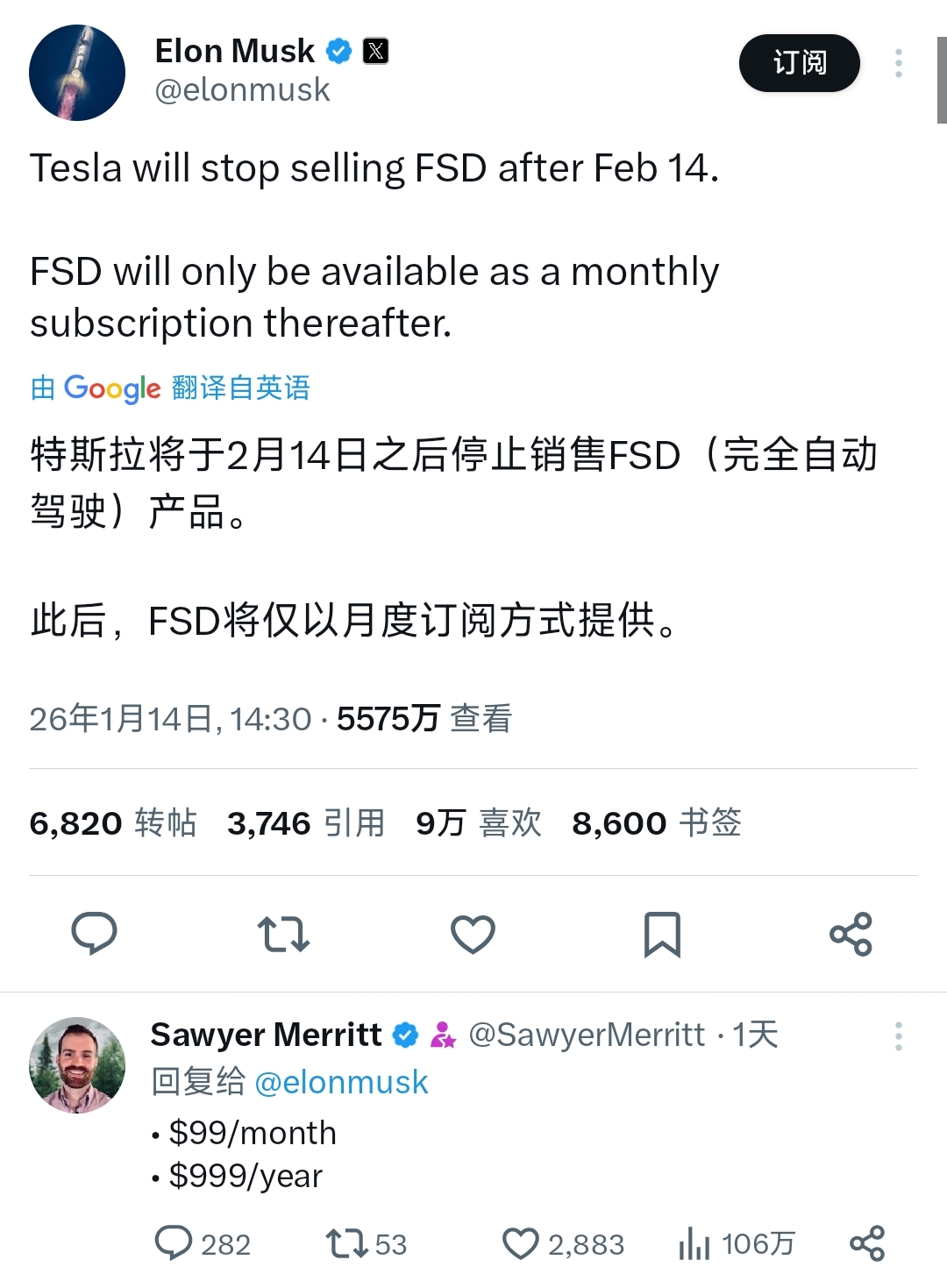
高阶辅助驾驶收费并非新鲜事,但当特斯拉CEO马斯克亲自下场官宣时,依然在全球车圈投下了一颗重磅炸弹。 1月14日,马斯克在社交平台发布信息称:2026年2月14日起,特斯拉全自动驾驶(FSD)将彻底废除一次性买断方案,全面转向订阅制,博主@Sawyer Merritt在评论区下方留言,该服务的月费为99美元,年费为999美元。 截图:X@Elon Musk 消息一出,海内外网友纷纷开启「嘲讽模式」。不少网友揶揄道:「今天取消买断,明天是不是方向盘和刹车也要按次收费?」也有人表达了对未来涨价的 担忧:「现在99美元,明年会不会变199?订阅制就是温水煮青蛙。」 当然,也有理性的声音认为,相比一次性掏出8000美元买断的巨款,每月99美元的门槛确实更低,对于偶尔需要的用户更友好。 实际上,汽车圈的订阅模式并不少见,此前奔驰和宝马就因为付费订阅服务项目站到了舆论中心,后轮转向、座椅加热、方向盘加热等配置均需要车主订 阅。 但作为行业龙头,特斯拉此举究竟意在何为?难道不担心此举会带来负面影响吗?而且,面对特斯拉的激进变革,长期以买断制为智驾主流收费模式的国产 品牌,是会坚守阵地,还是迫于压力,悄悄跟进这一「收割模式」 ...


为了万亿美元薪酬!马斯克取消FSD买断制,但不适合中国国情?
Sou Hu Cai Jing· 2026-01-16 00:21
Core Viewpoint - Tesla's decision to eliminate the one-time purchase option for its Full Self-Driving (FSD) software is driven by the need to achieve a target of 10 million active FSD subscriptions, which is part of Elon Musk's ambitious compensation plan [3][10]. Group 1: Tesla's Strategy - The shift from a one-time purchase model to a subscription model aims to convert existing customers into active subscribers, thereby generating continuous revenue and valuable data [6][10]. - The subscription model is seen as a lucrative business opportunity, with potential revenue exceeding 14,500 USD per vehicle over its lifetime compared to the one-time purchase price of 8,000 USD [10]. - Tesla's move is also a response to declining profits, as evidenced by a 37% drop in net profit year-over-year, despite a 6% increase in automotive revenue [10][11]. Group 2: Market Competition - Tesla faces increasing competition from domestic brands like BYD, which has surpassed Tesla in annual sales of electric vehicles, highlighting a shift in market dynamics [12]. - Domestic brands predominantly use a one-time purchase model for advanced driving systems, aligning with local consumer preferences for upfront payments rather than subscriptions [19][20]. - The competitive landscape is characterized by aggressive pricing strategies from domestic manufacturers, who often offer advanced driving features at significantly lower prices or even for free [16][20]. Group 3: Consumer Behavior - Chinese consumers generally prefer a one-time payment model for advanced driving features, with a significant portion unwilling to pay for subscriptions [19]. - The perception of subscription services as luxury items contrasts with the domestic approach of making advanced driving features standard, reflecting a broader trend towards "driving equality" in the market [26].