权力边界

Search documents
何韵:这场司法博弈,不仅关乎美国关税战走向
Xin Lang Cai Jing· 2026-02-23 22:47
Core Viewpoint - The recent developments in the U.S. tariff battle highlight a shift in legal grounds for imposing tariffs, reflecting intense domestic power struggles and posing significant challenges to global trade [1][2]. Group 1: Legal Framework and Court Rulings - The U.S. Supreme Court ruled that the imposition of tariffs under the International Emergency Economic Powers Act (IEEPA) was illegal, emphasizing that tax and tariff authority must be explicitly granted by Congress [2][5]. - Following the Supreme Court's decision, the Trump administration has turned to other legal provisions, such as Section 122 of the Trade Act of 1974, to continue imposing tariffs [3][4]. Group 2: Economic Implications - The total amount of tariffs collected under IEEPA since last year is approximately $175 billion, which raises questions about refunding these tariffs to consumers and the potential impact on federal deficits [3][4]. - The uncertainty in the financial markets has increased, with U.S. national debt surpassing $38 trillion and interest rates remaining around 4%, partly due to concerns over the stability of tariff revenues [4]. Group 3: Political and Governance Impact - The Supreme Court's ruling serves as a significant constraint on presidential power, testing the boundaries of authority within the U.S. political system and potentially undermining the traditional separation of powers [5][6]. - The ongoing tariff battle and the legal challenges surrounding it may lead to a more ideologically driven economic policy landscape in the future [2][5].
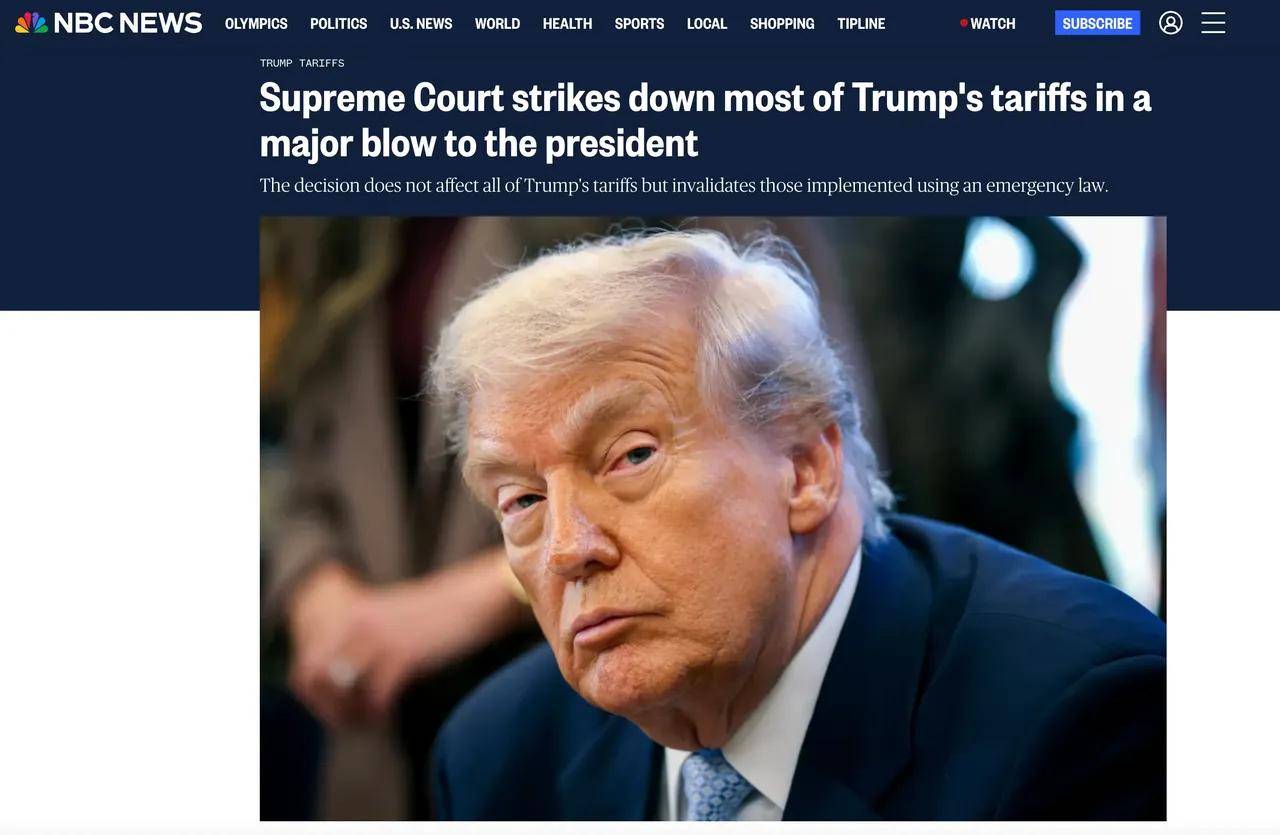
突发,美国最高法院作出裁决:美高层对等关税和芬太尼关税违法!
Sou Hu Cai Jing· 2026-02-21 07:22
Core Viewpoint - The U.S. Supreme Court ruled that the previous administration's imposition of certain aggressive tariffs was unlawful, limiting the executive's authority to unilaterally set tariffs under the International Emergency Economic Powers Act of 1977 [1][4]. Group 1: Legal Ruling - The ruling specifically targeted two types of tariffs: differentiated "reciprocal tariffs" imposed on different regions and punitive tariffs on certain goods from neighboring and related trade partners [4]. - Although tariffs on steel and aluminum products remain effective under other laws, the Supreme Court's decision has weakened the executive's administrative freedom in trade policy [4]. Group 2: Political Implications - The legal ruling has caused significant political upheaval, especially with midterm elections approaching, signaling a potential shift in trade protectionism [7]. - The ruling may undermine the confidence of core support groups for the administration, as it represents a check on the executive's policy execution capabilities [9]. - Observers, including those from Russia, are closely monitoring the situation to assess its impact on global supply chains and multilateral trade rules [9].

经观社论|乐见遏制趋利性执法新举措
经济观察报· 2025-11-08 07:18
Core Viewpoint - The development of the private economy and the improvement of the business environment may remain mere slogans, and rebuilding confidence in the private economy is a challenging task that requires strict adherence to power boundaries and robust protection of property rights [1][5]. Group 1: Regulatory Measures - The market regulatory departments of Jiangsu, Zhejiang, Shanghai, and Anhui have jointly issued "Eight Measures to Strictly Regulate Cross-Regional Law Enforcement in the Yangtze River Delta," marking the first regional collaborative mechanism targeting "ocean fishing" style law enforcement [2]. - The "Eight Measures" aim to address the long-standing issue of cross-regional law enforcement that harms the private economy and disrupts the business environment, particularly in economically developed areas [2][3]. - The measures include clarifying the concept of cross-regional law enforcement, standardizing case collaboration procedures, and emphasizing the need for prior notification and accompaniment during enforcement actions [3]. Group 2: Legal Framework and Enforcement - The "Private Economy Promotion Law," effective from May 20, 2024, emphasizes the protection of private enterprises and prohibits illegal administrative or criminal interventions in economic disputes [3]. - Central policies have been reinforced by the "Eight Measures," which require careful use of administrative coercive measures and unified administrative penalty discretion to optimize the business environment [3][4]. - The measures also establish a case consultation system to resolve jurisdictional disputes through negotiation and enhance supervision of cross-regional law enforcement to prevent excessive or insufficient penalties [3][4]. Group 3: Underlying Issues - The tendency for profit-driven law enforcement is closely linked to the financial pressures faced by certain regions, particularly economically underdeveloped areas, where reliance on penalty income is higher [4]. - The phenomenon of "ocean fishing" style law enforcement reflects a disregard for individual rights and the transformation of public power into a tool for local financial gain, undermining the legitimacy of law enforcement [4][5]. - The article warns that if the mindset of profit-driven enforcement is not adequately addressed, the effectiveness of governance measures will be limited, and the goal of fostering the private economy may remain unfulfilled [5].