标题党

Search documents
中国记协召开专题评议会:抵制“标题党”,倡导好标题
Xin Lang Cai Jing· 2025-12-30 13:55
Core Viewpoint - The meeting of the Chinese Journalists Association's News Ethics Committee focused on addressing the issue of "clickbait" headlines in the internet environment, emphasizing the need for quality headlines and responsible journalism [2][4]. Group 1: Discussion on "Clickbait" Phenomenon - The committee members acknowledged the positive efforts of mainstream media in creating quality headlines amidst the rise of "clickbait" in new media [2]. - Member Xiao Zuosheng highlighted that the "clickbait" phenomenon poses a serious threat to the authenticity and credibility of information, suggesting enhanced supervision and responsibility [2]. - Member Song Shuli pointed out that "clickbait" results from economic drivers, technological support, and industry competition, advocating for clearer standards and increased penalties for violations [2][3]. Group 2: Recommendations for Improvement - Member Wu Yuanyuan emphasized that mainstream media should prioritize news authenticity and value over traffic, advocating for improved content quality and industry self-discipline [2]. - Member Xu Zhuangzhi noted that the issue of "clickbait" stems from a lack of professional standards and ethics in journalism, calling for a balance between creativity in headlines and adherence to ethical practices [3]. - Member Chen Kaihe stressed the importance of remembering the original mission of journalism while innovating headlines, highlighting the need for continuous improvement in professional skills [3]. Group 3: The Role of Mainstream Media - Liu Siyang, the committee chair, stated that addressing the "clickbait" issue is crucial for mainstream media to genuinely win public trust, framing it as a significant challenge in the current media landscape [4][5]. - The committee called for a proactive stance against "clickbait" practices, reinforcing the responsibility and commitment of mainstream media to uphold quality journalism [5].


明知故蹭,“标题党”蒙人更害己
Bei Jing Ri Bao Ke Hu Duan· 2025-06-26 07:40
Group 1 - The article discusses the phenomenon of "clickbait" headlines that mislead readers by using famous names or ambiguous information to attract attention [1][2] - It highlights the negative impact of such practices on the credibility of accounts and the overall quality of news dissemination [2] - The article notes that over 80% of respondents express dislike for "clickbait" headlines, indicating a growing awareness and backlash against this trend [2] Group 2 - There is a positive correlation between the use of "clickbait" and metrics such as follower count, reading volume, and likes, which explains its persistent popularity despite criticism [2] - The article emphasizes the need for content creators to maintain integrity and prioritize factual reporting over sensationalism in the current "traffic-driven" environment [2] - It mentions that regulatory actions have been taken to address the issue of misleading headlines, suggesting a potential decline in the prevalence of "clickbait" in the future [2]
中国海关完全沉浸在自己的标题艺术中了
Hu Xiu· 2025-06-23 05:18
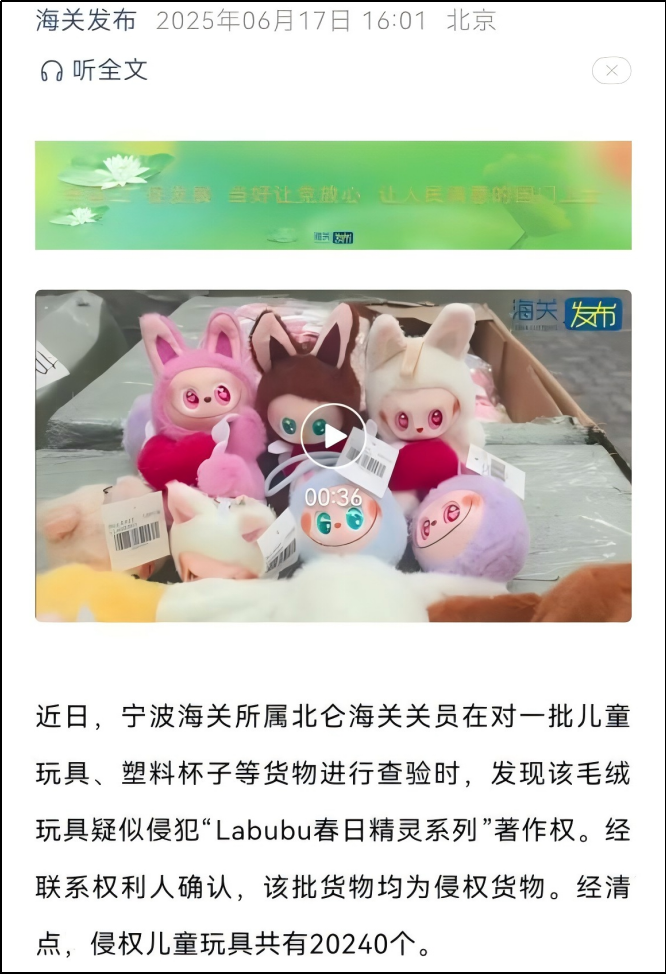
Core Viewpoint - The article discusses the creative and humorous approach taken by customs authorities in their public communications, particularly in addressing issues related to smuggling and counterfeit goods. Group 1: Customs Communication Style - Customs authorities have adopted a light-hearted and engaging tone in their announcements, often using witty titles to capture attention [7][30][49] - The use of humor in titles serves to make serious topics more relatable and engaging for the public [15][40][50] Group 2: Smuggling Incidents - Recent incidents include the discovery of counterfeit toys and a large number of unauthorized celebrity photos, highlighting the scale of smuggling activities [2][14] - Specific cases mentioned include travelers attempting to smuggle live animals and luxury goods in unusual ways, showcasing the lengths to which smugglers will go [56][62][68] Group 3: Public Awareness and Education - The humorous approach is also aimed at educating the public about the consequences of smuggling and the importance of compliance with customs regulations [51][74] - Customs authorities believe that engaging storytelling can enhance public understanding and awareness of their work [40][94]
重复的信息也有人看
Sou Hu Cai Jing· 2025-05-09 20:26
Core Viewpoint - The article discusses the overwhelming amount of information available in the digital age, highlighting the prevalence of repetitive content and the impact of attention-grabbing headlines on audience engagement [3][4][8] Information Overload - The internet has led to an explosion of information, with users receiving both new and repetitive content, often without discerning its quality or source [3][4] - Many individuals passively consume information, leading to a general acceptance of repeated content as they believe that free information cannot be selectively chosen [3][4] Role of AI and Media - A significant portion of online content is generated by artificial intelligence, which often lacks authenticity and can lead to a homogenization of information [4][6] - Media platforms tend to produce similar content due to capital monopolization, resulting in a limited range of information that adheres to regulatory boundaries [4][8] Audience Behavior - Users exhibit a tendency to forget previously encountered information, making them susceptible to re-engaging with repetitive content [6][7] - The generational shift in audience demographics means that younger viewers may find previously seen content fresh, as they are unaware of its repetition [7][8] Content Creation Challenges - Content creators, particularly in self-media, face limitations in originality due to the constraints imposed by media platforms and the need for vertical categorization [6][8] - The pressure to produce content within a narrow scope often results in the creation of similar works, which still manage to attract audience attention [6][7]