
校外培训监管

Search documents
长沙今年确保新增学位5万个以上
Xin Lang Cai Jing· 2026-02-26 19:41
Group 1: Education Resource Expansion - The implementation of a new round of basic education degree construction plan will add over 50,000 new degrees, with 27 new and expanded projects planned [2][3] - Key high school projects such as Changjun Middle School's new campus and Nanya Middle School's East Campus will be prioritized to ensure they are operational before the fall semester [2][3] - The expansion of special education and new city degrees will also occur, with 8 new or expanded schools for special education being established [2] Group 2: Quality and Balanced Development - Efforts will be made to promote quality educational resources to rural and underdeveloped schools, with a focus on creating nationally recognized quality balanced education districts [3] - The second phase of the county high school development enhancement action plan will be implemented to ensure high-quality education for county students [3] - Regulations for private education will be enforced while supporting its development, including establishing a funding supervision mechanism for private schools [3] Group 3: Student Health and Safety - A "health first" approach will be adopted throughout the education process, focusing on improving student physical health and reducing rates of myopia, obesity, and psychological issues [4] - Continuous development of health schools will be prioritized, with initiatives such as sports leagues and enhanced mental health education being implemented [4] - Safety measures will include the rectification of campus food services and the quality inspection of drinking water and school uniforms to ensure a safe environment for students [4]
教培收费不超五千形同虚设 高额国际课程归谁监管?
Nan Fang Du Shi Bao· 2026-02-10 01:36
Core Viewpoint - The international education and study abroad institutions are facing significant challenges, including closures and high tuition fees, which are not compliant with local regulations regarding prepayment limits [1][2]. Group 1: High Tuition Fees - International education training packages often exceed the regulatory limit of 5,000 yuan for single payments, with many institutions charging over 100 class hours and total fees far exceeding this amount [2][5]. - The Guangzhou Education Bureau has repeatedly warned parents against making large prepayments to off-campus training institutions, emphasizing that payments should not exceed 5,000 yuan at once [1][2]. Group 2: Regulatory Compliance - The Ministry of Education's notification on regulating prepayment for off-campus training institutions aims to prevent issues like "difficult refunds" and "running away with money," mandating that no single payment should cover more than three months or 60 class hours [1][3]. - Despite these regulations, many international education institutions continue to operate outside these guidelines, raising questions about the enforcement of such rules [2][5]. Group 3: Classification of Training - There is ambiguity regarding whether international education courses fall under "subject classes" as defined by the Ministry of Education, as they often include subjects like mathematics and foreign languages but do not adhere to national curriculum standards [4][6]. - The classification of international education training as either subject or non-subject training remains unclear, complicating regulatory oversight [6][7]. Group 4: Regulatory Oversight Challenges - The regulatory framework for international education institutions is fragmented, with responsibilities spread across various departments, making it difficult to enforce compliance effectively [5][6]. - The lack of clear jurisdiction over international education institutions means that issues related to pricing and consumer protection may not be adequately addressed by educational authorities [5][6].
一次性缴费五千封顶,别线下付
Xin Lang Cai Jing· 2026-01-30 17:41
Group 1 - The core viewpoint emphasizes the importance of understanding regulations regarding training programs for children during the 2026 winter vacation, particularly the prohibition of academic training [1] - The Hefei Education Bureau has clearly stated that any form of academic training during the winter vacation is considered illegal, including one-on-one tutoring and disguised training under the guise of "study tours" [1] - Parents are advised to resist any illegal practices such as schools conducting supplementary classes during holidays or altering school schedules [1] Group 2 - When enrolling children in non-academic training programs, parents should verify the qualifications of the institutions, ensuring they possess the necessary permits and licenses [1] - Payments for training should be made through official channels to ensure safety, with a cap on upfront fees not exceeding 5,000 yuan or covering more than three months or 60 class hours [2] - Parents are encouraged to supervise the compliance of training institutions, ensuring safety standards and proper qualifications of instructors are met [2] Group 3 - Free online learning resources are available through national platforms, providing a practical alternative for children to enhance their knowledge without incurring costs [2]
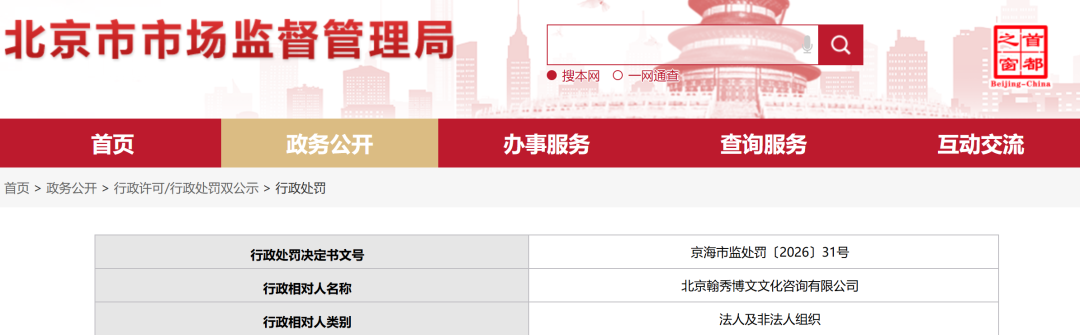
北京海淀一教培机构不到两年收入1583万元,官方:没有许可证,罚款6728万元,退还所收取费用
Mei Ri Jing Ji Xin Wen· 2026-01-20 12:50
Core Viewpoint - The Beijing Haidian District Market Supervision Administration imposed a fine of 67.283 million yuan on Beijing Hanxiu Bowen Cultural Consulting Co., Ltd. for operating an unapproved off-campus training institution and failing to refund all collected fees [2][3]. Group 1: Administrative Penalty Details - The penalty decision was based on the violation of the "Interim Measures for Administrative Penalties for Off-Campus Training" which prohibits operating without approval [3]. - The company generated a total income of 15.831 million yuan from subject training fees between October 19, 2023, and July 4, 2025, with 2.375 million yuan refunded to parents, leaving 2.680 million yuan in unrefunded fees [2][3]. - The company has not proposed any refund plan for the remaining unrefunded fees and has not returned the collected tuition fees [3]. Group 2: Company Background - Beijing Hanxiu Bowen Cultural Consulting Co., Ltd. is involved in various services including study abroad consulting and educational consulting, but it does not have the necessary license for educational training activities [4]. - The company is linked to two cases of "educational training contract disputes" involving its shareholder, Beijing Hanxiu Education Technology Co., Ltd. [4][5]. Group 3: Regulatory Environment - The Beijing Municipal Education Commission has intensified enforcement against illegal subject training, with a "zero tolerance" policy towards violations [6]. - The "Interim Measures for Administrative Penalties for Off-Campus Training" came into effect on October 15, 2023, establishing penalties for various forms of illegal training activities [6].

广州教育局通报
券商中国· 2025-12-14 09:51
Core Viewpoint - The Guangzhou Education Bureau has announced typical cases of illegal and irregular off-campus training institutions, highlighting the need for stricter regulation and compliance within the education sector [1]. Summary by Sections Illegal and Irregular Cases - Case 1: Guangzhou Huangpu District Ying*Cheng Education Training Center was penalized for improper fee collection, resulting in a warning and confiscation of illegal gains amounting to 100,097.24 yuan [2]. - Case 2: Guangzhou Wo*Creative Technology Information Co., Ltd. operated an unapproved off-campus training institution, leading to a penalty of 248,703.45 yuan and confiscation of 165,802.3 yuan in illegal gains [2]. - Case 3: Guangzhou Si*Le Consulting Service Co., Ltd. was fined 80,259.82 yuan and ordered to refund collected fees, with illegal gains of 40,129.91 yuan confiscated [3]. - Case 4: Guangzhou Si*Li Consulting Service Co., Ltd. faced similar penalties, including a fine of 21,299.29 yuan and confiscation of illegal gains of 21,299.29 yuan [3]. - Case 5: Guangzhou Baiyun District You*Education Training Center was fined 5,992.5 yuan and ordered to refund fees, with illegal gains of 5,992.5 yuan confiscated [3]. - Case 6: Guangzhou Qi*Culture Co., Ltd. was penalized with a fine of 383,674 yuan and confiscation of illegal gains of 191,837 yuan [4]. - Case 7: Guangzhou Yin*Bai Cultural Development Co., Ltd. received a fine of 2,138 yuan and confiscation of the same amount in illegal gains [4]. - Case 8: Guangzhou Zengcheng Long*Education Training Center was warned for exceeding its operational scope and had illegal gains of 16,650.56 yuan confiscated [5]. Regulatory Actions and Future Directions - The Guangzhou Education Bureau plans to enhance the enforcement of regulations regarding off-campus training institutions, aiming to create a more compliant and regulated educational environment [5]. - All off-campus training institutions are urged to adhere strictly to relevant laws and regulations, ensuring proper fee collection and maintaining integrity in operations [5].

山东加强校外培训机构跨部门综合监管
Qi Lu Wan Bao· 2025-11-12 17:31
Group 1 - The Shandong Provincial Education Department has issued compliance guidelines for off-campus education training institutions, focusing on seven areas including approval registration, venue safety, personnel qualifications, and fund supervision [1] - The guidelines prohibit off-campus training institutions from advertising in mainstream media, new media, public places, and online platforms, and specifically ban misleading commitments such as "guaranteed passing" or "improved scores" [1] - Institutions must create truthful enrollment brochures and advertisements, which must be filed with local education authorities and made public, ensuring compliance and supervision [1] Group 2 - Training institutions are required to sign pre-collection fund custody agreements with banks, with a maximum charging period of three months or 60 class hours, and a single charge not exceeding 5000 yuan [2] - Strict refund policies are established, requiring full refunds within five days before the course starts, and proportional deductions based on completed class hours after the course begins, with remaining fees refunded within 15 days [2] - A "black and white list" system will be established for off-campus training institutions, with compliant institutions placed on a white list and non-compliant ones subject to rectification or blacklisting [2]
教育部发文将培训机构纳入全国平台统一管理,支持在线选课、退费
Xin Jing Bao· 2025-03-26 10:37
Core Viewpoint - The Ministry of Education has introduced a comprehensive management approach for off-campus training institutions through a national platform, aiming to enhance regulatory efficiency and protect the rights of parents and students [1][2][3] Group 1: National Platform Overview - The national platform serves as a unified public service platform for off-campus training, providing a full-process regulatory and service framework through a website and three applications for parents, institutions, and management [1][2] - The platform has been under construction since 2021, focusing on safeguarding the rights of parents and students while ensuring effective supervision of off-campus training [2][3] Group 2: Features and Functions - The platform offers a "one-stop" service for off-campus training regulation, including functionalities for parents to query, evaluate, and select courses, as well as for institutions to manage course offerings and internal evaluations [4][5] - A "pay after learning" feature has been implemented, allowing parents and students to opt for a model where payment is made after course completion, thereby reducing financial risks [6][7] Group 3: Compliance and Quality Assurance - The platform mandates that all training institutions be included in a unified management system, which helps standardize operations and improve training quality [3][7] - Regular checks on training materials and strict entry mechanisms for personnel are established to ensure compliance and safety in off-campus training [6][7] Group 4: Stakeholder Engagement - The platform encourages collaboration among educational authorities, financial institutions, and training providers to ensure data interoperability and effective risk management [2][4] - Institutions with high credit ratings and good application performance on the platform may receive priority in participating in school after-school service projects [5]