气候难民

Search documents
这个国家正在学习如何有尊严地消失
3 6 Ke· 2025-10-27 03:18
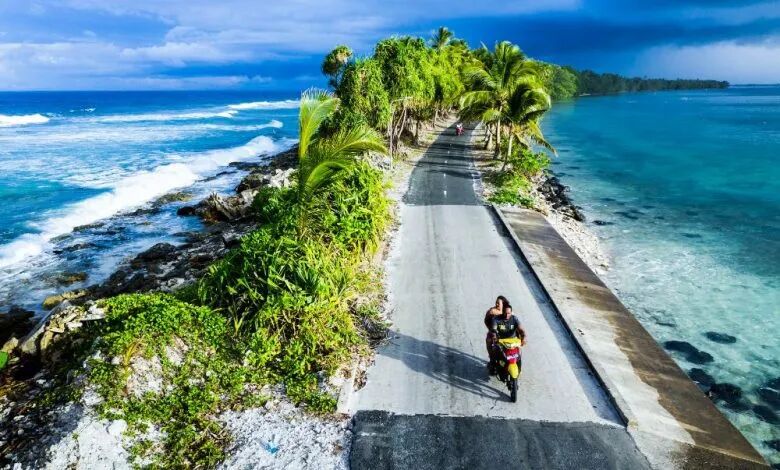
Core Points - Tuvalu is facing an existential crisis due to rising sea levels, with significant portions of its land expected to be permanently submerged by 2050 [4][5] - The introduction of a "climate visa" allows a limited number of Tuvaluans to migrate to Australia, highlighting the challenges of climate-induced migration [5][9] - The situation in Tuvalu reflects broader issues of climate justice, as the country contributes minimally to global carbon emissions yet bears the brunt of climate change impacts [9][10] Group 1: Geographic and Demographic Context - Tuvalu consists of nine coral atolls with a total land area of only 25.14 square kilometers and a population of approximately 12,000 [3] - The highest point in Tuvalu is less than 5 meters above sea level, making it extremely vulnerable to rising waters [4] Group 2: Climate Change Impact - Sea levels around Tuvalu have risen by 0.15 meters over the past 30 years, with projections indicating a potential rise of 61 centimeters by 2100 [4][6] - The local economy is heavily reliant on imports, with no industrial base, leading to food security concerns as climate impacts worsen [4][6] Group 3: Migration and Policy Responses - The "climate visa" allows 280 Tuvaluans per year to migrate to Australia, but this is insufficient for the entire population facing displacement [5][9] - The visa provides rights similar to Australian citizens, but the lottery system for selection raises concerns about fairness and accessibility [5][6] Group 4: Cultural Preservation Efforts - Tuvalu has initiated a "digital survival" plan to preserve its cultural heritage through 3D scanning and blockchain technology [6][9] - This approach aims to maintain cultural practices in a virtual space, raising questions about the authenticity and continuity of cultural identity [9][10] Group 5: Global Implications - The plight of Tuvalu serves as a warning for global climate challenges, with the potential for millions to become "climate refugees" in the future [6][10] - The situation underscores the need for a re-evaluation of international laws regarding climate-induced migration and the responsibilities of nations contributing to climate change [9][10]

年年“史上最热”,我们距离气候难民有多远?
Hu Xiu· 2025-07-22 04:03
Group 1 - The article highlights the increasing frequency and severity of extreme weather events globally, driven by climate change, which poses significant threats to human health and safety [1][4][7] - It reports that since June, regions such as the Middle East, Central Asia, and North Africa have experienced temperatures exceeding 40°C for 10-20 days, with Spain recording temperatures above 46°C and over 1,180 heat-related deaths by July 19 [1] - The World Bank's 2021 report indicates that climate change could force approximately 216 million people to migrate within their countries by 2050, emphasizing the urgency of addressing the issue of climate refugees [5][6] Group 2 - The article discusses the legal and definitional challenges surrounding climate refugees, noting that current international law does not adequately recognize or protect them [13][36] - It mentions that the United Nations has made efforts to define and address the issue of environmental migration, including the 2007 definition of "environmental migrants" by the International Organization for Migration [18] - Despite increasing global attention and initiatives, the lack of a cohesive international framework hampers effective action to support climate refugees [22][36] Group 3 - The article provides statistics indicating that in 2024, approximately 9.8 million people were displaced within their countries due to natural disasters, with the highest numbers in Africa and Asia [23][24] - It highlights that the number of displacements caused by natural disasters in 2024 was about 45.8 million, which is 2.4 times higher than a decade ago, while conflict-related displacements were about 20.1 million [27] - The interconnectedness of climate change, poverty, and conflict is emphasized, illustrating how climate refugees often face new social tensions in their new locations [30][31] Group 4 - The article outlines various international and regional actions taken to address the challenges faced by climate refugees, including the establishment of the Loss and Damage Fund at COP27 to support vulnerable countries [53][55] - It discusses initiatives like the Climate Refugee Protection Fund and proposals for climate passports to provide legal recognition and support for displaced individuals [54][55] - The article suggests that addressing climate refugee issues requires a comprehensive approach that integrates environmental, social, and economic strategies [56][61]