气象预测

Search documents
DeepMind 运作模式曝光,暗示根本没输 OpenAI:员工20% 时间重启创新,保守巨头直接变 “实验狂”
3 6 Ke· 2026-02-25 06:15
Core Insights - Google DeepMind is positioning itself as a modern version of Bell Labs, focusing on ambitious research agendas while allowing researchers the freedom to explore various paths [1][5][10] - The integration of Google Brain and DeepMind has led to the establishment of a central AI engine around the Gemini project, which is expected to mature by 2026 [2][9] - Google is reviving its lab culture, currently advancing approximately 30 projects, and leveraging a well-known innovation mechanism where employees can dedicate 20% of their time to exploratory projects [2][17] Group 1: Operational Model - Google DeepMind operates on two core methodologies: providing direction without dictating answers and fostering interdisciplinary collaboration among experts from various fields [1][6] - The leadership of Demis Hassabis is pivotal, as he balances top-down direction with bottom-up innovation, allowing for a unique approach to research and development [6][7] - The company emphasizes a long-term perspective, as evidenced by its significant breakthroughs in quantum error correction and the development of a flood prediction system covering 150 countries [3][29] Group 2: Gemini Project - Gemini serves as the foundational infrastructure for the company, with major iterations occurring every 5 to 6 months, immediately integrating into core products like Search and Workspace [4][9] - The project is designed to support a wide range of applications, from generative AI to scientific research, demonstrating a commitment to both immediate and long-term goals [2][9] Group 3: Innovation and Experimentation - The revival of Google's lab culture has led to the development of AI-native products, such as Notebook LM and Flow, which are designed to enhance user interaction and creativity [10][11][14] - The company continues to encourage innovation through its 20% time policy, allowing employees to pursue projects outside their primary responsibilities, contributing to a vibrant culture of creativity [17][19] - Notable projects like Learn Your Way and Co-Scientist exemplify the company's commitment to leveraging AI for educational and research advancements [18][19] Group 4: AI in Education - Google DeepMind is actively researching the impact of AI on education, with findings indicating that a significant majority of students and teachers are utilizing AI tools [22][23] - The company aims to create personalized learning experiences and assist teachers in enhancing their productivity, thereby transforming traditional educational methods [24][25] Group 5: Scientific Advancements - Google DeepMind is making strides in quantum computing, materials science, and meteorological predictions, with significant breakthroughs in each area [29][30][33] - The company has developed a flood prediction model that has the potential to save lives by providing timely warnings, showcasing the practical applications of its research [34] - Project Suncatcher aims to utilize space for AI training, reflecting the company's forward-thinking approach to harnessing solar energy for computational needs [35][36]

2月全省大部降水偏少 平均最低气温比常年略高
Xin Lang Cai Jing· 2026-02-01 00:45
Core Insights - The weather forecast for February 2026 in Guangdong province indicates a significant reduction in precipitation across most areas, with temperatures expected to be close to or slightly above historical averages [1][2] - The forecast predicts four cold air events throughout the month, which may lead to low-temperature rainy weather in certain regions, particularly in northern Guangdong during the early part of the Spring Festival [1][2] Summary by Sections Precipitation Forecast - Most areas in Guangdong are expected to experience a 20% to 50% decrease in rainfall compared to the historical average, except for the southwestern region, which may see a 10% increase [1] - In Guangzhou, the expected monthly rainfall is between 20mm and 45mm, averaging 25mm to 40mm, which is 20% to 50% lower than the historical average of 51.7mm [2] Temperature Forecast - Average temperatures in northern Guangdong are projected to be 0.5°C to 1.0°C higher than the historical average, while most other areas will be close to or slightly above the norm [1] - In Guangzhou, the average temperature is forecasted to range from 15.5°C to 18.0°C, with an overall average of 16.2°C to 16.7°C, also reflecting a 0.5°C to 1.0°C increase compared to the last 30 years [2] Cold Air Events - The month is expected to see four cold air processes occurring on specific dates: February 6-8 (weak), 11-13 (weak), 16-18 (moderate to weak), and 24-27 (weak) [1] - The cold air events are likely to coincide with periods of light to moderate rainfall, particularly affecting northern regions of Guangzhou from February 17-19 [2] Public Advisory - The meteorological departments advise the public to monitor daily weather updates due to the long-term nature of the forecasts, as actual conditions may vary [2] - There is a warning regarding the potential impacts of reduced rainfall on forest fire risks and the need for careful water management during the month [2]
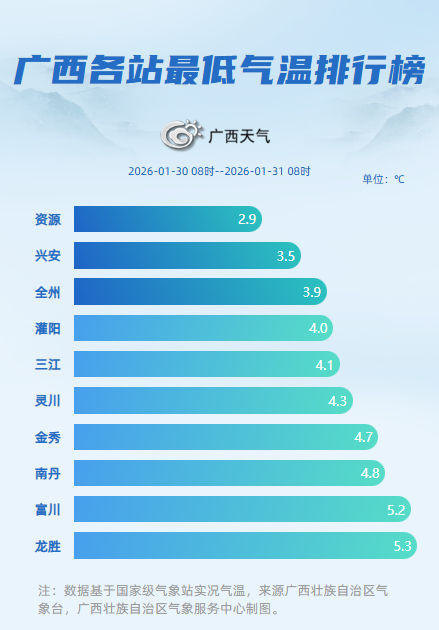
冷空气持续输出 桂中、桂南局地降温超10℃ 寒凉天气直抵桂南 将冷到……
Xin Lang Cai Jing· 2026-01-31 09:11
Core Points - The article discusses the weather conditions in Guangxi, highlighting a significant drop in temperature due to cold air, with a decrease of 5-10°C in most areas compared to the same time yesterday [1] - The forecast indicates that cold weather will persist for the next two days, with a gradual temperature rise expected on February 2 [1] Weather Forecast - Tonight and tomorrow, the region will experience mostly cloudy to overcast skies, with localized light rain in Baise City and potential ice and road icing in high-altitude areas [2] - The lowest temperatures are expected to range from -3 to 2°C in high-altitude areas, 2 to 7°C in northeastern Guangxi, and 7 to 13°C in other regions [2] - The highest temperatures will range from 6 to 18°C in northern Guangxi and 18 to 28°C in southern Guangxi, with the highest recorded temperature at 28°C in Rongxian, Yulin [2] Climate Overview - In February, the average precipitation across Guangxi is expected to be 46.2 mm, with monthly rainfall ranging from 17.0 to 105.3 mm [4] - The average temperature for February is projected to be 13.6°C, with a range of 8.4 to 16.8°C across different areas [4] Precipitation and Temperature Predictions - For February, precipitation is forecasted to be 50-80 mm in northeastern Guangxi and 10-50 mm in other areas, with some regions expected to have 10-30% more rainfall than the historical average [6] - Average temperatures in February are expected to be 8-11°C in northern Guilin and Liuzhou, and 14-17°C in other regions, with slight increases compared to historical averages [7] Major Weather Events - Significant weather events are anticipated between February 6-10, 14-18, and 24-26, with cold air leading to light to moderate rain, and potential snow and frost in northern areas [8]