氢能社会

Search documents
杨春和院士:地质储氢是大规模储氢优先发展路径
中国能源报· 2025-11-29 00:40
Core Viewpoint - Geological hydrogen storage is currently the most feasible and prioritized method for large-scale hydrogen storage in China, with steady progress being made in this area [4][6]. Group 1: Geological Hydrogen Storage - Geological hydrogen storage is essential for meeting the hydrogen energy demand at a large scale, particularly when production reaches millions of tons [6][10]. - Successful cases of salt cavern hydrogen storage have been established in Pingdingshan, Henan, and Daye, Hubei, showcasing the potential of geological storage methods [7][8]. Group 2: Project Details - The Pingdingshan project plans to store 1.5 million cubic meters of hydrogen, utilizing hydrogen as a byproduct from a chemical plant [7]. - The Daye project, with a total investment of 3.437 billion yuan, aims to produce 1,800 tons of green hydrogen annually and features a full-cycle application model [7][8]. Group 3: Challenges and Considerations - There are significant challenges in the development of geological hydrogen storage, including misconceptions about hydrogen safety and the need for improved regulations and standards [10][11]. - The industry must address the knowledge gap regarding hydrogen as an energy source and ensure rigorous validation before launching new projects to avoid potential risks [11][12].

丰田联手亿华通 再成立燃料电池公司!
Qi Cha Cha· 2025-09-22 01:48
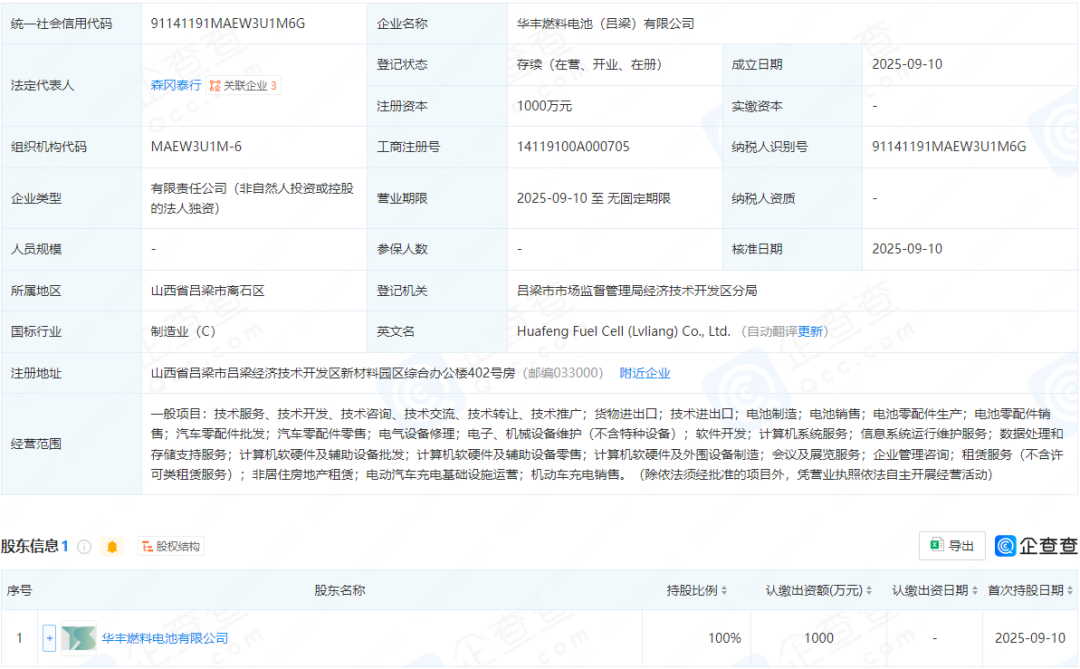
Group 1 - Huafeng Fuel Cell (Lvliang) Co., Ltd. was established on September 10, 2025, with a registered capital of 10 million yuan [1][2] - The company is engaged in battery manufacturing, sales, and production of battery components, as well as wholesale and retail of automotive parts [1][2] - Huafeng Fuel Cell (Lvliang) Co., Ltd. is wholly owned by Huafeng Fuel Cell Co., Ltd., which is jointly funded by Beijing Yihuatong Technology Co., Ltd. and Toyota Motor Corporation, each holding 50% [2][4] Group 2 - The establishment of Huafeng Fuel Cell Co., Ltd. in June 2021 aimed to promote the production and sales of fuel cell systems developed by United Fuel Cell System R&D (Beijing) Co., Ltd. to advance the hydrogen energy society and environmentally friendly mobility [4]


【环时深度】从“先驱”到“跟不上步伐”,日本反思AI落后
Huan Qiu Shi Bao· 2025-08-24 23:05
Core Viewpoint - Japan is reflecting on its lagging position in AI development compared to the US and China, despite its historical contributions to the field during the first AI boom from the 1950s to 1970s [1][2] Group 1: Historical Context - Japan's AI research began in the 1950s, contributing significantly to advancements in natural language processing, speech recognition, and image processing [1] - The "Fifth Generation Computer Systems" project launched in 1982 aimed to create a "supercomputer" capable of reasoning and learning, but it failed to deliver expected results and was terminated in 1992, leading to a stagnation in AI research [2][3] - From the 1990s to the early 2000s, Japan's focus on manufacturing overshadowed the importance of software and services, causing it to miss opportunities in the internet revolution [3][4] Group 2: Current Challenges - Japan's AI development is hindered by a lack of digital workforce, high legal barriers, and conservative capital investment, with only 26.7% of the population having used generative AI by 2024 [5][6] - The aging population and declining birth rates contribute to a shortage of talent and acceptance of AI technologies, with low usage rates among younger demographics [7][8] - Japan's strict data protection laws complicate the creation of effective training datasets for AI, limiting the potential for innovation [9] Group 3: Government and Industry Response - The Japanese government has initiated several strategies to boost AI development, including the "e-Japan Strategy" and recent AI legislation aimed at elevating AI to a national strategic priority [4][10] - There is a call for increased investment in AI education and attracting global talent to address the skills gap, with only 12 universities offering dedicated data science programs [8][11] - Collaborative efforts between government and industry, such as the "Manufacturing AI Visual Inspection Plan," aim to enhance AI integration in various sectors [11][12]
2025 H1燃电装机TOP5是谁?
势银能链· 2025-08-06 04:04
Core Insights - The article highlights a significant decline in fuel cell installation and vehicle sales in the first half of 2025, with installation capacity at 253.69 MW, down 5.6% year-on-year and 53.8% quarter-on-quarter, and vehicle sales at 1,967 units, down 22.0% year-on-year and 57.3% quarter-on-quarter [2]. Fuel Cell Installation Overview - In H1 2025, the top five companies in fuel cell installation accounted for a market concentration of 61.1%, with Dongfang Hydrogen Energy leading at 19.7% [2]. - Dongfang Hydrogen Energy focuses on diverse applications including traction vehicles and logistics, with systems primarily in the 112-135 kW range, and some traction vehicles utilizing a new 200 kW high-power system [2]. - Hyundai Hydrogen Technology promotes cold chain logistics vehicles with a power output of 90 kW, having deployed 350 vehicles, primarily in Guangzhou [2]. - Yuntai Hydrogen Energy is involved in specialized vehicles, with power selections between 110-130 kW [2]. Company Profiles Dongfang Hydrogen Energy - Established in 2015, it is a state-owned enterprise producing hydrogen fuel stacks and systems for various applications, including transportation and distributed power generation [5]. - The company has successfully developed multiple demonstration vehicle types and achieved rapid production and delivery of fuel cell systems [6]. Hyundai Hydrogen Technology - HTWO Guangzhou, a subsidiary of Hyundai Motor Group, has established a leading production line for hydrogen fuel cell systems with an annual capacity of 6,500 units [8]. - The company has initiated demonstration operations for logistics vehicles, achieving significant mileage and reliability in complex environments [8]. Yuntai Hydrogen Energy - Founded in May 2022, Yuntai focuses on hydrogen technology product development and has established a comprehensive supply chain from materials to commercial applications [9]. - The company has launched a hydrogen refueling station and committed to competitive pricing for hydrogen fuel over the next several years [12]. Huafeng Fuel Cell - A joint venture between Beijing Yihua Technology and Toyota, established in June 2021, focusing on the production and sales of fuel cell systems [10]. Rongcheng New Energy - Part of Rongcheng Group, it integrates hydrogen energy solutions across the entire industry chain and has deployed 800 hydrogen fuel cell vehicles and 12 refueling stations [13].