
燃料电池系统

Search documents
每日投资策略-20260306
Zhao Yin Guo Ji· 2026-03-06 04:36
Macro Commentary - The Chinese government has pragmatically lowered the economic growth target for 2026, reflecting a willingness to tolerate short-term slowdown for higher quality long-term development [2] - The focus of policy is shifting towards stabilizing investment, with increased fiscal resources aimed at attracting private capital into emerging sectors such as AI infrastructure, digital industries, and green industries [2] - The government has explicitly set re-inflation as a policy goal, aiming for a moderate recovery in price levels through supply-demand rebalancing [2] Market Performance - The Hang Seng Index closed at 25,321, up 0.28% for the day but down 1.21% year-to-date [2] - The Shanghai Composite Index rose 0.64%, while the Shenzhen Composite Index increased by 1.17% [2] - The US markets saw declines, with the Dow Jones down 1.61% and the S&P 500 down 0.56% [4] Automotive Industry Commentary - In February, the average discount in the Chinese automotive industry remained stable compared to January, but discounts for German brands narrowed due to significant price reductions by BMW and Mercedes [5] - New model launches in March and April may act as positive catalysts for stock prices, despite weak first-quarter earnings expectations [5] - Traditional automakers like Geely and Great Wall Motors saw increases in average discounts, with Geely reaching a new high of 13.1% [6][7] New Energy Vehicles - Ideal's average discount remained stable at 5.3%, while XPeng's increased to 5.7%, indicating a need for new popular models to support sales growth [6] - NIO's average discount slightly increased to 1.6%, driven by larger discounts on specific models [6] - The new energy vehicle market is facing pressure from rising competition and the need for innovative products to maintain sales momentum [6] Company Insights - Reshaping Energy (2570 HK) is expected to benefit from a new round of hydrogen energy subsidies, potentially doubling the total subsidy amount compared to the previous round [8] - The company is projected to maintain an 18% market share in fuel cell systems, with sales expected to reach 1,200 units in FY25, generating revenue of 660 million yuan [9] - JD Group (JD US) reported a revenue of 352.3 billion yuan for Q4 2025, a 1.5% year-on-year increase, with expectations for steady growth in core business profitability [10] - Bilibili (BILI US) achieved a total revenue of 8.32 billion yuan in Q4 2025, driven by strong advertising performance, with an expected revenue growth of 6% in Q1 2026 [10]


亿华通(688339.SH):2025年度净亏损6.28亿元
Ge Long Hui A P P· 2026-02-27 13:35
Group 1 - The company reported a revenue of 262.13 million yuan for the fiscal year 2025, representing a year-on-year decline of 28.51% [1] - The net profit attributable to the parent company was -628.29 million yuan, a decrease of 37.65% year-on-year [1] - The net profit attributable to the parent company after deducting non-recurring gains and losses was -685.88 million yuan, down 26.37% year-on-year [1] Group 2 - The hydrogen fuel cell industry is still in the early stages of commercialization, with increasing market competition leading to sustained pressure on product prices [1] - Due to cash flow pressures, the company adopted a cautious market expansion strategy, resulting in a year-on-year decline in fuel cell system sales [1] - Overall profitability of the company has been affected by these market conditions [1]

亿华通2025年归母净亏损约6.28亿元,同比增长37.65%
Zhi Tong Cai Jing· 2026-02-27 13:08
Core Viewpoint - Yihuatong (02402) reported a significant decline in revenue and an increase in net losses for the fiscal year 2025, indicating challenges in its operational performance and market conditions [1] Financial Performance - Total revenue for the year was approximately 262 million yuan, representing a year-on-year decrease of 28.51% [1] - The net loss attributable to the parent company was around 628 million yuan, which is a year-on-year increase of 37.65% [1] - Basic loss per share was reported at 2.71 yuan [1] Contributing Factors - The increase in losses was primarily due to the company's cautious market strategy in response to cash flow pressures, leading to a decline in fuel cell system sales [1] - The company recognized an increase in credit impairment losses and asset impairment losses based on accounting prudence principles compared to the previous year [1] - Investment losses from joint ventures increased year-on-year, influenced by market conditions and the operational status of associated companies [1]
亿华通(02402)2025年归母净亏损约6.28亿元,同比增长37.65%
智通财经网· 2026-02-27 13:00
Core Viewpoint - Yihuatong (02402) reported a significant decline in revenue and an increase in net losses for the fiscal year 2025, indicating challenges in its operational performance and market conditions [1] Financial Performance - Total revenue for the year was approximately 262 million yuan, representing a year-on-year decrease of 28.51% [1] - Net loss attributable to shareholders was around 628 million yuan, which is a year-on-year increase of 37.65% [1] - Basic loss per share was reported at 2.71 yuan [1] Contributing Factors - The increase in losses is primarily attributed to several factors: - The company adopted a cautious market strategy due to cash flow pressures, leading to a decline in fuel cell system sales [1] - The company increased provisions for credit impairment losses and asset impairment losses based on accounting prudence, which expanded year-on-year [1] - Investment losses from joint ventures increased year-on-year due to market conditions and the operational status of associated companies [1]
亿华通:2025年净利润亏损6.28亿元,同比下降37.65%
Cai Jing Wang· 2026-02-27 10:15
Core Viewpoint - Yihuatong reported a significant decline in both revenue and net profit for the fiscal year 2025, indicating challenges in the hydrogen fuel cell industry due to increased competition and pricing pressures [1] Financial Performance - The company achieved an operating revenue of 262 million yuan, representing a year-on-year decrease of 28.51% [1] - The net profit showed a loss of 628 million yuan, which is a year-on-year decline of 37.65% [1] Industry Context - The hydrogen fuel cell industry is still in its early commercialization phase, facing intensified market competition that has led to sustained pressure on product prices [1] - Due to cash flow pressures, the company has adopted a cautious market expansion strategy, which has contributed to a decline in fuel cell system sales during the reporting period [1]
亿华通:2025年净利润同比下降37.65%
Xin Lang Cai Jing· 2026-02-27 10:04
Core Viewpoint - The company reported a significant decline in revenue and net profit for 2025, indicating challenges in the hydrogen fuel cell industry due to increased competition and market pressures [1] Financial Performance - The company achieved an operating revenue of 262.13 million yuan in 2025, a year-on-year decrease of 28.51% [1] - The net profit attributable to the parent company was -628.29 million yuan, reflecting a year-on-year decline of 37.65% [1] - The net profit attributable to the parent company after deducting non-recurring gains and losses was -685.88 million yuan, down 26.37% year-on-year [1] Industry Context - The hydrogen fuel cell industry is still in its early commercialization stage, facing intensified market competition that has led to sustained pressure on product prices [1] - The company has adopted a cautious market expansion strategy due to cash flow pressures, which has resulted in a decline in fuel cell system sales during the reporting period [1] - Overall profitability has been adversely affected by these market conditions and strategic decisions [1]
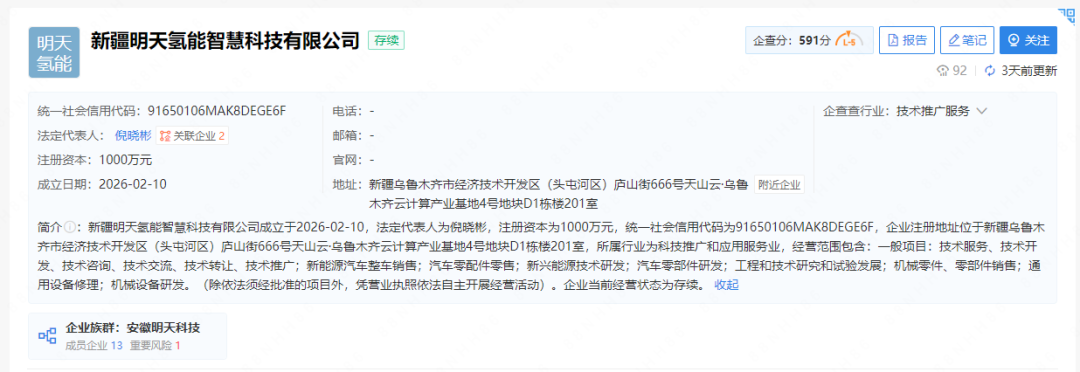
1000万!新疆明天氢能智慧科技有限公司成立
Qi Cha Cha· 2026-02-26 01:35
Group 1 - Xinjiang Tomorrow Hydrogen Energy Wisdom Technology Co., Ltd. is jointly held by Anhui Tomorrow New Energy Technology Co., Ltd., Hefei Huasheng Pump Valve Co., Ltd., Hefei Zhongke Brain-like Intelligent Technology Co., Ltd., and Liu'an Hydrogen Energy No. 7 Enterprise Management Center (Limited Partnership) [1] - The company was established on February 10, 2026, with a registered capital of 10 million yuan [2] - The business scope includes technology services, development, consulting, and sales related to new energy vehicles and hydrogen energy technology [2] Group 2 - Anhui Tomorrow New Energy Technology Co., Ltd. was founded on June 7, 2017, and is based in Hefei, Anhui Province [2] - The company focuses on hydrogen energy and fuel cell fields, with main operations in R&D and production of new energy vehicles, fuel cell systems, hydrogen refueling station construction, and hydrogen technology applications [2] - Anhui Tomorrow Hydrogen Energy Technology Co., Ltd., a controlling enterprise, was established on July 2017 with a registered capital of 500 million yuan and completed over 100 million yuan in Series B financing in 2022 [3]

中金 • 联合研究 | 氢基能源系列二:燃料电池——阶段性承压与新动能蓄势
Xin Lang Cai Jing· 2026-02-09 23:50
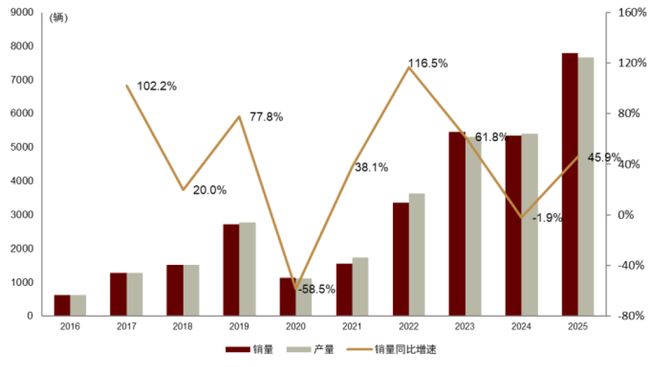
Group 1 - The promotion of fuel cell vehicles during the 14th Five-Year Plan period has not met expectations, with the industry facing challenges such as weak growth, poor profitability, and accounts receivable backlog [1][2] - In Q4 2025, a surge in fuel cell vehicle orders occurred, but sales momentum has been insufficient since 2024, primarily due to the impact of policy changes [2][4] - The average price of fuel cell systems has decreased by nearly 90% since 2018, creating significant challenges for profitability among manufacturers [7][10] Group 2 - The promotion of fuel cell vehicles is constrained by three main bottlenecks: cost disadvantages due to subsidy reductions, slow infrastructure development, and long accounts receivable cycles [2][11][15] - Despite short-term pressures, China's hydrogen energy strategy remains firm, with expectations for new supportive policies and the expansion of application scenarios, indicating potential for long-term growth [2][24] - The application of fuel cells is expanding beyond transportation to include power generation, energy storage, and rail transit, suggesting a second growth curve for the industry [29][30][33] Group 3 - The transition from nationwide purchase subsidies to a reward-based system for specific regions has stimulated growth in fuel cell vehicle production and sales from 2021 to 2023 [5][4] - The construction of hydrogen refueling stations has not kept pace with expectations, impacting the convenience of hydrogen refueling and limiting the operational radius of fuel cell vehicles [14][15] - New policies, such as highway fee exemptions for hydrogen vehicles, have been introduced in multiple provinces, potentially reducing operational costs and enhancing competitiveness against electric trucks [24][26]
中金 • 联合研究 | 氢基能源系列二:燃料电池——阶段性承压与新动能蓄势
中金点睛· 2026-02-09 23:38
Core Viewpoint - The fuel cell vehicle industry is facing challenges such as slow growth, poor profitability, and accounts receivable backlog, but there is potential for long-term development supported by national hydrogen energy strategies and new application scenarios [1][2][15]. Group 1: Current Industry Status - The sales of fuel cell vehicles have shown insufficient growth momentum since 2024, with a surge in demand observed in 4Q25, yet still falling short of the 2025 targets [1][4]. - The average price of fuel cell systems has decreased by nearly 90% since 2018, creating significant challenges for profitability as the industry remains in a bottoming phase [1][6]. - Three major bottlenecks hindering the promotion of fuel cell vehicles include cost disadvantages due to subsidy reductions, slow construction of hydrogen refueling stations, and long payment cycles for subsidies leading to cash flow pressures for companies [1][10][13]. Group 2: Policy and Strategic Support - Despite short-term pressures, hydrogen energy is positioned as a key component of China's future energy system, with ongoing policy support such as highway fee exemptions and the construction of "hydrogen corridors" [2][23][22]. - The transition from nationwide purchase subsidies to a reward-based system for demonstration areas has stimulated growth in fuel cell vehicle production and sales from 2021 to 2023 [3][4]. - New cities are joining fuel cell vehicle demonstration city clusters, which is expected to accelerate industry development and increase financial support for fuel cell vehicle sales [22]. Group 3: Future Prospects and Applications - The fuel cell application market is expanding beyond transportation to include fixed power generation and energy storage, indicating a second growth curve for the industry [27][29]. - The establishment of hydrogen corridors is expected to enhance the convenience of hydrogen refueling, thereby accelerating the adoption of fuel cell vehicles in logistics and transportation [24][26]. - The National Energy Administration has initiated pilot projects in hydrogen energy, which will further clarify the potential for fuel cells in fixed power generation and energy storage applications [29][30].

中金:我国氢能战略坚定 看好燃料电池行业中长期发展
智通财经网· 2026-02-06 06:33
Core Viewpoint - The fuel cell vehicle promotion during the 14th Five-Year Plan period is lagging behind expectations, with the industry facing challenges such as weak growth, poor profitability, and accounts receivable backlog. However, the hydrogen energy strategy remains clear, and new support policies are anticipated, which may help the fuel cell industry gradually overcome short-term difficulties and possess significant long-term growth potential [1]. Group 1: Market Dynamics - In 4Q25, a rush to install fuel cell vehicles is expected, but there remains a gap to the 2025 phase target. Since 2024, the sales momentum for fuel cell vehicles has been insufficient, influenced by the policy window period [2]. - The average price of fuel cell systems has decreased by nearly 90% since 2018, posing significant challenges to profitability for manufacturers, with the industry still in a bottoming phase [2]. Group 2: Bottlenecks in Promotion - The promotion of fuel cell vehicles faces multiple obstacles: first, the reduction of subsidies has highlighted cost disadvantages, intensifying competition from electric vehicles; second, the construction speed of hydrogen refueling stations has not met expectations, complicating refueling convenience and reducing investment motivation due to high construction costs; third, the long cycle of subsidy fund disbursement has led to accounts receivable backlog, which may pressure company operations and limit research and expansion capabilities [3]. Group 3: Long-term Development Outlook - Despite short-term pressures, the country positions hydrogen energy as a key component of the future energy system, essential for achieving carbon neutrality in non-electric sectors. Policy-wise, various regions are advancing hydrogen energy industry plans, with ongoing support measures such as toll fee reductions and "hydrogen corridors" construction; application-wise, fuel cell applications are expanding from transportation to power generation, energy storage, and rail transit, indicating a potential second growth curve that supports long-term industry development [4].