
水利投资增长

Search documents
东吴证券:“雨带北移”或推动2026年水利相关投资录得较高增长
Sou Hu Cai Jing· 2026-01-29 00:03
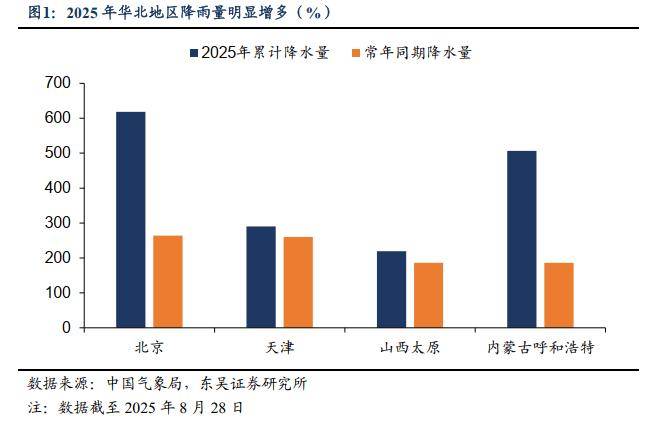
Core Viewpoint - Since 2021, the "northward shift of the rain belt" has significantly increased rainfall duration and volume in North China, leading to a rise in flood disasters and disruptions in project commencement. In this context, multiple departments have mentioned the need to accelerate the improvement of flood control and drainage infrastructure in North China by 2026, with water-related investments expected to see high growth in 2026. It is estimated that fixed asset investment in water, environment, and public facility management will increase by approximately 0.5 trillion yuan in 2026, driving infrastructure investment up by about 2.1 percentage points and overall fixed asset investment by about 1.1 percentage points, playing a crucial role in stabilizing investment [1][4][19]. Group 1: Objective Facts of the Northward Shift of the Rain Belt - From 2011 to 2020, the average duration of the rainy season in North China was only 27 days, but since 2021, it has significantly increased, with durations recorded at 59 days and 50 days in 2021 and 2022, respectively. The rainy season in 2025 reached a new high in both duration and precipitation [2][8]. - In 2025, the rainy season in North China began on July 5, 13 days earlier than the average, and ended on September 2, 16 days later than usual, resulting in a total duration of approximately 59 days, the longest since 1961 [9][10]. - The average national precipitation in 2025 was about 668 mm, 4.5% more than the average, with North China's rainy season precipitation reaching 356.6 mm, an increase of 161.1% compared to the norm [10]. Group 2: Economic Impact of the Northward Shift of the Rain Belt - The increase in extreme weather events, such as heavy rainfall, has led to a significant rise in flood disasters in North China. In July 2023, severe flooding in Beijing, Hebei, and Tianjin affected 5.512 million people, with direct economic losses reaching 165.79 billion yuan. In the first three quarters of 2025, flood disasters in North China caused direct economic losses of approximately 97.99 billion yuan, accounting for 59% of the national total [3][11]. - The increase in rainy days has also disrupted project commencement in North China. For instance, during the 2025 rainy season, the cement dispatch rate in North China dropped from 50% to 34%, significantly lower than the seasonal variation of 1.5% observed in the past five years. In Beijing, the dispatch rate fell from 57.5% on July 4, 2025, to 30% by August 29, 2025 [3][11]. Group 3: Potential Growth in Water Investment in 2026 - In response to the increased flood disasters and project disruptions caused by the northward shift of the rain belt, there has been a noticeable increase in policy emphasis on water-related investments in North China. The 2025 Central Economic Work Conference explicitly mentioned the need to address the shortcomings in flood control and drainage infrastructure, with expectations for high growth in water-related investments in 2026 [4][15]. - In the fourth quarter of 2023, China issued 1 trillion yuan in bonds to support post-disaster recovery and enhance disaster prevention and mitigation capabilities, leading to high growth in fixed asset investment in the water, environment, and public facility management sector in 2024. Assuming a similar growth rate in 2026, fixed asset investment in this sector is expected to increase by about 0.5 trillion yuan, contributing to a 2.1 percentage point rise in infrastructure investment and a 1.1 percentage point rise in overall fixed asset investment [19][4].


又一超级水利工程将落地,全国水利投资已连续三年突破万亿元
Di Yi Cai Jing· 2025-06-20 14:21
Core Viewpoint - The rapid development of water conservancy construction in recent years has led to the implementation of several major water conservancy projects, particularly those that have been under discussion for many years [1][5]. Group 1: Major Projects and Investments - The "Yin Da Ji Min" project in Sichuan is set to commence construction within the year, with a total static investment of 57.4 billion yuan and a construction period of 96 months [2][3]. - The project aims to draw water from the Dadu River to the Chengdu Plain, with a designed water intake flow of 80 cubic meters per second and a total water conveyance length of 304.4 kilometers [3]. - The project will involve three energy recovery power stations with a total installed capacity of 388 megawatts [3]. Group 2: Water Supply and Coverage - The "Yin Da Ji Min" project will supply water to eight cities and 43 counties, with average water supply volumes projected to be 1.326 billion cubic meters in 2035 and 1.523 billion cubic meters in 2050 [4]. - The Dujiangyan irrigation area is expected to reach an irrigation area of 11.647 million acres by 2025, expanding its coverage to include new regions [4]. Group 3: Growth in Water Investment - National water conservancy investment has shown rapid growth, with significant projects being launched, including the "Yin Da Ji Min" project and others like the "Yin Jiang Bu Han" project, which has a total investment of 58.235 billion yuan [5][6]. - In the first quarter of this year, eight major water conservancy projects were initiated, with a total investment scale of 43.73 billion yuan, representing a year-on-year increase of 27.8% [6]. - Water conservancy construction investment reached a historical high of 1.1996 trillion yuan in 2023, following a record of 1.0893 trillion yuan in 2022, marking a 43.8% increase from 2021 [7].