
雨带北移

Search documents
东吴证券:“雨带北移”或推动2026年水利相关投资录得较高增长
Sou Hu Cai Jing· 2026-01-29 00:03
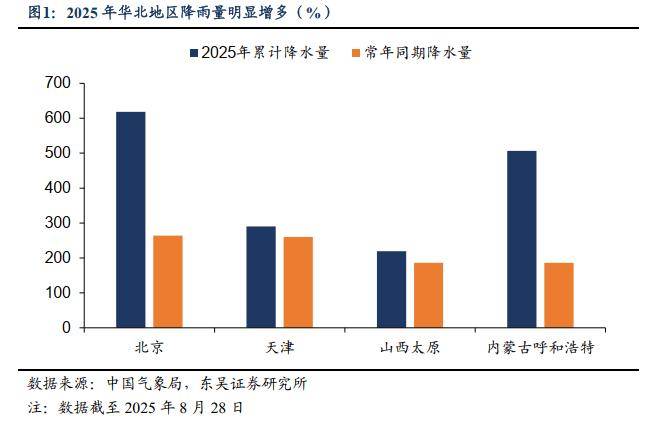
Core Viewpoint - Since 2021, the "northward shift of the rain belt" has significantly increased rainfall duration and volume in North China, leading to a rise in flood disasters and disruptions in project commencement. In this context, multiple departments have mentioned the need to accelerate the improvement of flood control and drainage infrastructure in North China by 2026, with water-related investments expected to see high growth in 2026. It is estimated that fixed asset investment in water, environment, and public facility management will increase by approximately 0.5 trillion yuan in 2026, driving infrastructure investment up by about 2.1 percentage points and overall fixed asset investment by about 1.1 percentage points, playing a crucial role in stabilizing investment [1][4][19]. Group 1: Objective Facts of the Northward Shift of the Rain Belt - From 2011 to 2020, the average duration of the rainy season in North China was only 27 days, but since 2021, it has significantly increased, with durations recorded at 59 days and 50 days in 2021 and 2022, respectively. The rainy season in 2025 reached a new high in both duration and precipitation [2][8]. - In 2025, the rainy season in North China began on July 5, 13 days earlier than the average, and ended on September 2, 16 days later than usual, resulting in a total duration of approximately 59 days, the longest since 1961 [9][10]. - The average national precipitation in 2025 was about 668 mm, 4.5% more than the average, with North China's rainy season precipitation reaching 356.6 mm, an increase of 161.1% compared to the norm [10]. Group 2: Economic Impact of the Northward Shift of the Rain Belt - The increase in extreme weather events, such as heavy rainfall, has led to a significant rise in flood disasters in North China. In July 2023, severe flooding in Beijing, Hebei, and Tianjin affected 5.512 million people, with direct economic losses reaching 165.79 billion yuan. In the first three quarters of 2025, flood disasters in North China caused direct economic losses of approximately 97.99 billion yuan, accounting for 59% of the national total [3][11]. - The increase in rainy days has also disrupted project commencement in North China. For instance, during the 2025 rainy season, the cement dispatch rate in North China dropped from 50% to 34%, significantly lower than the seasonal variation of 1.5% observed in the past five years. In Beijing, the dispatch rate fell from 57.5% on July 4, 2025, to 30% by August 29, 2025 [3][11]. Group 3: Potential Growth in Water Investment in 2026 - In response to the increased flood disasters and project disruptions caused by the northward shift of the rain belt, there has been a noticeable increase in policy emphasis on water-related investments in North China. The 2025 Central Economic Work Conference explicitly mentioned the need to address the shortcomings in flood control and drainage infrastructure, with expectations for high growth in water-related investments in 2026 [4][15]. - In the fourth quarter of 2023, China issued 1 trillion yuan in bonds to support post-disaster recovery and enhance disaster prevention and mitigation capabilities, leading to high growth in fixed asset investment in the water, environment, and public facility management sector in 2024. Assuming a similar growth rate in 2026, fixed asset investment in this sector is expected to increase by about 0.5 trillion yuan, contributing to a 2.1 percentage point rise in infrastructure investment and a 1.1 percentage point rise in overall fixed asset investment [19][4].


东吴证券晨会纪要2026-01-29-20260129
Soochow Securities· 2026-01-29 00:02
Macro Strategy - The core viewpoint is that the reform of the public housing fund can release significant consumption potential by lowering housing costs, thereby saving more funds for consumption. Three specific paths are proposed to reduce housing costs: expanding rental withdrawals, broadening the usage scope of the fund, and further lowering loan interest rates. The total potential release of funds is estimated at approximately 515.1 billion yuan, which could theoretically stimulate consumption by about 360.6 billion yuan, increasing the growth rate of resident consumption by 0.7 percentage points [1][15]. Fixed Income Strategy - The report discusses the "see-saw" relationship between stocks and bonds, emphasizing that this relationship is not stable or universal. The direction of stock and bond pricing is determined by the interplay between the numerator (earnings) and the denominator (interest rates). When the economy performs well, stock prices may rise due to improved earnings, but rising interest rates can suppress bond prices and increase stock discount rates, leading to uncertain stock index directions. Conversely, in a weak economic environment, stock prices may decline even if bond prices rise [2][18]. Industry Insights - The commercial aerospace sector is highlighted as a key investment area for 2026, driven by the successful launch of domestic rockets, which has removed previous operational bottlenecks. The report suggests focusing on four main areas: SpaceX-related stocks, rocket and satellite sectors, and space computing/solar power. Specific companies to watch include Maimai Co., Anhui Helit, and others in the rocket and satellite sectors [3][21]. Water Conservancy Investment - The report indicates that the "northward shift of the rain belt" since 2021 has led to increased rainfall and flooding in northern China, prompting a focus on enhancing water conservancy infrastructure. It is projected that water-related investments in 2026 could see significant growth, contributing to a recovery in overall fixed asset investments by approximately 1.1 percentage points [2][16][17]. Electric Power Equipment - The report emphasizes the potential for rapid development in space solar power due to the acceleration of commercial aerospace and low-orbit satellite advancements. Companies involved in space power supply and equipment are recommended for investment, including Jun Da Co. and Ming Yang Smart Energy [6][21]. Food and Beverage Industry - The report discusses the potential of AKK bacteria as a beneficial symbiotic organism in gut health, with applications in obesity and diabetes management. The market for AKK is expected to grow significantly, with a focus on leading companies in the probiotic sector [3][23].
宏观深度报告:“雨带北移”或推动2026年水利相关投资录得较高增长
Soochow Securities· 2026-01-28 02:24
Group 1: Rain Belt Shift and Its Impact - Since 2021, the "northward shift of the rain belt" has significantly increased rainfall duration and volume in North China, leading to more frequent flooding disasters and disruptions in project commencement[1] - In 2025, the average rainfall in North China reached 356.6 mm, which is 161.1% higher than the historical average, contributing to a national average rainfall of 668 mm, 4.5% above normal[6] - Flood disasters in North China caused direct economic losses of approximately 979.9 billion yuan in the first three quarters of 2025, accounting for 59% of the national total[6] Group 2: Investment Projections for 2026 - In response to the increased flooding risks, the government plans to accelerate investments in flood control and drainage infrastructure in North China, with expectations for significant growth in water-related investments in 2026[1] - Assuming a 5% increase in fixed asset investment growth for water management and public facilities compared to the past five years, water-related investments in 2026 could increase by approximately 0.5 trillion yuan[6] - This increase in water-related investment is projected to boost overall fixed asset investment by about 1.1 percentage points, contributing to a stabilization in investment trends[6] Group 3: Policy and Infrastructure Focus - The 2025 Central Economic Work Conference emphasized the need to address the shortcomings in flood control infrastructure in North China, highlighting the importance of enhancing disaster response capabilities[6] - In the fourth quarter of 2023, the issuance of 1 trillion yuan in government bonds aimed at disaster recovery and infrastructure improvement is expected to lead to a 17.6% growth in fixed asset investment in water, environment, and public facilities management in North China[6] - The focus on improving flood control and drainage infrastructure is expected to remain a priority in national policy discussions leading into 2026[6] Group 4: Risks and Considerations - The sustainability of the rain belt shift remains uncertain, with potential for rainfall in 2026 to exceed expectations[6] - There is a risk that national investment stabilization policies may not meet expectations, leading to lower-than-anticipated growth in water-related investments[6] - Some data used for projections are based on historical estimates, which may contain inaccuracies[6]