
汽车产业高端化

Search documents
“价格承诺”方案落地!中欧电动汽车反补贴案达成积极成果 专家:能极大提升进口商积极性 把利润留给中国车企
Mei Ri Jing Ji Xin Wen· 2026-01-13 13:47
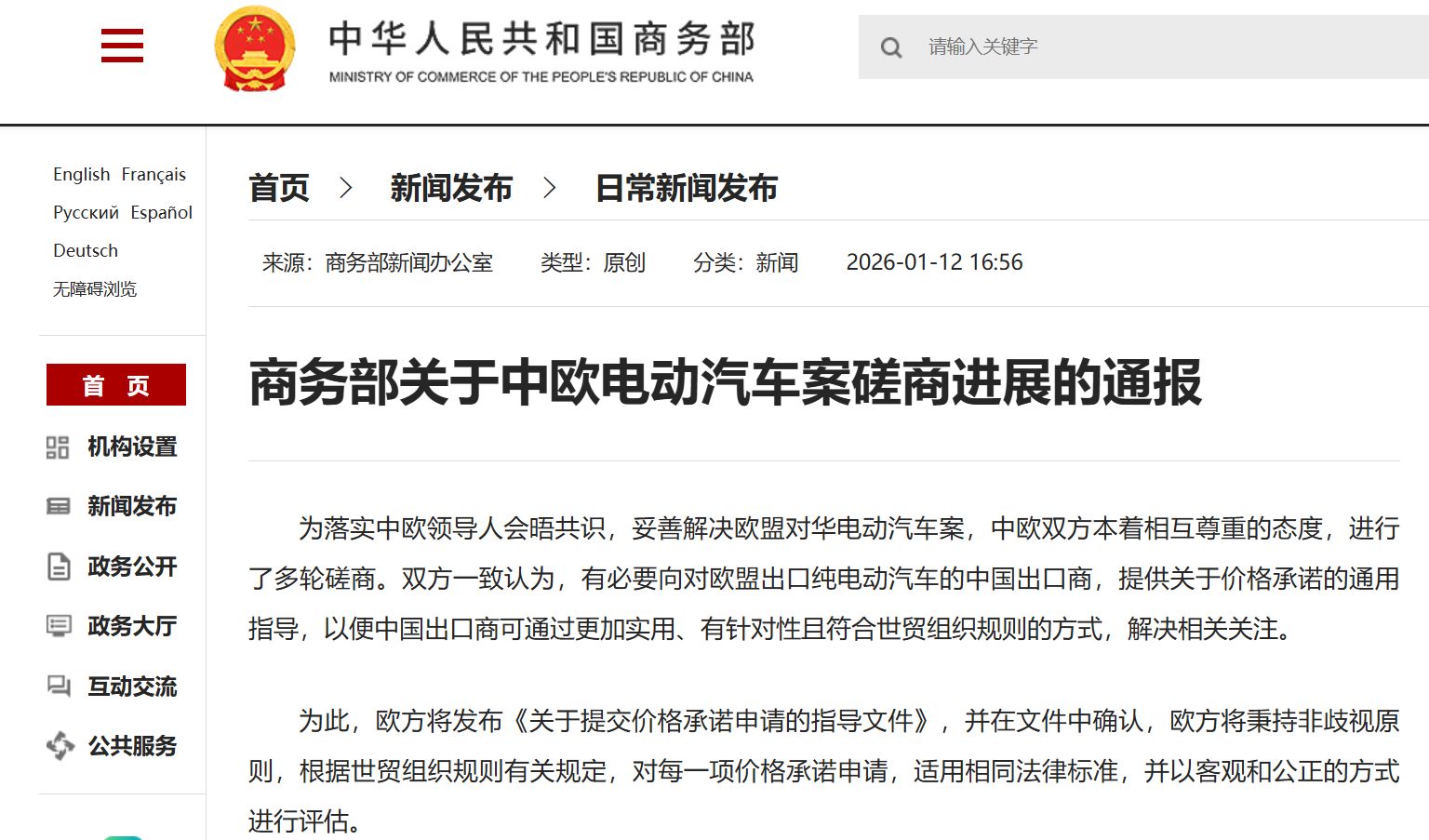
Core Viewpoint - The EU has made significant progress in negotiations with China regarding anti-subsidy tariffs on electric vehicles, replacing high tariffs with a "price commitment" mechanism to facilitate exports of Chinese electric vehicles to the EU [1][3][4]. Group 1: Negotiation Outcomes - The "price commitment" mechanism is a result of mutual discussions between the EU and China, aimed at managing trade frictions and maintaining a rules-based international trade order [3][4]. - The Chinese automotive industry sees the adoption of the "price commitment" as a major positive outcome, signaling enhanced cooperation between China and the EU in the automotive sector [3][4]. Group 2: Impact on Export Pricing - Previously proposed high anti-subsidy taxes could have reached nearly 45%, significantly impacting the cost structure and pricing of Chinese electric vehicles in the EU market [4]. - The EU's decision to implement a "price commitment" mechanism is intended to allow Chinese exporters to raise vehicle prices, thereby mitigating potential impacts on the local automotive market [4][6]. Group 3: Guidelines for Price Commitment - The EU has published guidelines for submitting price commitments, which will be evaluated based on non-discrimination and fairness principles, in accordance with WTO rules [5][6]. - The guidelines outline two potential methods for determining the minimum import price (MIP), ensuring that prices do not fall below those of comparable non-subsidized electric vehicles produced in the EU [6][10]. Group 4: Market Dynamics and Growth Potential - The agreement is expected to stabilize market access for Chinese electric vehicles in the EU, with projections indicating an annual growth rate of approximately 20% for Chinese electric vehicles in the EU market [9][10]. - The "price commitment" mechanism is anticipated to encourage Chinese automakers to shift from a low-cost strategy to a focus on high-end products and local production in Europe [9][10]. Group 5: Industry Reactions - Various industry associations have expressed support for the resolution of the EU's anti-subsidy case, highlighting the importance of dialogue in maintaining stable economic and trade relations between China and the EU [11][12]. - The consensus reached is viewed as a significant step towards fostering cooperation and stability in the automotive supply chain between the two regions [11][12].


今年车市表现超出预期?中汽协许海东:近5年中国汽车产业的爆发显而易见
Zhong Guo Jing Ying Bao· 2025-10-18 05:12
Core Insights - The Chinese automotive market has exceeded expectations in 2023, with a projected annual sales volume surpassing 34 million units, exceeding the initial forecast by 1 million units [1][2] Group 1: Market Performance - From January to September 2023, the automotive market achieved a year-on-year growth of 12.9%, with September alone showing a growth of 14.9% [1] - In September, automotive production and sales reached 3.276 million and 3.226 million units respectively, marking a historical milestone with both figures exceeding 3 million units for the first time [1] - The cumulative production and sales from January to September were 24.433 million and 24.436 million units, reflecting year-on-year growth of 13.3% and 12.9% respectively [1] Group 2: Policy Impact - The primary driver of sustained growth in the automotive market has been the subsidy policies, particularly the "scrap and update" and "replacement update" subsidies introduced by the government [2] - The scale of stimulus policies for the automotive sector has doubled to 300 billion yuan, providing strong support for market performance [2] - The upcoming expiration of the new energy vehicle purchase tax exemption is expected to trigger another wave of consumer spending in the automotive market [2] Group 3: Structural Changes in the Industry - The automotive industry in China is undergoing significant structural changes, with total production expected to rise from 30.09 million units in 2021 to over 34 million units in 2023 [3] - New energy vehicles have seen explosive growth, with production expected to exceed 16 million units in 2023, up from approximately 1.35 million units in 2020 [3] - The market share of Chinese brand passenger vehicles has surged from about 30% in mid-2020 to around 70% currently, reshaping the competitive landscape [3] Group 4: High-End Market Development - The automotive industry's growth includes a strong push towards high-end products, driven by improved design capabilities and quality assurance systems [4] - New energy vehicles have shown significant growth in high-end segments, with C and D class models experiencing notable increases in sales [4] - Chinese automotive brands are increasingly focusing on high-end market segments, with several new premium brands emerging [4][5] Group 5: Consumer Insights and Market Trends - The rise of Chinese automotive brands is supported by a deep understanding of consumer needs, particularly in the MPV segment, which has seen competitive products launched by various domestic manufacturers [5] - The design and functionality of new MPV offerings cater to both business and family needs, reflecting a strategic response to market demands [5]