
价格承诺

Search documents
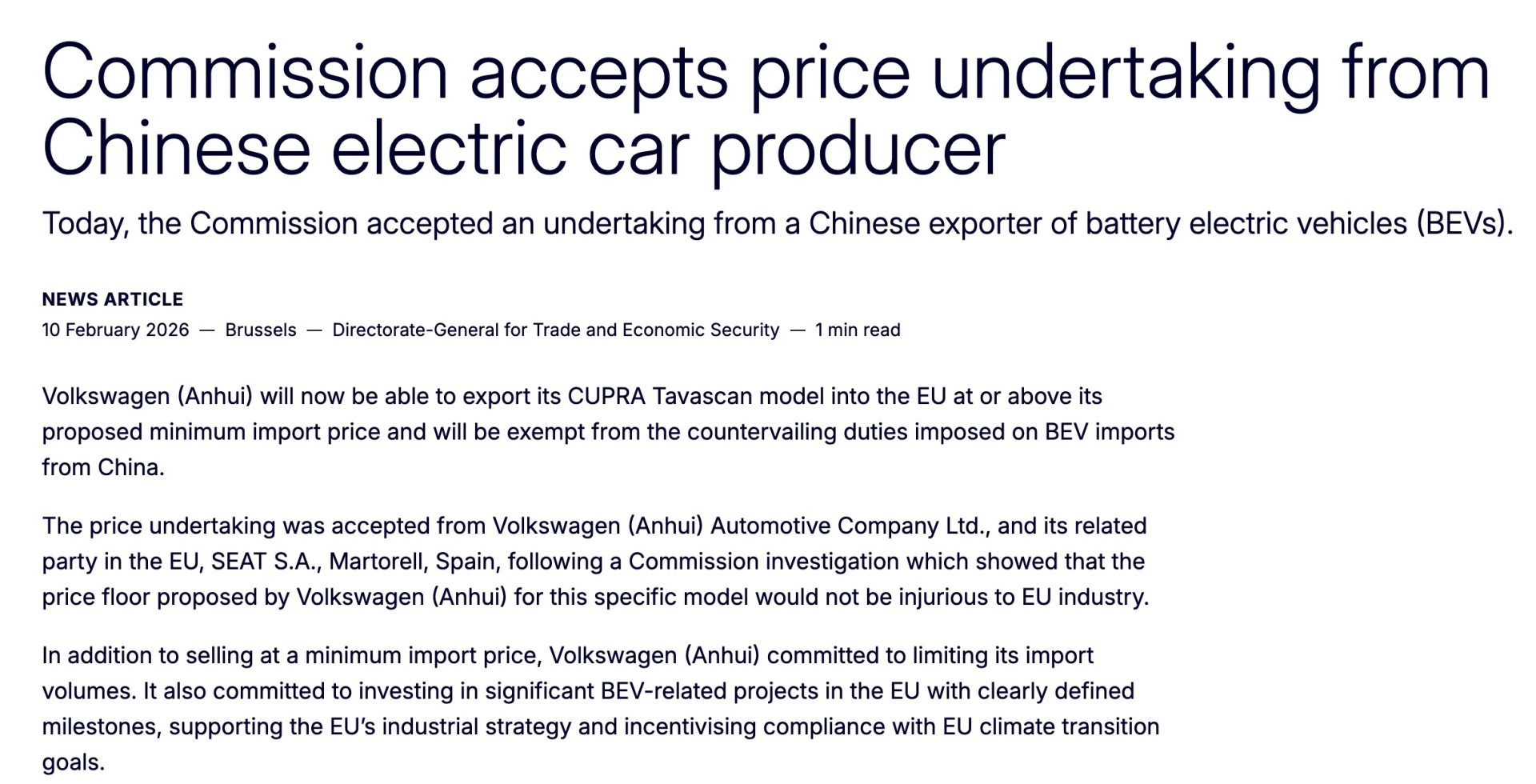
豁免最高20.7%反补贴税,欧委会接受大众安徽价格承诺!大众汽车承诺限制出口的数量,并将在欧盟投资一系列与纯电动汽车相关的重要项目
Mei Ri Jing Ji Xin Wen· 2026-02-12 14:10
Core Viewpoint - The European Commission has accepted Volkswagen (Anhui) Co., Ltd.'s price commitment plan for the CUPRA Tavascan model, allowing it to be exempt from a previously applicable anti-subsidy tax of up to 20.7% [1][3]. Group 1: Price Commitment and Exemption - Volkswagen's price commitment involves setting a minimum export price for the CUPRA Tavascan model, which will exempt it from the anti-subsidy tax [1]. - The European Commission concluded that the minimum price set by Volkswagen would not harm the EU industry, leading to the acceptance of the price commitment [1]. Group 2: Investment and Compliance - In addition to the minimum import price, Volkswagen has committed to limiting the quantity of exports to the EU and investing in significant projects related to pure electric vehicles within the EU [3]. - These investments will have clear phased goals to support the EU industry strategy and align with EU climate transition objectives [3]. Group 3: Context and Implications - This approval marks the first successful case since the framework consensus on the "price commitment" mechanism was reached between China and the EU on January 12, 2023 [6]. - The Chinese Ministry of Commerce expressed that the agreement is welcomed by the international community and aims to create an open and stable market environment for industrial development [3]. Group 4: Challenges for Other Companies - Other companies seeking approval may face structural challenges, as the approval of Volkswagen's plan was closely tied to local investment commitments and backing from domestic brands [8]. - The complexity of product and distribution channels may also affect the feasibility of proposals from other companies, as simpler submissions are easier to evaluate [8]. - The ownership structure of companies may introduce uncertainties, particularly for wholly-owned or controlled Chinese enterprises, despite the EU's stated non-discrimination principle [8].

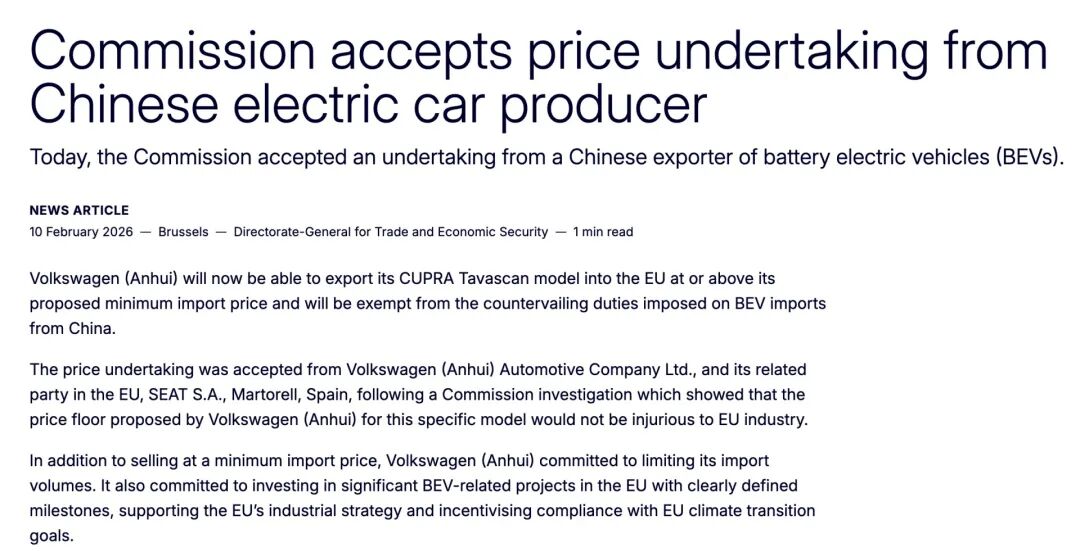
豁免最高20.7%反补贴税!欧委会接受大众安徽价格承诺 中欧电动汽车反补贴案迎来首个获批个案
Mei Ri Jing Ji Xin Wen· 2026-02-12 11:54
Core Viewpoint - The European Commission has accepted Volkswagen (Anhui) Co., Ltd.'s price commitment plan, allowing the CUPRA Tavascan model to be exempt from a previously applicable anti-subsidy tax of up to 20.7% by setting a minimum export price [1][3] Group 1: Price Commitment and Exemptions - Volkswagen's price commitment was proposed by Volkswagen and its EU affiliate, SEAT S.A., and was deemed not harmful to the EU industry [1] - The acceptance of the price commitment allows Volkswagen to sell the CUPRA Tavascan at a minimum import price, thus avoiding the anti-subsidy tax [3] Group 2: Investment and Strategic Goals - Volkswagen has also committed to limiting the quantity of exports to the EU and investing in significant projects related to pure electric vehicles within the EU [3] - These investments will have clear phased goals to support the EU industry strategy and align with EU climate transition objectives [3] Group 3: Context and Implications - This approval marks the first successful case since the framework consensus on the "price commitment" mechanism was reached between China and the EU on January 12 [6] - The EU has issued guidelines for Chinese electric vehicle exporters to utilize price commitments, which will replace anti-subsidy taxes for qualifying companies [6][7] - The guidelines specify that companies can submit proposals individually or jointly, set minimum import prices for specific models, and include annual export quantity commitments [7] Group 4: Challenges for Other Companies - The approval of Volkswagen's plan is closely tied to its investment commitments in the EU and the backing of local brands, which may pose challenges for other companies seeking similar approvals [8] - The complexity of product and distribution channels can affect the feasibility of proposals, with simpler submissions being more favorable for evaluation [8] - The ownership structure of companies may also influence the approval process, as Volkswagen Anhui is a joint venture with a 75% stake held by the German parent company [8]
价格承诺还是加关税,中国车企出口欧洲要做“选择题”
Bei Ke Cai Jing· 2026-01-19 13:25
Core Viewpoint - The recent developments in the EU-China electric vehicle case are expected to significantly boost market confidence and inject new momentum into automotive trade and investment cooperation between China and Europe [1]. Group 1: Price Commitment Guidance - The European Commission has released guidance allowing Chinese electric vehicle manufacturers to submit price commitment applications, which can replace anti-subsidy duties if approved [1][2]. - The guidance allows companies to choose the range of products covered by the price commitment, enabling them to apply for specific models while exporting others under anti-subsidy duties [3][4]. - The price commitment mechanism is designed to offset the damage caused by Chinese electric vehicle exports to the EU industry, potentially through minimum import prices or export quantity restrictions [2]. Group 2: Challenges and Recommendations - The complexity of the price commitment design poses challenges, as it must meet EU requirements while ensuring the commercial sustainability of companies in the European market [10]. - Companies are advised to conduct comprehensive assessments of their operational and export situations, including product structure and pricing systems, to avoid simplistic decision-making [9][11]. - The guidance emphasizes the need for companies to prepare compliance materials and ensure data accuracy to mitigate legal and operational risks [10]. Group 3: Historical Context and Future Implications - The EU initiated an anti-subsidy investigation against Chinese electric vehicles in October 2023, citing unfair subsidies that harm the local automotive industry [14]. - The investigation is politically significant, as it was self-initiated by the EU rather than prompted by external parties [14]. - The release of the guidance on January 12, 2024, is seen as a positive outcome following multiple negotiations, indicating a "soft landing" for the electric vehicle case and benefiting future cooperation in the automotive supply chain between China and Europe [15].
“价格承诺”方案落地,中欧电动汽车反补贴案出结果
Sou Hu Cai Jing· 2026-01-15 12:55
Core Viewpoint - The EU has made significant progress in negotiations with China regarding anti-subsidy tariffs on electric vehicles, replacing high tariffs with a "price commitment" mechanism, which is seen as a positive signal for managing trade frictions between the two parties [1][3][12]. Group 1: Negotiation Outcomes - The "price commitment" mechanism is a major outcome of multiple rounds of negotiations between China and the EU, indicating a mutual effort to enhance cooperation in the automotive industry [3][12]. - The EU will provide general guidance for Chinese exporters of pure electric vehicles to comply with WTO rules, allowing for a more practical approach to address concerns [1][5]. - The agreement is viewed as a pragmatic breakthrough that stabilizes market access and expectations for the industry [3][4]. Group 2: Impact on Tariffs and Pricing - Previously proposed high anti-subsidy tariffs could have reached nearly 45%, significantly impacting the cost and pricing structure for Chinese electric vehicle exports to Europe [4][5]. - The EU's decision to adopt the "price commitment" mechanism aims to avoid imposing tariffs as high as 35.3%, allowing Chinese companies to maintain a competitive edge in the EU market [4][8]. - The "price commitment" will require Chinese exporters to set minimum export prices that are higher than previous levels, which may affect sales volumes but ultimately retains profits within the companies [6][7]. Group 3: Industry Implications - The new mechanism is expected to help Chinese electric vehicle manufacturers avoid the negative impacts of high tariffs, thus enhancing their profitability and market presence in Europe [7][10]. - The agreement encourages a shift away from a "low-price volume" strategy towards a focus on high-end products and local production in Europe [9][10]. - The established legal standards and evaluation processes in the guidance document are anticipated to regulate pricing behavior and reduce trade friction risks [10][11]. Group 4: Industry Associations' Reactions - Various industry associations, including the China Association of Automobile Manufacturers, have expressed strong support for the resolution of the EU's anti-subsidy case, highlighting its importance for stable economic and trade relations [11][12]. - The consensus reached is seen as a response to industry concerns and is expected to promote healthy development in China-EU economic and trade cooperation [12][13].

中欧电动汽车案破局 中企迎来价格承诺新考题
Mei Ri Jing Ji Xin Wen· 2026-01-14 12:17
Group 1 - The negotiations between China and the EU regarding the anti-subsidy case for electric vehicles have yielded positive results, allowing Chinese electric vehicle companies to submit price commitment applications based on the newly released guidelines [1][2] - The European Commission has committed to an objective and fair review of the applications submitted by Chinese companies, which can replace high anti-subsidy tariffs (ranging from 7.8% to 35.3%) with price commitments, thus reducing export costs and mitigating risks of profit compression or market exit [1][2] - The guidelines clarify the application process and pricing standards, eliminating policy uncertainties and enabling companies to plan export strategies and long-term development more clearly, while also fostering collaboration across the electric vehicle industry chain [1][2] Group 2 - The achievement of this "soft landing" is significant, as the EU initiated an anti-subsidy investigation into Chinese electric vehicles in October 2023, leading to a five-year anti-subsidy tariff starting October 30, 2024, which cast a shadow over Chinese electric vehicle exports [2] - Chinese electric vehicle companies are encouraged to adapt proactively within the new regulatory framework, ensuring they understand the detailed rules to avoid potential risks, such as pricing too high or too low, and managing complex sales channels to prevent cross-subsidy issues [3] - Companies should optimize operational processes by establishing detailed cost accounting systems for various export models and simplifying sales channel structures to enhance pricing transparency and reduce regulatory verification difficulties [3] Group 3 - Companies heavily reliant on low-priced models need to reassess their local production strategies, as price commitments limit low-price competition, and local production in Europe can fundamentally avoid trade barriers while aligning with EU industrial policy [3] - The EU will review the import quotas and price commitments of Volkswagen's Chinese subsidiary by December 2025, serving as a practical case that will provide important references for subsequent companies [4] - The introduction of the guidelines creates valuable opportunities for the electric vehicle industry, marking a new starting point for companies to adapt to regulatory constraints and market competition, solidifying their development advantages in the European market [4]
“价格承诺”方案落地! 中欧电动汽车反补贴案出结果
Mei Ri Jing Ji Xin Wen· 2026-01-14 12:04
Core Viewpoint - The EU has made significant progress in negotiations with China regarding electric vehicle anti-subsidy tariffs, replacing high tariffs with a "price commitment" mechanism, which is seen as a positive signal for both parties to manage trade frictions [1][2]. Group 1: Negotiation Outcomes - The "price commitment" mechanism is a pragmatic breakthrough that preserves access for Chinese electric vehicles to the EU market while avoiding the impact of high tariffs [2]. - The EU's previous proposed tariffs could have reached nearly 45%, posing a significant threat to Chinese electric vehicle exports and potentially forcing some companies out of the EU market [3]. - The agreement allows Chinese exporters to submit price commitments that will replace anti-subsidy tariffs, thus stabilizing market access and industry expectations [4][6]. Group 2: Price Commitment Mechanism - The "price commitment" requires that the selling price of Chinese electric vehicles in the EU must not be lower than that of similar local models, aimed at protecting the EU automotive industry [5]. - The mechanism allows for a single company or a group of companies to submit price commitments, with a preference for single submissions to simplify evaluations [5]. - This approach is expected to lead to higher vehicle prices, which may impact sales but ultimately allows companies to retain profits that would otherwise go to tariffs [6]. Group 3: Industry Implications - The agreement is anticipated to encourage Chinese automakers to shift from a "low-price volume" strategy to a focus on high-end products and local production in Europe [7][8]. - The established legal standards and evaluation processes are expected to regulate pricing behavior and reduce trade friction risks, promoting technological investment and high-value products [8]. - The collaboration between China and the EU is projected to result in an annual growth rate of approximately 20% for Chinese electric vehicles in the EU market, setting a precedent for resolving global trade disputes [8]. Group 4: Industry Associations' Responses - Various industry associations have expressed strong support for the resolution of the EU's anti-subsidy case against Chinese electric vehicles, highlighting its importance for stable economic and trade relations [9][10]. - The consensus reached is viewed as a significant example of resolving differences through dialogue within the framework of WTO rules, benefiting both the automotive industry and broader economic cooperation [9].
乘联分会:1月1-11日全国乘用车新能源市场零售11.7万辆 同比下降38%
Zhi Tong Cai Jing· 2026-01-14 08:14
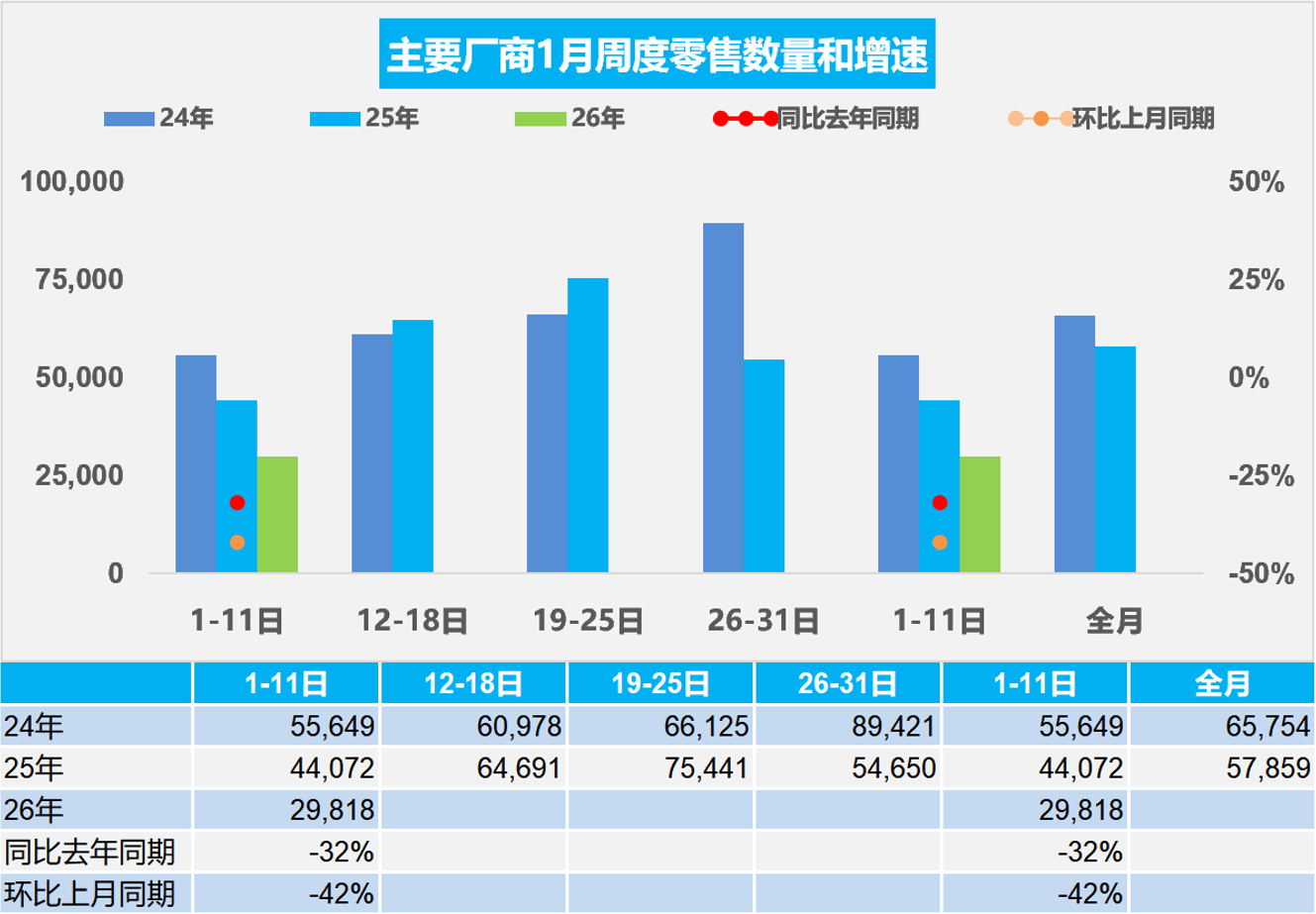
Group 1: New Energy Vehicle Market Performance - From January 1 to January 11, the retail sales of new energy vehicles in the passenger car market reached 117,000 units, a year-on-year decrease of 38% and a month-on-month decrease of 67% [1] - The retail penetration rate for new energy vehicles in the passenger car market is 35.5%, while the wholesale penetration rate is 43.9% [1] - The wholesale of new energy vehicles in the passenger car market totaled 167,000 units, down 30% year-on-year and 51% month-on-month [1] Group 2: Overall Passenger Car Market Trends - The total retail sales of passenger cars from January 1 to January 11 were 328,000 units, reflecting a year-on-year decline of 32% and a month-on-month decline of 42% [3] - The wholesale volume for passenger cars was 381,000 units, down 40% year-on-year and 30% month-on-month [5] - The average daily retail sales in the first week of January were 30,000 units, a decrease of 32% year-on-year and 42% month-on-month [3] Group 3: Policy Impact on Market - The National Development and Reform Commission announced a policy to promote large-scale equipment updates and a trade-in program, which is expected to boost domestic automobile consumption [3] - The subsidy for scrapping and updating passenger cars is projected to decrease by 20% on average per vehicle, with the maximum decline reaching 30% [3] - The expiration of the vehicle purchase tax exemption policy is contributing to the weak retail performance in January, but the market is expected to improve as subsidy details are rolled out [6] Group 4: Electric Vehicle Export and Market Dynamics - The Ministry of Commerce reported progress in negotiations regarding the EU-China electric vehicle case, which aims to provide price commitments to Chinese exporters, avoiding high tariffs [7] - This agreement is expected to stabilize market access for Chinese electric vehicles in the EU and promote a shift towards higher-end products [7] - The average price of passenger vehicles has seen a slight decline, influenced by structural changes in consumer purchasing power [8] Group 5: Battery Export Tax Changes - The announcement to reduce export tax rebates for lithium batteries is expected to have minimal impact on supply and demand in the short term [10] - The adjustment aims to align export prices with market realities and address international concerns, potentially easing trade tensions [10] - The first quarter's domestic demand for lithium batteries is projected to be only 18% of the annual total, indicating limited immediate effects on the industry [10]
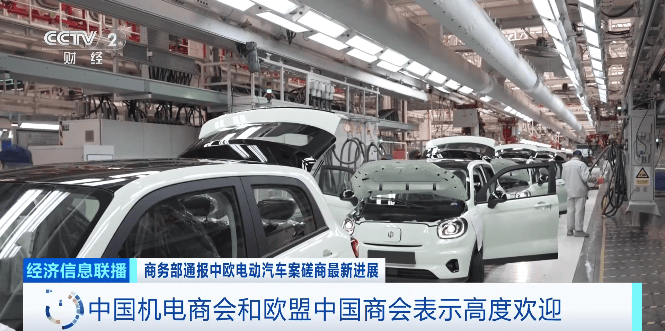
中欧电动汽车案“软着陆”,双方商会表示高度欢迎
Sou Hu Cai Jing· 2026-01-13 14:21
Group 1 - The core viewpoint of the article is that significant progress has been made in the price commitment negotiations regarding the EU-China electric vehicle case, as announced by the Ministry of Commerce of China [1] - The China Electromechanical Products Import and Export Chamber expressed that resolving the EU's anti-subsidy case against Chinese electric vehicles is a common expectation among the industry, and the negotiations have successfully achieved a "soft landing" [3] - The Director of the Legal Service Department of the China Electromechanical Products Import and Export Chamber highlighted the complexity of negotiating price commitments for electric vehicles, emphasizing that this achievement will promote the stable development of the relevant industrial and supply chains between China and the EU [5] Group 2 - The EU Chamber of Commerce in China welcomed the successful dialogue and negotiations that led to a "soft landing" for the electric vehicle case, which addresses significant concerns within the automotive industry [7] - This outcome is expected to enhance economic and investment cooperation between China and the EU, contributing to the healthy and stable development of bilateral relations [7] - The joint decision made by China and the EU is not only significant for bilateral relations but also serves as a positive global example of managing differences through dialogue and maintaining a rules-based multilateral trading system [7]
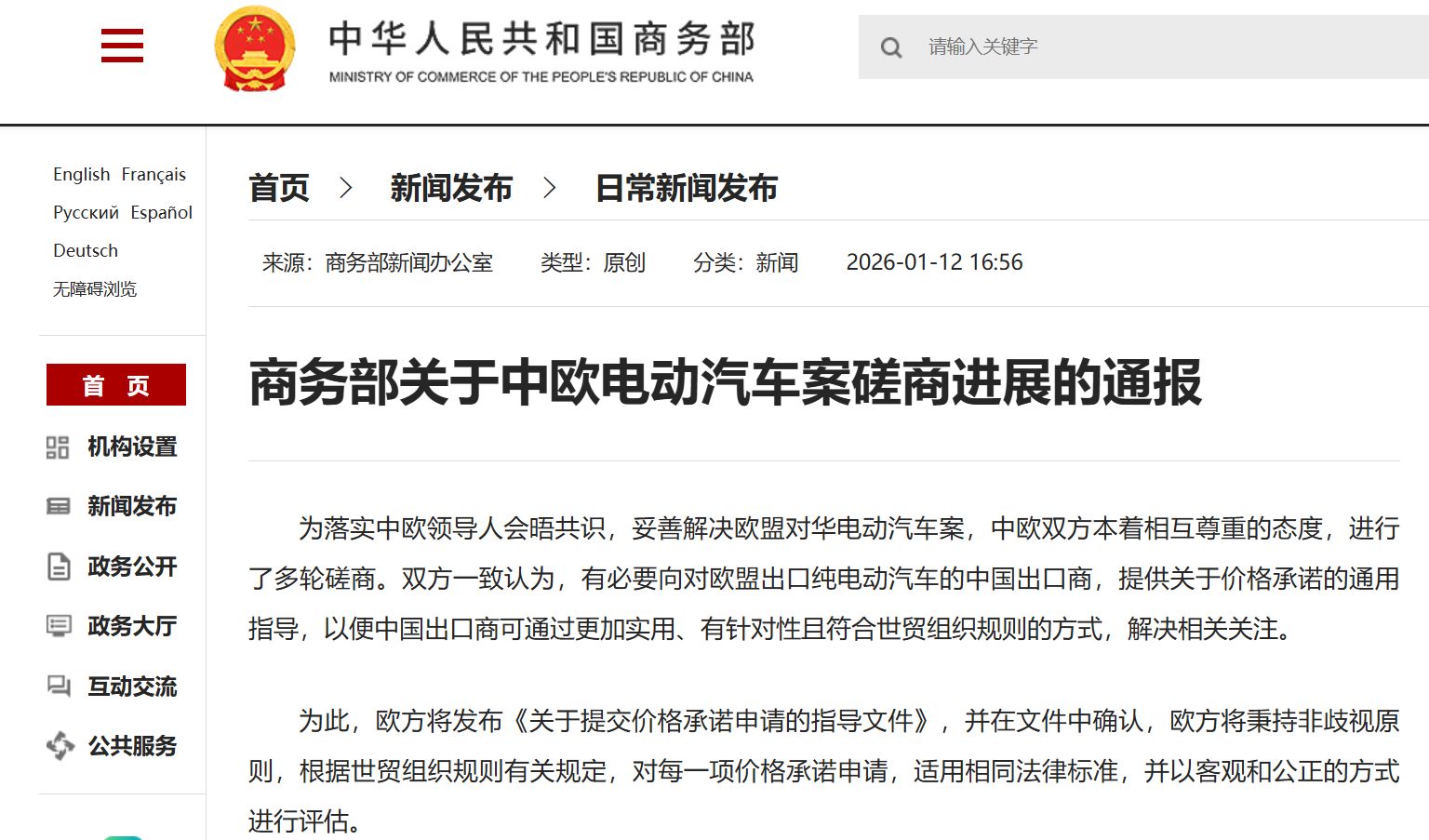
“价格承诺”方案落地!中欧电动汽车反补贴案达成积极成果 专家:能极大提升进口商积极性 把利润留给中国车企
Mei Ri Jing Ji Xin Wen· 2026-01-13 13:47
Core Viewpoint - The EU has made significant progress in negotiations with China regarding anti-subsidy tariffs on electric vehicles, replacing high tariffs with a "price commitment" mechanism to facilitate exports of Chinese electric vehicles to the EU [1][3][4]. Group 1: Negotiation Outcomes - The "price commitment" mechanism is a result of mutual discussions between the EU and China, aimed at managing trade frictions and maintaining a rules-based international trade order [3][4]. - The Chinese automotive industry sees the adoption of the "price commitment" as a major positive outcome, signaling enhanced cooperation between China and the EU in the automotive sector [3][4]. Group 2: Impact on Export Pricing - Previously proposed high anti-subsidy taxes could have reached nearly 45%, significantly impacting the cost structure and pricing of Chinese electric vehicles in the EU market [4]. - The EU's decision to implement a "price commitment" mechanism is intended to allow Chinese exporters to raise vehicle prices, thereby mitigating potential impacts on the local automotive market [4][6]. Group 3: Guidelines for Price Commitment - The EU has published guidelines for submitting price commitments, which will be evaluated based on non-discrimination and fairness principles, in accordance with WTO rules [5][6]. - The guidelines outline two potential methods for determining the minimum import price (MIP), ensuring that prices do not fall below those of comparable non-subsidized electric vehicles produced in the EU [6][10]. Group 4: Market Dynamics and Growth Potential - The agreement is expected to stabilize market access for Chinese electric vehicles in the EU, with projections indicating an annual growth rate of approximately 20% for Chinese electric vehicles in the EU market [9][10]. - The "price commitment" mechanism is anticipated to encourage Chinese automakers to shift from a low-cost strategy to a focus on high-end products and local production in Europe [9][10]. Group 5: Industry Reactions - Various industry associations have expressed support for the resolution of the EU's anti-subsidy case, highlighting the importance of dialogue in maintaining stable economic and trade relations between China and the EU [11][12]. - The consensus reached is viewed as a significant step towards fostering cooperation and stability in the automotive supply chain between the two regions [11][12].
EU guidance sets price undertaking route for Chinese EV imports
Yahoo Finance· 2026-01-13 13:04
Core Viewpoint - The European Commission has provided guidance for Chinese electric vehicle (EV) exporters to avoid EU anti-subsidy duties by submitting price undertakings based on minimum import prices [1][4]. Group 1: Guidance on Price Undertakings - The guidance outlines the structure and content required for price undertaking offers, including minimum import prices, product scope, annual sales volumes, distribution channels, and risks related to cross-compensation [2][5]. - All price undertaking offers will be evaluated under the same legal standards as per the EU's basic anti-subsidy Regulation, ensuring an objective and non-discriminatory assessment process aligned with World Trade Organization (WTO) rules [3][4]. Group 2: Assessment Criteria - Acceptable undertakings must eliminate the harmful effects of subsidization, be practical, limit cross-compensation risks, and comply with broader policy considerations [3]. - Minimum import prices can be determined by adjusting historical costs, insurance, and freight prices or by referencing sales prices of comparable non-subsidized BEVs produced in the EU [5]. Group 3: Submission and Evaluation Process - Chinese exporters can submit price undertaking offers individually or jointly, with each proposal evaluated on its own merits [6]. - The China Chamber of Commerce to the EU (CCCEU) stated that the outcome of the China-EU consultations supports trade stability and reflects business concerns, emphasizing the importance of dialogue in dispute management [6][7]. Group 4: Market Impact - CCCEU believes that the constructive outcome will enhance market confidence, create a stable environment for Chinese EV manufacturers in Europe, and foster deeper cooperation between China and the EU in market development and technological innovation [7].