汽车风阻系数

Search documents
余承东:车辆120km/h时 风阻消耗能量可达70%
Feng Huang Wang· 2026-01-22 03:56
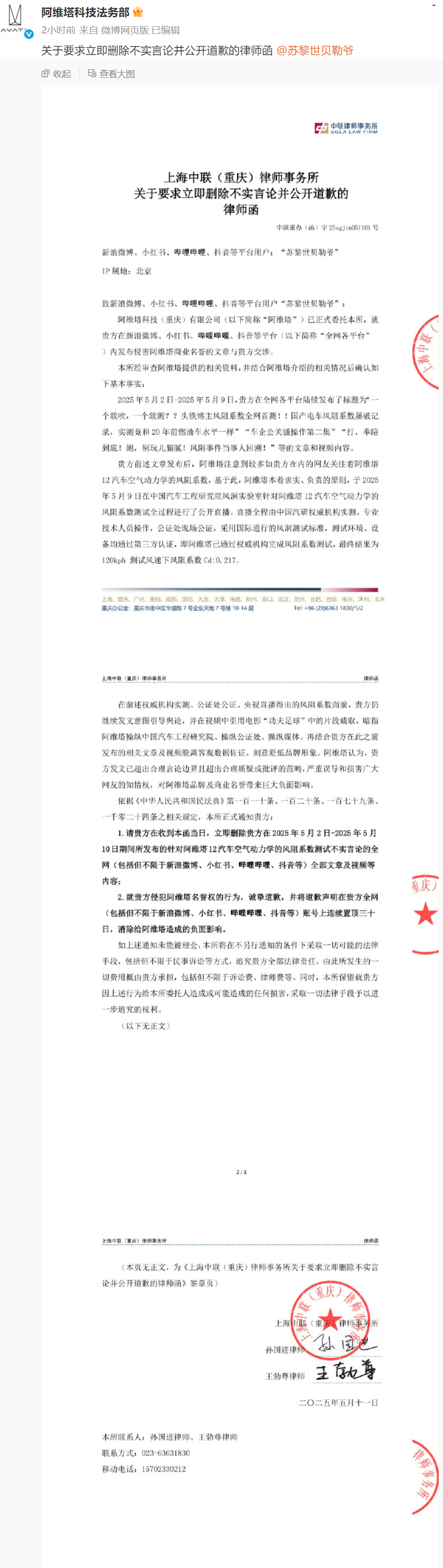
Core Viewpoint - The article emphasizes the importance of the drag coefficient in electric vehicles, highlighting it as a critical factor affecting the range of electric cars [1] Group 1: Importance of Drag Coefficient - The drag coefficient is often overlooked but is crucial for electric vehicle range, with energy consumption at 120 km/h reaching up to 70% due to drag [1] - A slight difference in drag coefficient can lead to a significant variation in range, potentially affecting the distance by several dozen kilometers with the same battery capacity [1] Group 2: Recent Developments - The Zhijie R7 has recently achieved a key certification in a professional wind tunnel, with its pure electric Ultra version recording a drag coefficient of only 0.217 under specific testing conditions (120 km/h at 23°C) [1]


理性看待风阻系数测试争议
Jing Ji Ri Bao· 2025-05-16 21:54
Core Viewpoint - The recent controversy over the wind resistance coefficient of the Avita 12 highlights the intense competition and scrutiny within the automotive industry, particularly among electric vehicle manufacturers, where such technical parameters have become critical for consumer perception and product differentiation [1][2]. Group 1: Wind Resistance Coefficient Importance - The wind resistance coefficient is a key parameter that measures the air resistance a vehicle faces while driving, directly impacting fuel economy, range, stability at high speeds, and noise levels [1]. - The significance of low wind resistance has been amplified in the electric vehicle sector, where it not only affects consumer perception but also enhances the vehicle's range [1]. - The marketing strategy of Tesla, particularly with the Model S, has set a precedent in the industry, linking low wind resistance with technological advancement and reshaping consumer expectations [1]. Group 2: Industry Competition and Marketing Dynamics - The automotive market has seen a shift from price competition to a focus on technical specifications, with companies striving to present their data as superior to competitors [2]. - The rise of self-media and digital platforms has led to a competitive environment where sensationalism is often used to attract attention, sometimes at the expense of accuracy [2]. Group 3: Testing Standards and Industry Challenges - Rigorous testing standards and methodologies are essential for accurate wind resistance measurements, with the China Automotive Engineering Research Institute's wind tunnel facility costing approximately 550 million yuan [3]. - The lack of unified national standards for aerodynamic testing in China has allowed for unregulated and potentially misleading private testing, leading to public disputes and calls for regulatory oversight [3]. - Recent controversies surrounding various vehicle tests reflect the need for improved regulation and standardization in the automotive testing industry to protect consumer rights and support industry development [3]. Group 4: Broader Implications of Wind Resistance - While the wind resistance coefficient is often viewed as a symbol of technological prowess, its impact is most pronounced in high-speed scenarios, with less significance in everyday urban driving conditions [4]. - Companies should focus on balanced development across various performance metrics rather than prioritizing wind resistance as the sole indicator of quality [4]. - The best technologies should enhance user experience rather than merely serve as marketing metrics, emphasizing the importance of practical application over theoretical superiority [4].
中国汽研首次公开直播阿维塔12风洞测试
Jing Ji Ri Bao· 2025-05-12 07:38
Core Viewpoint - The live broadcast of the wind resistance coefficient test for the Avita 12 marks a significant milestone in China's automotive industry, showcasing advancements in aerodynamics and the competitive landscape among electric vehicle manufacturers [1][2]. Group 1: Wind Resistance Coefficient Testing - The China Automotive Engineering Research Institute conducted a live broadcast of the wind resistance coefficient test for the Avita 12, which is the first public live stream of such tests in the automotive sector [1]. - The test simulated six different conditions, revealing that at a wind speed of 160 km/h, the Avita 12 achieved a wind resistance coefficient of 0.2172, which slightly increased at 120 km/h [1]. Group 2: Importance of Wind Resistance Coefficient - The wind resistance coefficient is a critical parameter that quantifies the aerodynamic efficiency of vehicles, directly impacting fuel economy, range, stability at high speeds, and noise levels [2]. - A 10% reduction in wind resistance can lead to a fuel savings rate of 1.5% in NEDC comprehensive conditions, highlighting the importance of this metric for electric vehicles [2]. Group 3: Competitive Landscape and Technological Innovations - As competition intensifies in the automotive market, manufacturers are not only competing on price but also on technical parameters such as wind resistance [2]. - The Avita 12 incorporates innovative features like electronic side mirrors, air suspension, a disc-wing front face, hidden radar, and an external active intake grille to reduce wind resistance and enhance user experience [2]. Group 4: Industry Perspectives - Experts emphasize the need for rational evaluation of the pursuit of lower wind resistance coefficients, comparing it to the past focus on acceleration metrics in traditional fuel vehicles [2]. - The willingness to publicly broadcast such tests is seen as a demonstration of courage and capability within the industry, suggesting that optimizing wind resistance should be a key focus for future research and development [2].

阿维塔发律师函:要求博主立即删帖,道歉声明连续置顶三十日
21世纪经济报道· 2025-05-12 04:12
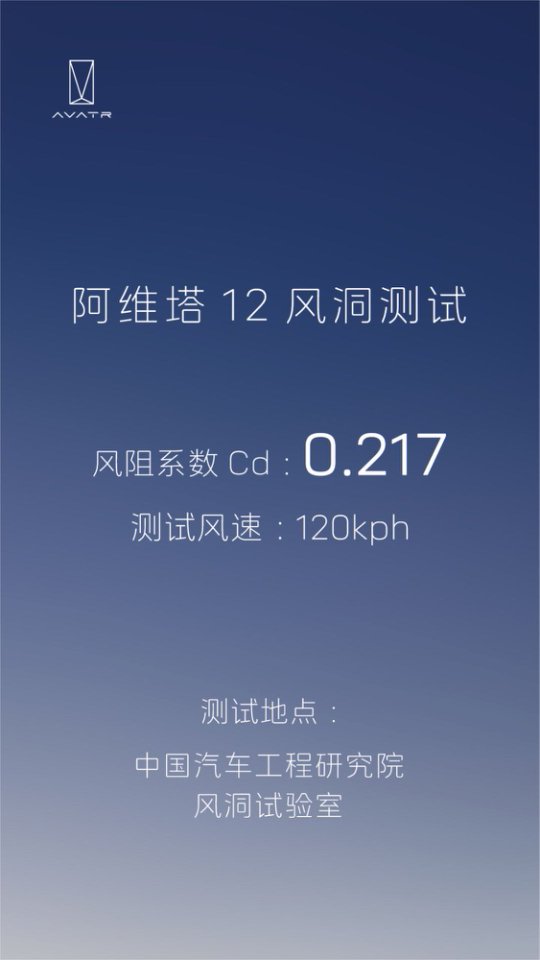
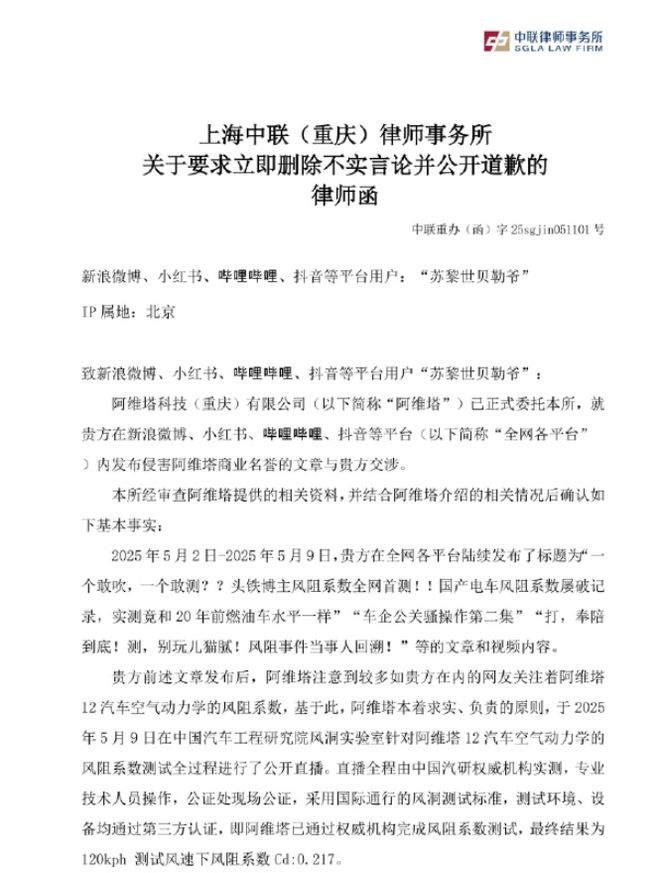
Core Viewpoint - The article discusses a legal dispute between Avita Technology and a social media influencer, "Zurich Beller," regarding false claims about the aerodynamic drag coefficient of Avita 12 vehicles, highlighting the importance of accurate testing and public perception in the automotive industry [1][2]. Group 1: Legal Actions and Claims - Avita Technology's legal department issued a letter demanding the influencer to delete false statements made about the aerodynamic drag coefficient testing of the Avita 12 vehicle and to publicly apologize [1]. - The influencer's posts included titles that questioned the credibility of Avita's testing and suggested manipulation of results, which Avita claims misled the public and harmed its reputation [2]. Group 2: Testing and Results - Avita conducted a live broadcast of the drag coefficient testing on May 9, 2025, at the China Automotive Engineering Research Institute, with results showing a drag coefficient (Cd) of 0.217 at a speed of 120 km/h, validated by a third-party authority [2]. - The testing process was conducted under internationally accepted standards, with professional oversight and public notarization, reinforcing the credibility of the results [2]. Group 3: Industry Context - The drag coefficient is a critical parameter in assessing a vehicle's aerodynamic efficiency, affecting fuel economy, range, stability at high speeds, and noise levels [5]. - Previous discussions by industry executives highlighted potential methods for optimizing drag coefficients, including both legitimate and questionable practices, indicating ongoing concerns about transparency in automotive testing [5].

汽车风阻系数被质疑造假,阿维塔发律师函:要求博主立即删帖,道歉声明连续置顶三十日
2 1 Shi Ji Jing Ji Bao Dao· 2025-05-12 03:35
Core Viewpoint - Avita Technology has taken legal action against the blogger "Zurich Beileye" for spreading false statements regarding the aerodynamic drag coefficient testing of the Avita 12 vehicle, demanding immediate removal of the content and a public apology [1][2][3]. Group 1: Legal Action and Response - Avita's legal notice requires "Zurich Beileye" to delete all posts and videos made between May 2, 2025, and May 10, 2025, that contain false claims about the Avita 12's aerodynamic testing [1][3]. - The notice also demands a public apology to be pinned on the blogger's social media accounts for 30 days to mitigate the negative impact on Avita's reputation [1][2]. Group 2: Testing and Results - Following the controversy, Avita conducted a live broadcast of the aerodynamic drag coefficient testing of the Avita 12 on May 9, 2025, at the China Automotive Engineering Research Institute [2][4]. - The testing was performed by a certified authority, with results showing a drag coefficient (Cd) of 0.217 at a test speed of 120 kph, adhering to international testing standards [2][4]. Group 3: Public Perception and Industry Context - The blogger's claims have drawn significant public attention, leading Avita to take proactive measures to clarify the situation and uphold its brand integrity [2][4]. - The drag coefficient is a critical parameter affecting vehicle performance, including fuel efficiency, range, stability at high speeds, and noise levels [6].
否认风阻系数造假,阿维塔发律师函:要求删除不实言论并公开道歉
Di Yi Cai Jing· 2025-05-12 03:18
Core Viewpoint - The company Avita Technology has requested the blogger "Zurich Beller" to delete false statements regarding the aerodynamic drag coefficient testing of the Avita 12 vehicle and to issue a public apology, which should be pinned on all social media platforms for thirty days [1][3][10]. Group 1: Legal Actions and Statements - Avita's legal department issued a lawyer's letter on May 12, demanding the immediate removal of false statements made by the blogger between May 2 and May 10 [1][3]. - The lawyer's letter claims that the blogger's posts have caused significant negative impact on Avita's brand and commercial reputation [3][10]. - If the demands are not met, Avita's legal team will pursue all possible legal actions, including civil litigation, with the blogger bearing all associated costs [10][11]. Group 2: Testing and Results - On May 9, Avita conducted a live broadcast of the aerodynamic drag coefficient testing of the Avita 12 at the China Automotive Engineering Research Institute's wind tunnel laboratory [2][8]. - The testing was performed by a recognized authority, with professional technicians operating the equipment, and the process was certified by a notary public, adhering to international wind tunnel testing standards [2][8]. - The final result of the drag coefficient at a wind speed of 120 kph was reported as Cd: 0.217 [2][8]. Group 3: Public Reaction and Misleading Information - Despite the authoritative testing and notarization, the blogger continued to publish content that Avita claims misleads the public and damages the company's reputation [3][9]. - The blogger's posts included provocative titles and insinuations that Avita manipulated the testing process, which Avita argues exceeds reasonable criticism and misleads the audience [3][9].