
流通股比例

Search documents
中金 • 全球研究:印尼应如何化解MSCI市场准入风险?
中金点睛· 2026-02-03 23:43
Core Viewpoint - Indonesia's stock market is at a critical turning point due to MSCI's warning about low liquidity and transparency, which could lead to a downgrade from emerging to frontier market status. However, proactive reforms by the Financial Services Authority, the stock exchange, and the sovereign wealth fund may create long-term advantages for Indonesia [1]. Group 1: MSCI Emerging Market Index Analysis - Indonesia's weight in the MSCI Emerging Market Index is approximately 1%, significantly lower than major markets like China, Taiwan, India, and South Korea. The situation worsened after MSCI decided to freeze adjustments for Indonesian companies, halting new additions and weight increases due to transparency issues [3]. - If transparency does not improve by May 2026, MSCI may downgrade Indonesia's weight or classify it as a frontier market, potentially leading to an outflow of $3 billion to $5 billion [3]. - Following MSCI's announcement, the Jakarta Composite Index dropped over 7% in late January 2026, resulting in a market capitalization loss of about $80 billion, highlighting the impact of low liquidity on market volatility [3]. Group 2: Market Reform Initiatives - In response to MSCI's concerns, the Financial Services Authority and the stock exchange are accelerating reforms, focusing on increasing the minimum float ratio from 7.5% to 15% starting February 2026. This aims to enhance market liquidity and reduce manipulation risks [4]. - The reform plan includes a phased approach, initially raising the float requirement for new listings to 10%, eventually targeting over 25% based on market capitalization. Monthly disclosures of float data will be implemented to improve transparency [4]. Group 3: Alternative Solutions for Quality Indonesian Companies - Even if the likelihood of a downgrade is low, it would significantly reduce Indonesia's attractiveness to global institutional investors, as many emerging market funds cannot invest in frontier market assets. This may lead to increased foreign capital outflow and lower market liquidity [5]. - Dual listings on more mature exchanges, such as the Hong Kong Stock Exchange or Singapore Exchange, could provide Indonesian companies with a risk-hedging strategy and maintain visibility in global markets [6]. - The inclusion of the Indonesian Stock Exchange in the "recognized securities exchange" list by the Hong Kong Stock Exchange from November 2023 simplifies the listing process for Indonesian companies, allowing access to significant capital from mainland China through the Southbound Trading mechanism [6].


印尼股市崩盘,发生了什么?
Hua Er Jie Jian Wen· 2026-01-28 10:49
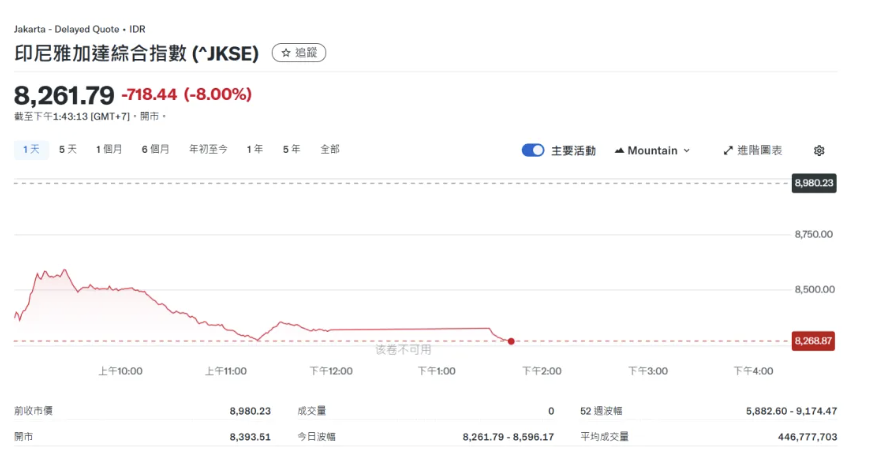
Core Viewpoint - The Indonesian stock market experienced a significant sell-off, with the Jakarta Composite Index dropping 7.4%, marking the largest single-day decline in over nine months, following MSCI's announcement to suspend certain index adjustments until regulatory issues regarding concentrated shareholding are addressed [1] Group 1: Market Reaction - The Jakarta Composite Index fell as much as 8.8% during trading, triggering a trading halt, with stocks expected to be included in the MSCI index suffering severe losses [1] - Foreign investors have begun to withdraw, with a net sell of $192 million in Indonesian stocks as of the week ending January 23, ending a streak of 16 consecutive weeks of net inflows [1] - The Indonesian exchange recorded a net outflow of approximately 30 trillion Indonesian rupiah (about $1.8 billion) on Wednesday morning [1] Group 2: MSCI's Warning - MSCI's decision is viewed as a warning signal rather than a final conclusion, with the market already pricing in potential negative outcomes [2] - The decision followed months of market consultation, with MSCI proposing stricter standards for the recognition of the free float of Indonesian securities [2] - The Indonesian exchange has committed to responding to MSCI's requirements for increased market transparency and will collaborate to seek consensus [2] Group 3: Structural Issues - The issue of free float has become a focal point for the Indonesian stock market, with the Jakarta Composite Index outperforming the MSCI Indonesia Index last year, highlighting concerns over liquidity mismatches [3] - Indonesian regulators are planning to gradually raise the minimum free float requirement from the current 7.5% to a long-term target of 25%, although no clear timeline has been set [3] - Comparatively, the minimum free float requirements in markets like Hong Kong and India are set at 25%, and Thailand at 15% [3] Group 4: Economic Concerns - MSCI's decision may exacerbate concerns regarding Indonesia's economic development path, with investor confidence already fragile due to macroeconomic uncertainties [4] - Recent political changes, including the dismissal of the long-serving finance minister, have raised market unease [4] - The Indonesian government is exploring mechanisms from other countries to enhance local exchange transparency [4]
流通股比例亚太最低!MSCI将审核印尼股市,或导致20亿美元流出“东南亚最大股市”
Hua Er Jie Jian Wen· 2026-01-20 06:14
Core Viewpoint - MSCI is considering tightening the definition of free float shares, which could lead to over $2 billion in capital outflows from the Indonesian stock market, affecting investor confidence and capital flows significantly [1][2]. Group 1: Impact of Proposed Changes - The proposed new rules by MSCI may reduce the free float market capitalization of 15 constituent stocks, leading to an estimated outflow of around $2 billion from foreign passive funds if implemented [2]. - Indonesia's benchmark index has the lowest average free float ratio among major Asia-Pacific indices, with over 200 stocks having a free float ratio below 15% [2]. - The Jakarta Composite Index has seen a record high increase of over 22% last year, while the MSCI Indonesia Index declined by 3%, indicating a significant divergence between the two indices [1][2]. Group 2: Regulatory Challenges - Regulatory bodies are attempting to address concerns by raising the minimum free float requirement from 7.5% to a range of 10%-15%, with a long-term goal of 25%, but no timeline has been set [3]. - Current tax regulations in Indonesia encourage companies to hold shares for at least three years without paying income tax on reinvested dividends, which complicates the identification of truly publicly held shares [3]. - Even if companies increase the number of tradable shares, the market may still lack the liquidity needed to absorb new stocks, as institutional investors remain selective and retail investors may not have sufficient funds [3]. Group 3: Investor Sentiment - Despite the potential for capital outflows, some investors believe in the long-term growth potential of the Indonesian market, viewing it as too attractive for index providers to continue reducing weight [4]. - The low free float ratio has led to a divergence in indices, causing fund managers to incur costs as the Jakarta Composite Index cannot effectively track due to low trading volumes [4][5]. - Financial regulators are preparing stricter rules for smaller companies going public, indicating a move towards greater transparency and governance improvements in the Indonesian market [5].
