消费贷利率调整

Search documents
信用卡拐点之际:流通卡收缩,建行成首家信用卡贷款规模破万亿银行丨年报观察
Xin Lang Cai Jing· 2025-04-02 13:21
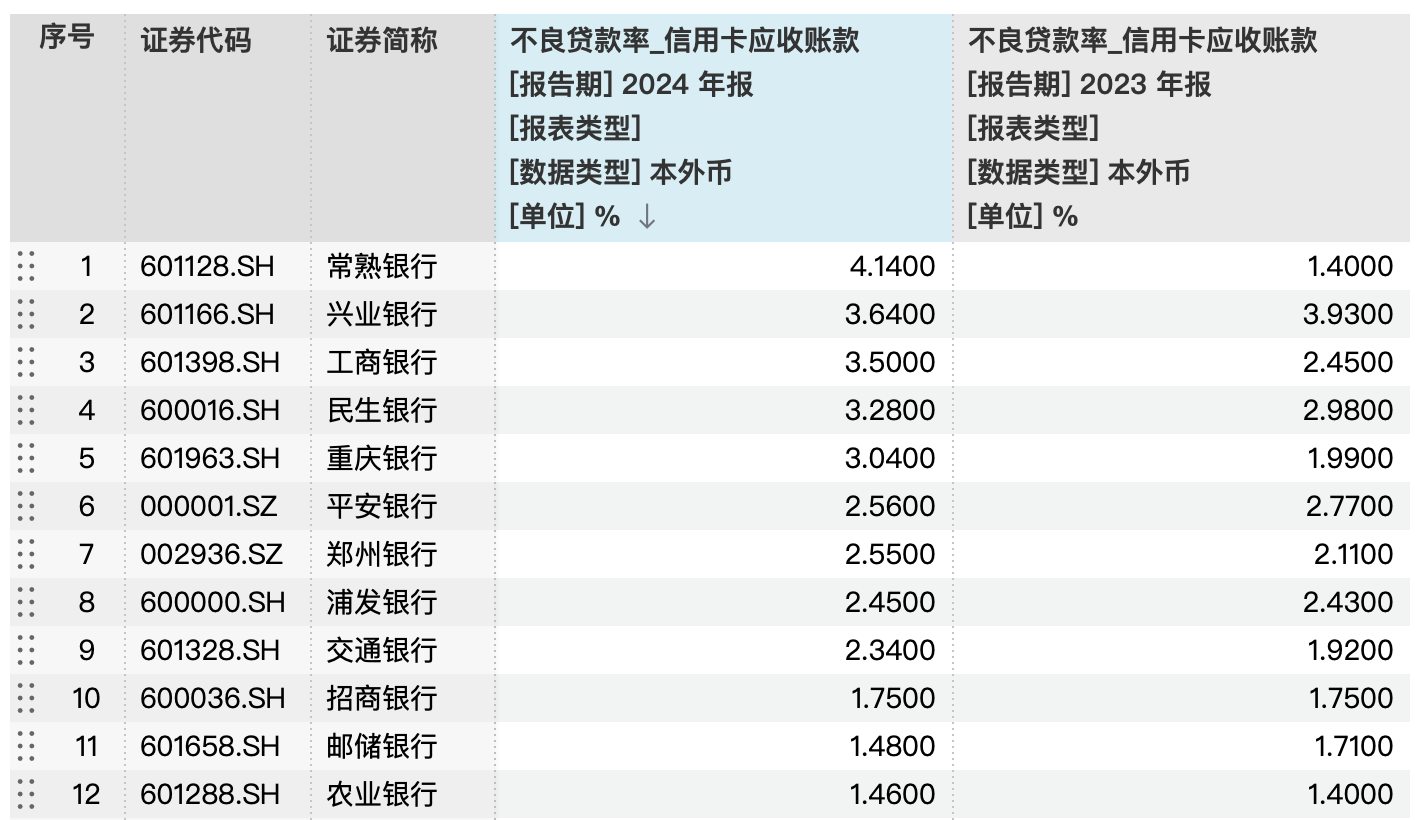
Core Insights - The credit card business in China is facing challenges, with a notable decline in transaction volumes and an increase in non-performing loans, despite some banks like China Construction Bank achieving significant growth in credit card loan balances [1][4][8]. Group 1: Credit Card Loan Balances - China Construction Bank (CCB) has become the first bank in the country to surpass 1 trillion yuan in credit card loans, reaching 1.07 trillion yuan in 2024, an increase of 688 billion yuan from the end of 2023 [2][3]. - Agricultural Bank of China (ABC) showed the most significant growth in credit card loans, increasing by 1.587 billion yuan, with its share in personal loans rising from 8.67% to 9.73% [3]. - Ping An Bank experienced a substantial reduction in credit card loans, with a balance of 435 billion yuan, down 791 billion yuan year-on-year, leading to a decrease in its share of personal loans from 25.99% to 24.62% [3]. Group 2: Asset Quality and Non-Performing Loans - The overall asset quality of credit card loans has deteriorated, with banks like Changshu Bank and Chongqing Bank reporting significant increases in non-performing loan ratios, rising to 4.14% and 3.04% respectively [4][5]. - The total amount of overdue credit card loans reached 123.964 billion yuan by the end of 2024, marking a year-on-year increase of 26.32% [5]. Group 3: Market Trends and Consumer Behavior - The total number of credit cards in circulation has decreased significantly, dropping from 807 million in mid-2022 to 727 million by the end of 2024, a reduction of 80 million cards [8]. - Credit card transaction volumes have also declined, with major banks like China Merchants Bank and Ping An Bank reporting decreases in credit card spending of approximately 390 billion yuan and 460 billion yuan respectively [8][10]. - The shift towards consumer loans is evident, with several banks reporting an increase in the proportion of consumer loans within their personal loan portfolios, indicating a strategic pivot in response to market conditions [11][12]. Group 4: Strategic Adjustments by Banks - Some banks are restructuring their credit card operations, with China Merchants Bank and Ping An Bank focusing on high-quality customer acquisition and adjusting their credit card issuance strategies [8][10]. - Traffic Bank is transitioning to a localized management model for its credit card business, aiming to provide integrated financial services to better meet customer needs [10].







李嘉诚旗下长和突然公告!三桶油合计日赚近10亿!多家银行停发3%以下消费贷!四家国有大行集体官宣!金价再创历史新高!
新浪财经· 2025-03-31 01:09
Group 1: Cheung Kong Holdings Announcement - Cheung Kong Holdings announced that its board is aware of media reports regarding a potential spin-off of its global telecommunications assets and operations [2] - The company is exploring opportunities to enhance long-term shareholder value, including possible transactions related to its global telecommunications business [2][3] - As of the announcement date, no decisions have been made regarding any transactions related to the global telecommunications business [3] Group 2: China National Petroleum Corporation (CNPC) Financial Results - CNPC reported a record net profit of 1646.8 billion yuan for 2024, a 2.0% increase year-on-year, with total revenue reaching 2.9 trillion yuan [7][8] - The company declared a total dividend of approximately 860.2 billion yuan for the year, with a payout ratio of 52.2%, marking the highest level in history [8] - The combined net profit of the "Big Three" oil companies exceeded 352.9 billion yuan, averaging about 9.7 billion yuan per day [9] Group 3: Consumer Loan Rate Adjustments - Several banks have begun to suspend the issuance of consumer loans with interest rates below 3%, effective April 1 [11][12] - The move is part of a strategy to balance market expansion with risk control, as low-interest loans may overlook borrowers' repayment capabilities [12] - The competitive landscape for consumer loans has intensified, prompting banks to focus on attracting high-quality customers [12] Group 4: State-Owned Banks Capital Raising - Four major state-owned banks announced plans to issue A-shares to raise a total of 520 billion yuan for core tier-one capital replenishment [14][15] - The capital raising is seen as a proactive measure to strengthen the banks' capital bases and enhance their ability to serve the real economy [16] - The issuance plans require approval from shareholders, regulatory bodies, and stock exchanges before implementation [16] Group 5: Country Garden Financial Results - Country Garden reported total revenue of approximately 252.8 billion yuan for 2024, with a significant reduction in net loss to about 35.1 billion yuan compared to 178.4 billion yuan in 2023 [23][24] - The company delivered over 380,000 housing units in 2024, covering 31 provinces and 242 cities [24] - Country Garden is currently negotiating debt restructuring plans with creditors [24]




上调!叫停!消费贷利率或迎重要变化
证券时报· 2025-03-30 04:00
Core Viewpoint - The article discusses the upcoming increase in annualized interest rates for consumer loans, with many banks expected to raise rates to no less than 3% starting in April 2025, potentially phasing out existing products with rates below this threshold [1][2]. Group 1: Interest Rate Changes - Multiple banks have received notifications to raise the annualized interest rates for consumer loans to a minimum of 3% starting April 2025, leading to urgent actions by bank staff to inform customers to withdraw funds before the deadline [1][2]. - Existing consumer loan products with interest rates below 3% are likely to be discontinued, prompting banks to encourage customers to withdraw or test their loan limits before the new rates take effect [2][3]. Group 2: Market Competition and Rate Trends - The consumer loan market has seen intense competition since 2025, with many banks offering rates below 3%, some as low as 2.4%, which is below the central bank's one-year loan market quotation rate [4]. - Banks like Ningbo Bank and others have introduced promotional activities, with rates as low as 2.49% and various incentives to attract customers [4]. Group 3: Expert Opinions and Regulatory Insights - Experts express concerns about the negative implications of excessively low consumer loan rates, including the risk of consumers overextending themselves financially and the potential misuse of loan funds [5]. - The central economic work conference in December 2024 emphasized the need for financial institutions to avoid "involution" competition and maintain reasonable loan rates to ensure commercial sustainability [6].

银行突发:上调!叫停!
券商中国· 2025-03-30 02:15
Core Viewpoint - Starting from April 2025, the annual interest rate for credit consumer loan products will be raised to no less than 3%, potentially leading to the discontinuation of existing products with rates below 3% [2][4]. Group 1: Interest Rate Changes - Multiple banks have received notifications to increase the annual interest rate for credit consumer loans to a minimum of 3% starting in April 2025, with existing products below this threshold likely to be phased out [2][4]. - Banks are actively contacting customers who have applied for loans with rates below 3%, urging them to withdraw funds before the deadline of March 31, 2025 [2][3]. Group 2: Market Competition - The consumer loan market has seen intense competition since 2025, with many banks offering loans at rates below 3% to capture market share, with some rates dropping as low as 2.4% [4]. - Banks like Ningbo Bank are offering promotional rates as low as 2.49%, and other banks are providing limited-time coupons to attract borrowers [4]. Group 3: Consumer Behavior and Risks - Experts warn that excessively low personal consumer loan rates may lead to negative consequences, such as consumers taking on debt without proper consideration of their financial situation [5]. - The central economic work conference in December 2024 emphasized the need for financial institutions to avoid "involution" competition and maintain reasonable loan rates to ensure sustainable business practices [5].