
液氧甲烷技术

Search documents
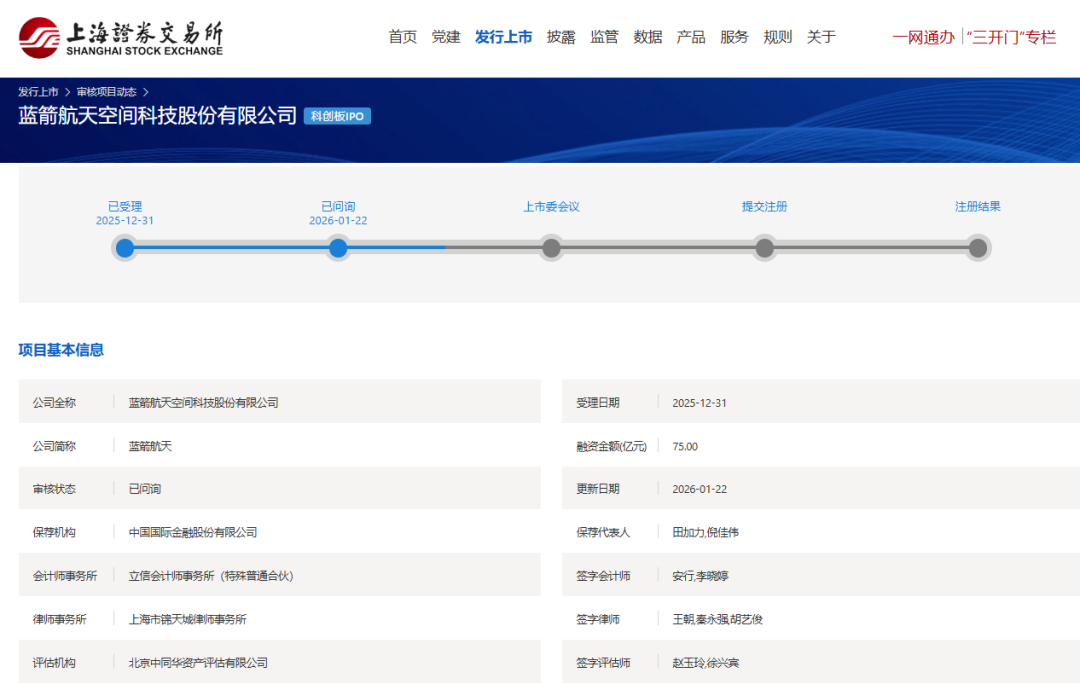
冲击商业航天第一股,蓝箭航天IPO审核状态变更为“已问询”
2 1 Shi Ji Jing Ji Bao Dao· 2026-01-23 07:04
Core Viewpoint - Blue Arrow Aerospace is progressing towards its IPO on the Sci-Tech Innovation Board, marking a significant step in the commercial rocket sector in China, with several other companies also pursuing IPOs [1][4]. Group 1: Company Information - Blue Arrow Aerospace has changed its IPO review status to "inquiry" as of January 22, 2026, after being accepted on December 31, 2025 [2]. - The company aims to raise 7.5 billion yuan (approximately 1.1 billion USD) through its IPO, with funds allocated for projects enhancing reusable rocket capacity and technology [2]. - The company is backed by China International Capital Corporation and has engaged Lixin Accounting Firm and Shanghai Jintiancheng Law Firm for auditing and legal services, respectively [2]. Group 2: Technology and Competitive Edge - Blue Arrow Aerospace has adopted a liquid oxygen-methane technology path, with its self-developed "Tianque" liquid oxygen-methane engine considered a core competitive advantage [3]. - Compared to traditional liquid oxygen-kerosene and solid fuels, liquid oxygen-methane offers lower costs, easier maintenance, and greater potential for reusability, making it an ideal choice for next-generation reusable rockets [3]. - The Zhuque-2 series rockets have successfully completed four flight missions, successfully placing commercial satellites into orbit, with contracts signed with China Star Network and Yuanxin Satellite for satellite launch services [3]. Group 3: Industry Context - In addition to Blue Arrow Aerospace, several other commercial rocket companies are also in the process of pursuing IPOs, including Zhongke Aerospace, Xinghe Power, Tianbing Technology, and Interstellar Glory, indicating a growing trend in the commercial space sector [1][4].

商业火箭专题-聚焦技术突破-重构全球格局
2026-01-15 01:06
Summary of Key Points from the Conference Call Industry Overview - The focus is on the commercial space launch industry, particularly advancements in rocket technology and the competitive landscape between the United States and China [1][4][21]. Core Insights and Arguments - **Rocket Engine Importance**: Rocket engines are critical components, accounting for 30%-50% of the total rocket cost. Solid fuel engines are simpler and have shorter launch cycles but are less controllable and have lower payload capacities. Liquid fuel engines offer better control and higher payload capacities but are more complex and have longer launch cycles [1][5]. - **Global Launch Statistics**: In 2025, there are expected to be 341 global space launches, a 25% increase from 2024. The U.S. leads with 211 launches, while China is expected to conduct 90 launches. The U.S. accounts for 84% of the total payload mass launched, significantly outpacing China, which holds only 10% [1][6][7]. - **SpaceX's Dominance**: SpaceX is the leader in the U.S. commercial space sector, with 92% of its launches being commercial payloads. The company has significantly reduced launch costs through technological innovations, including reusable rocket technology [1][8][9]. - **Financial Projections for SpaceX**: SpaceX's revenue is projected to reach $13.1 billion in 2024, with Starlink contributing $8.2 billion. The company's valuation is expected to rise to $800 billion by 2025, with an IPO planned for 2026 targeting a valuation of $1.5 trillion [1][8]. - **Cost Reduction through Reusability**: The Falcon 9 rocket's reusability has led to a significant reduction in launch costs. The cost per kilogram dropped from $1,867.82 to $1,063 after nine reuses, representing a 43% reduction compared to single recovery and a 63% reduction compared to non-recovery [1][11]. Other Important but Potentially Overlooked Content - **Technological Gaps**: China is working to close the technological gap with the U.S. in reusable rocket technology and liquid oxygen-methane engine technology. Companies like Blue Arrow Aerospace and others are making progress, but significant advancements are still needed [4][21][22]. - **Domestic Market Valuations**: Major Chinese commercial space companies have valuations significantly lower than their U.S. counterparts, with Tianming Technology valued at 22.5 billion yuan and Blue Arrow Aerospace at 22 billion yuan, compared to SpaceX's $800 billion valuation [4][18][19]. - **Future Directions**: The next two years are expected to see breakthroughs in China's reusable technology and advancements in full-flow staged combustion cycle engines, which could reshape the global commercial space landscape [22].