
可回收技术

Search documents
今日起更名生效!火箭密集发射季,资金大举流入卫星ETF招商(159218)
Sou Hu Cai Jing· 2026-02-27 02:17
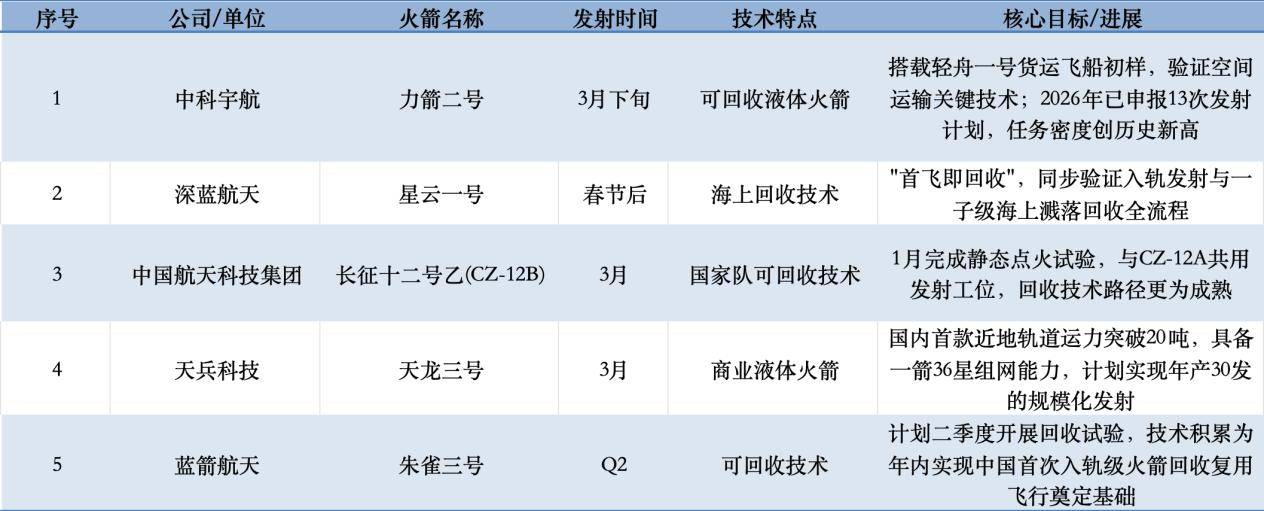
Core Viewpoint - The Chinese commercial space market is experiencing significant growth, with multiple companies preparing for IPOs and advancements in reusable rocket technology, indicating a shift from concept validation to large-scale implementation [1] Group 1: Market Dynamics - The first satellite industry ETF in the market has been renamed to "Satellite ETF Zhaoshang (159218)" and has seen over 200 million yuan net inflow in the past five days, reflecting increasing market interest [1] - A rare "rocket launch season" is expected in March, with at least six new rockets scheduled for launch globally, marking a critical transition in the space industry from experimental validation to large-scale application [1][2] Group 2: Reusable Rocket Technology - Reusable rockets are entering a critical phase in China, with a dual-drive model involving both state-owned and private enterprises expected to launch five rockets around March [2] - The economic value of reusable technology is highlighted by the cost reduction of SpaceX's Falcon 9 rocket, where the launch cost drops from $50 million to $20 million through booster reuse, achieving a 60% reduction [4] - The cost per kilogram to orbit can decrease by over 70% with multiple reuses of boosters, making reusable rockets essential for competitive positioning in the global low Earth orbit market [5] Group 3: Satellite Industry Evolution - The global satellite industry is undergoing a transformation, with accelerated network deployment and expanded application scenarios, transitioning from a focus on communication to becoming a "distributed space cloud server" [6] - By 2026, China is expected to enter a high-frequency satellite internet deployment phase, with significant projects like the Thousand Sails and GW constellations [6] - The satellite internet industry in China is projected to grow from approximately 28 billion yuan in 2023 to over 51.6 billion yuan by 2028, indicating a shift in the value chain towards operational services and data applications [6] Group 4: Investment Perspective - The successful commercialization of reusable rockets is anticipated to create a positive feedback loop in the satellite industry, with launch costs dropping below $20 million enabling the economic viability of low Earth orbit satellite constellations [7] - The Satellite ETF Zhaoshang (159218) covers the entire satellite industry chain, including manufacturing, launch, ground equipment, and operational services, aligning with the current development phase of the industry [8]

高华科技:公司产品主要应用于全箭遥测及控制系统、火箭贮箱、火箭发动机、试车台、发射靶场等场景
Zheng Quan Ri Bao Wang· 2026-02-12 11:44
Core Viewpoint - The company is actively advancing its technology and product applications in the aerospace sector, focusing on telemetry and control systems, rocket storage tanks, rocket engines, test stands, and launch sites [1] Group 1: Company Developments - The company confirmed that its technology research and development, product adaptation, and market application in the aerospace field are progressing as planned [1] - The company aims to continuously deepen its involvement in the aerospace support sector to enhance its core technological competitiveness [1] Group 2: Industry Focus - The company is committed to supporting the realization of reusable technology within the aerospace industry [1]
商业航天需要冲刺也需要耐心
Bei Jing Shang Bao· 2026-01-18 15:11
Core Viewpoint - The commercial aerospace sector in China is experiencing significant growth and interest, driven by government support and increasing demand for satellite launches, despite facing high risks and challenges in profitability [1][2][4]. Group 1: Industry Overview - The commercial aerospace sector has been included in government work reports for two consecutive years, indicating strong policy support [1]. - The market is witnessing a surge in demand, with China submitting an application for an additional 203,000 satellites to the International Telecommunication Union, significantly surpassing SpaceX's Starlink application total [1]. - The sector is characterized by a dual structure of state-owned and private enterprises, exemplified by the GW and Qianfan constellations, which enhances market opportunities [2]. Group 2: Company Developments - Star River Dynamics publicly apologized for the failure of its first flight test of the Ceres II rocket, highlighting the challenges faced by companies in the sector [1]. - Other companies like Blue Arrow Aerospace, Tianbing Technology, and Interstellar Glory are also pursuing IPOs, competing to become China's "first commercial aerospace stock" [1]. - The industry is under pressure to adopt reusable rocket technology to reduce costs and meet the increasing demand for satellite launches [2]. Group 3: Market Dynamics - The commercial aerospace industry is seen as a high-risk, high-technology field with long investment return cycles, which has historically limited the number of commercial launch contracts [2]. - The recent failures in flight tests, such as the Zhuque-3 recovery attempt, reflect the ongoing challenges and the need for product optimization and iteration [3]. - The market is currently experiencing a mix of excitement and caution, with a need for quality investments amidst potential market corrections and scrutiny of companies for compliance and performance issues [4].
超捷股份(301005) - 2026年01月15日投资者关系活动记录表
2026-01-15 13:20
Group 1: Company Overview - The company focuses on the research, production, and sales of high-strength precision fasteners and special connectors, primarily used in automotive key components such as turbocharging systems and exhaust systems [2] - In the field of new energy vehicles, products are applied in battery trays, chassis, and electric control inverters [2] Group 2: Commercial Aerospace Business - The commercial aerospace business includes manufacturing rocket body structural components, with production lines completed in 2024 [3] - The company aims to optimize customer structure, expand production capacity, and deepen product categories in the commercial aerospace sector [3] Group 3: Team Advantages and Industry Barriers - The core team has over 40 years of experience in rocket manufacturing, ensuring a strong foundation for the business [3] - The commercial aerospace industry has significant entry barriers, including high technical requirements, talent scarcity, and substantial capital investment [4] Group 4: Production Capacity and Market Impact - The company has a production capacity of 10 rocket bodies per year, with the ability to increase capacity based on order demand [4] - Structural components account for over 25% of the total cost of a commercial rocket [3] Group 5: Future Trends and Technology - The maturity of reusable technology is expected to enhance the frequency and economic viability of launches, potentially increasing demand for new rocket body structural components [5] - Continuous tracking of advanced manufacturing technologies, including 3D printing, is planned to assess their impact on product structure and manufacturing systems [4]
商业火箭专题-聚焦技术突破-重构全球格局
2026-01-15 01:06
Summary of Key Points from the Conference Call Industry Overview - The focus is on the commercial space launch industry, particularly advancements in rocket technology and the competitive landscape between the United States and China [1][4][21]. Core Insights and Arguments - **Rocket Engine Importance**: Rocket engines are critical components, accounting for 30%-50% of the total rocket cost. Solid fuel engines are simpler and have shorter launch cycles but are less controllable and have lower payload capacities. Liquid fuel engines offer better control and higher payload capacities but are more complex and have longer launch cycles [1][5]. - **Global Launch Statistics**: In 2025, there are expected to be 341 global space launches, a 25% increase from 2024. The U.S. leads with 211 launches, while China is expected to conduct 90 launches. The U.S. accounts for 84% of the total payload mass launched, significantly outpacing China, which holds only 10% [1][6][7]. - **SpaceX's Dominance**: SpaceX is the leader in the U.S. commercial space sector, with 92% of its launches being commercial payloads. The company has significantly reduced launch costs through technological innovations, including reusable rocket technology [1][8][9]. - **Financial Projections for SpaceX**: SpaceX's revenue is projected to reach $13.1 billion in 2024, with Starlink contributing $8.2 billion. The company's valuation is expected to rise to $800 billion by 2025, with an IPO planned for 2026 targeting a valuation of $1.5 trillion [1][8]. - **Cost Reduction through Reusability**: The Falcon 9 rocket's reusability has led to a significant reduction in launch costs. The cost per kilogram dropped from $1,867.82 to $1,063 after nine reuses, representing a 43% reduction compared to single recovery and a 63% reduction compared to non-recovery [1][11]. Other Important but Potentially Overlooked Content - **Technological Gaps**: China is working to close the technological gap with the U.S. in reusable rocket technology and liquid oxygen-methane engine technology. Companies like Blue Arrow Aerospace and others are making progress, but significant advancements are still needed [4][21][22]. - **Domestic Market Valuations**: Major Chinese commercial space companies have valuations significantly lower than their U.S. counterparts, with Tianming Technology valued at 22.5 billion yuan and Blue Arrow Aerospace at 22 billion yuan, compared to SpaceX's $800 billion valuation [4][18][19]. - **Future Directions**: The next two years are expected to see breakthroughs in China's reusable technology and advancements in full-flow staged combustion cycle engines, which could reshape the global commercial space landscape [22].
超捷股份(301005) - 2026年01月09日投资者关系活动记录表
2026-01-09 10:20
Group 1: Automotive Business Overview - The company focuses on the research, production, and sales of high-strength precision fasteners and special connectors, primarily used in automotive engine turbocharging systems, transmission control systems, exhaust systems, and other key components [2][3] - In the new energy vehicle sector, products are applied in battery trays, chassis and body connections, electric control inverters, and battery swapping systems [3] Group 2: Competitive Landscape - The automotive fastener market has a low entry barrier with many small to medium-sized enterprises; however, only large manufacturers can pass the qualification audits of Tier 1 customers, leading to market share concentration among top companies [3] Group 3: Revenue Growth and Challenges - The company's automotive revenue growth is supported by advantages such as quality customer resources, rich technical experience, quality control capabilities, stable supply capacity, and better customer service [3] - Despite significant revenue growth in recent years, profit margins have declined due to factors such as a slowdown in the automotive industry in H1 2023, rising material costs since H2 2021, and increased depreciation from the Wuxi project [3][4] Group 4: Future Growth Directions - Future growth in the automotive sector includes expanding exports, developing new customers (e.g., NIO, BYD), product category expansion, and increasing domestic market share [4] Group 5: Commercial Aerospace Business Overview - The commercial aerospace segment focuses on manufacturing structural components for commercial rockets, including major sections, fairings, and engine parts, with production lines completed in 2024 [4][5] - Structural components account for over 25% of the cost of a commercial rocket [4] Group 6: Barriers to Entry in Aerospace - The aerospace sector has high technical, talent, and financial barriers, requiring advanced technology, skilled personnel, and significant capital investment for production line construction [5] Group 7: Production Capacity and Future Prospects - The company has completed a riveting production line with an annual capacity of 10 rockets, with the ability to increase capacity based on order demand [5][6] - The maturity of reusable technology is expected to enhance launch frequency and operational efficiency, creating new business growth opportunities [6]
超捷股份(301005) - 2026年01月08日投资者关系活动记录表
2026-01-08 13:24
Group 1: Business Overview - The company focuses on commercial aerospace, primarily manufacturing rocket structural components, including major segments like shells, fairings, and engine parts [2][3] - In 2024, the company completed its production line construction with an annual capacity of 10 rockets, which can be increased based on order demand [2][3] Group 2: Market Dynamics - The rocket structural component manufacturing sector is currently experiencing a supply shortage, which is a bottleneck for rapid industry growth [3] - The market is expected to maintain a supply-demand imbalance, with a growing capacity gap anticipated in the coming year [3] Group 3: Competitive Landscape - There are limited suppliers capable of large-scale delivery in the domestic market, primarily located in regions like Beijing-Tianjin-Hebei, Chengdu-Chongqing, and Shandong [3] - The industry has high technical barriers, requiring specialized knowledge and experience, often from teams with "national team" backgrounds [3][4] Group 4: Company Advantages - The company has established stable, small-batch product deliveries to leading private rocket companies, gaining valuable R&D and manufacturing experience [3] - Key advantages include a skilled workforce with extensive experience in the aerospace sector and financial resources for equipment purchases and production line construction [3] Group 5: Technological Considerations - 3D printing technology has specific applications in aerospace but is limited for large structural components due to size and cost constraints [3][4] - The company will continue to monitor advancements in manufacturing technologies, including 3D printing, to assess their potential impact on product structure and manufacturing systems [3] Group 6: Future Growth and Challenges - The introduction of reusable rocket technologies is expected to enhance launch frequency and operational efficiency, potentially increasing demand for new rocket structural components [4] - The manufacturing of rocket structural components is capital-intensive, requiring stable financial support for production line development [4] Group 7: Automotive Business Insights - The company also manufactures high-strength precision fasteners for the automotive industry, with applications in various critical components [7][8] - The automotive sector has shown steady growth, with revenue increasing year-on-year, despite some temporary impacts from capacity adjustments [8][9] Group 8: Strategic Growth Opportunities - Future growth in the automotive sector may come from expanding exports and developing new customer relationships, particularly with key players like NIO and BYD [10][11] - The company aims to enhance its product offerings and increase the value per vehicle through diversification and increased market share [11]
星辰大海万亿征途-看好商业航天新纪元
2025-12-29 15:51
Summary of Conference Call Records Industry Overview - The commercial aerospace market is projected to reach a scale of 1.5 trillion by 2025, with an accelerated launch schedule by the end of the year indicating a strong growth trajectory for 2026, including potential IPOs of major companies and the maturation of reusable technology, positioning commercial aerospace as a key investment theme [1][2] Key Companies and Investment Opportunities 1. Changjiang Communication - Holds a 15% stake in Changfei Optical Fiber, corresponding to a market value of approximately 15 billion, currently in a state of market value inversion [6] - Deeply tied to Shanghai Yanjin, expected to generate 1-1.5 billion in new optical station construction revenue from overseas expansion in 2026 [6] - Established a satellite team to develop baseband and communication data transmission equipment, and won a project for vehicle-mounted terminals for emergency departments, with a market potential of approximately 6-10 billion nationwide [6] 2. Aerospace Intelligent Equipment - Affiliated with the Fifth Academy of Aerospace, comparable in importance to China Satellite, focusing on Hall thrusters and attitude control systems, backed by 502 Institute, and is the sole supplier with a strong core positioning advantage [6] 3. Fudan Microelectronics - FPGA technology recognized by China Star Network, positioned well in the satellite sector with promising future prospects [6] 4. Xingtong Measurement and Control - A core subsidiary of Zhongke Xingtong, listed on the Beijing Stock Exchange, integrating AI algorithms for aerospace simulation and situational awareness, planning to deploy nearly 200 satellites over five years, with the first two low-orbit satellites expected to launch in the first half of 2026 [8] 5. Other Notable Companies - **Yukede**: Becomes the only data center service provider for the Beijing Social Science Committee-led space data center innovation consortium, providing computing infrastructure and operational services [9] - **Xinwei Communication**: Strong prospects in commercial aerospace, collaborating with Starlink and Amazon's Project Cooper, with revenues from Starlink reaching several hundred million this year [11] Industry Trends and Challenges - The commercial aerospace sector currently faces a talent supply shortage, with existing companies in the core supply chain maintaining a first-mover advantage. New entrants face challenges such as satellite verification and a lack of skilled personnel [9] - The demand for satellite launches is expected to rise rapidly, with a total of 20,000 satellites needed by 2025, indicating significant growth potential in the sector [9] Additional Insights - The integration of AI in aerospace applications is expected to enhance operational capabilities and situational awareness, indicating a trend towards more advanced technological solutions in the industry [8] - The collaboration between companies like Jun Da and Youyi Optical is crucial for meeting stringent space application requirements and validating materials for aerospace use [13]
超捷股份(301005) - 2025年12月15日投资者关系活动记录表
2025-12-15 10:52
Group 1: Commercial Space Business Development - The company is conducting feasibility studies for the production line of commercial rocket fuel tanks, focusing on compatibility and investment efficiency based on market trends and customer needs [2] - The maturity of reusable technology is expected to enhance launch frequency and operational efficiency, leading to increased demand for new rocket structures, thus creating new business growth opportunities [4] - The company is actively expanding its customer base in the commercial space sector and has made substantial progress, with new customer orders expected to enter mass cooperation in Q1 of the following year [4] Group 2: Manufacturing Capabilities and Market Position - The company completed the construction of a riveting production line in the first half of 2024, with an annual capacity of 10 units, and is prepared to expand capacity based on order demand [4] - The manufacturing of rocket structural components is currently constrained by supply, with a limited number of suppliers capable of large-scale delivery, indicating a strong market position for the company [5] - The company has established stable, small-batch product deliveries to leading private rocket companies, leveraging its experienced team and financial resources for equipment purchases and production line construction [5] Group 3: Aerospace and Automotive Business Performance - The aerospace business has shown improvement due to recovering customer demand and product optimization, with ongoing efforts to enhance production organization and delivery capabilities [6] - The automotive sector has experienced stable revenue growth, although profit margins have fluctuated due to material cost increases and depreciation from new projects [7] - The company anticipates enhanced profitability in the automotive sector by 2026, driven by optimized capacity structure and increased high-value product ratios [8] Group 4: Growth Drivers in Automotive Sector - Key growth drivers for the automotive business include expanding exports, new customer development, product category expansion, and increased industry concentration [8] - Strategic partnerships with international suppliers like Magna, Valeo, and Bosch provide a solid foundation for overseas market expansion [8]
可完全回收的亚微米打印晶体管问世
Ke Ji Ri Bao· 2025-10-20 23:42
Core Insights - Duke University scientists have developed fully functional carbon-based transistors at the sub-micron scale using printing technology, which are comparable in performance to industry standards and fully recyclable [1] - This breakthrough could have a profound impact on the $150 billion electronic display industry and contribute positively to environmental protection [1] Group 1: Manufacturing Technology - The new printing method utilizes carbon nanotubes, graphene, and nanocellulose inks to create various thin-film transistor architectures on substrates like silicon, glass, and even paper [2] - The team overcame previous limitations of aerosol jet printing technology, which could not produce patterns smaller than 10 microns, by developing a "high-precision capillary printing" system [1][2] Group 2: Industry Impact - The new sub-micron printed TFTs are close to meeting the requirements for driving OLED displays, which require at least two transistors to control each pixel [2] - This technology could lead to disruptive changes in the electronic display field, as every electronic display contains a large array of micro thin-film transistors to control each pixel [2] Group 3: Environmental Benefits - The printing process is more energy-efficient and results in lower greenhouse gas emissions compared to traditional TFT manufacturing methods [3]