
深度价值派

Search documents
自己赚了9位数,客户10年方回本:一个私募的残酷启示录
Xin Lang Cai Jing· 2026-01-16 04:41
Core Insights - The article narrates the story of a private equity founder and fund manager who, despite a successful personal investment history, faced significant challenges with a specific fund that took ten years for investors to break even [2][7][25] - The narrative highlights the importance of a systematic investment approach and the pitfalls of emotional decision-making under pressure [11][12][15] Group 1: Fund Performance - The fund, launched in 2014-2015 with over 80 million, failed to deliver returns, with most investors only recovering their principal by 2025 [4][7] - Many investors exited early due to severe net value fluctuations and long-term losses, as the fund lacked a 20% stop-loss mechanism [8][9] Group 2: Investment Strategy - The fund manager's decision to heavily invest at market peaks was influenced by external pressures, leading to a lack of a validated long-term profit system [11][12] - The article emphasizes that investing at market highs typically results in lower value propositions, and a mature investment system should prioritize win rates and risk-reward ratios over anxiety and rankings [13][14] Group 3: Client Management - The fund manager did not treat client funds as his own, leading to a misalignment of interests, as he maintained a high exposure to the market despite its risks [16][18] - The article suggests that a successful wealth management approach requires aligning the interests of the manager and the clients, ensuring that client funds are managed with the same care as personal investments [20][26] Group 4: Investment Timing - The article discusses the challenge of managing funds from investors who enter at different times, advocating for tailored strategies based on the timing of investments [21][22] - It highlights the necessity of adopting conservative strategies for newer investors without a safety net, contrasting with strategies for those who entered the market earlier [24][28]


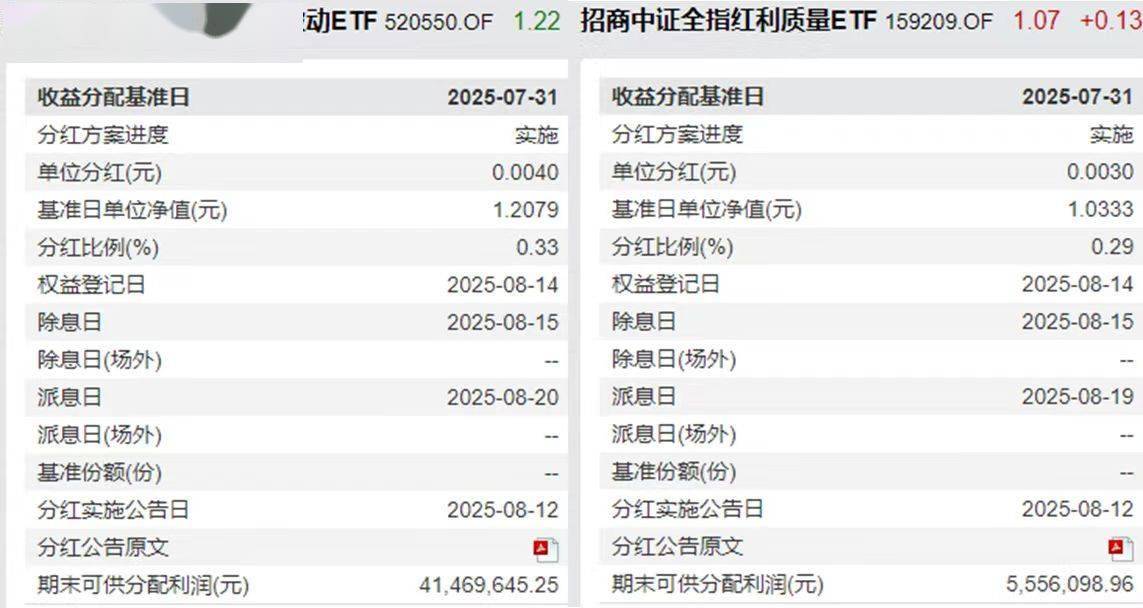
双红利ETF同步分红!港股红利低波ETF(520550)、中证红利质量ETF(159209)于8月14日权益登记
Sou Hu Cai Jing· 2025-08-12 01:13
Core Viewpoint - Two dividend ETFs under China Merchants Fund have implemented dividend distributions, highlighting the growing trend of dividend investment strategies in the market [1][2]. Group 1: Dividend Distribution Details - The CSI Dividend Quality ETF (code: 159209) distributed a cash dividend of 0.003 yuan per share, with a distribution ratio of 0.3% [1]. - The Hong Kong Dividend Low Volatility ETF (code: 520550) distributed a cash dividend of 0.004 yuan per share, with a distribution ratio of 0.33% [1]. - The Hong Kong Dividend Low Volatility ETF linked funds (Class A 024029/Class C 024030) have fully opened for subscription and redemption [1]. Group 2: Investment Strategies - The market has formed two main dividend investment strategies: - Deep Value Strategy: Represented by the Hong Kong Dividend Low Volatility ETF, which tracks the Hang Seng High Dividend Low Volatility Index, focusing on "high dividend + low volatility" factors, with a current dividend yield exceeding 8% [1]. - Value Growth Strategy: The CSI Dividend Quality ETF focuses on "high dividend + high profitability quality," selecting high-quality fundamentals in sectors like consumer and pharmaceuticals, with a historical yield of 3%-5% [1]. Group 3: Investment Recommendations - Current allocation suggestions recommend a dynamic balance to seize dividend opportunities, allowing investors to choose based on their risk preferences [2]. - Conservative investors may focus on the Hong Kong Dividend Low Volatility ETF, while aggressive investors may pay attention to the CSI Dividend Quality ETF [2]. - For portfolio allocation, a "barbell strategy" is suggested to dynamically adjust the proportion of the two product types, with regular rebalancing recommended [2].
双份红包齐发,攻守配置显优势
Ge Long Hui· 2025-07-15 10:13
Core Viewpoint - The article discusses the recent dividend distributions of two ETFs managed by China Merchants Fund, highlighting the strong performance of dividend stocks in both A-share and Hong Kong markets, and the evolving strategies in dividend investment [1][2]. Group 1: Dividend Distribution - China Merchants Fund's two ETFs, the CSI Dividend Quality ETF (code: 159209) and the Hong Kong Dividend Low Volatility ETF (code: 520550), have recently implemented dividend distributions, with the former distributing a cash dividend of 0.003 yuan per share (0.3% dividend ratio) and the latter distributing 0.004 yuan per share (0.35% dividend ratio) [1]. - The Hong Kong Dividend Low Volatility ETF's linked funds (Class A 024029/Class C 024030) have opened for subscription and regular investment since July 14 [1]. Group 2: Investment Strategies - The current market has developed two main dividend investment strategies: - Deep Value Strategy, represented by the Hong Kong Dividend Low Volatility ETF, which tracks the Hang Seng High Dividend Low Volatility Index, focusing on "high dividend + low volatility" factors, with a current dividend yield exceeding 8% [1]. - Value Growth Strategy, represented by the CSI Dividend Quality ETF, which emphasizes "high dividend + high profitability quality," selecting high-quality fundamentals in sectors like consumer and pharmaceuticals, with historical data showing long-term returns outperforming mainstream indices [1]. Group 3: Investment Recommendations - Analysts suggest a dynamic balance in dividend investment opportunities, allowing investors to choose based on their risk preferences. Conservative investors may focus on the Hong Kong Dividend Low Volatility ETF, while aggressive investors may consider the CSI Dividend Quality ETF [2]. - For portfolio allocation, a "barbell strategy" is recommended to dynamically adjust the proportion of the two types of products, with periodic rebalancing suggested [2]. - Both ETFs utilize a monthly assessment dividend mechanism, enhancing cash flow experience for investors while effectively controlling holding costs through a low fee structure [2].