深度感知技术

Search documents
一个人,赚走苹果160亿
36氪· 2026-03-04 14:40
Core Viewpoint - The article discusses the entrepreneurial journey of Aviad Maizels, highlighting his success in the tech industry, particularly with his companies PrimeSense and Q.ai, and the significant acquisitions by major players like Apple and Microsoft [6][27]. Group 1: Aviad Maizels' Entrepreneurial Journey - Aviad Maizels successfully sold his first company, PrimeSense, to Apple for $350 million, which developed the technology behind Kinect, a leading motion-sensing device [14][16]. - His second venture, Q.ai, focuses on advanced computer vision technology that interprets subtle facial movements, leading to a $2 billion acquisition by Apple, marking one of its largest deals in a decade [6][27]. - Maizels' journey reflects the changing landscape of entrepreneurship, where success is often tied to timing and market needs rather than just individual talent [9][24]. Group 2: Impact of Technology and Market Trends - The article emphasizes how the internet era has democratized entrepreneurship, allowing younger individuals to create billion-dollar companies with innovative ideas [8][9]. - PrimeSense's Kinect became a cultural phenomenon, selling over 10 million units and setting records for the fastest-selling consumer electronics product [14][22]. - Q.ai's technology aims to revolutionize user interaction with devices, potentially allowing for control through subtle facial movements, which aligns with current trends in wearable technology [27][28]. Group 3: Challenges and Market Dynamics - Maizels faced significant challenges, including market misjudgments and the need for strategic pivots, particularly during the development of new technologies [19][22]. - The article discusses the pressures of maintaining independence versus the benefits of being acquired by larger companies, suggesting that sometimes collaboration leads to greater success [34][35]. - The narrative illustrates the balance between innovation and market demands, highlighting that even successful entrepreneurs must navigate complex industry dynamics [24][30].




伞:我会飞了!人:我湿透了!这项硬核发明主打一个陪伴
机器人大讲堂· 2026-01-31 04:07
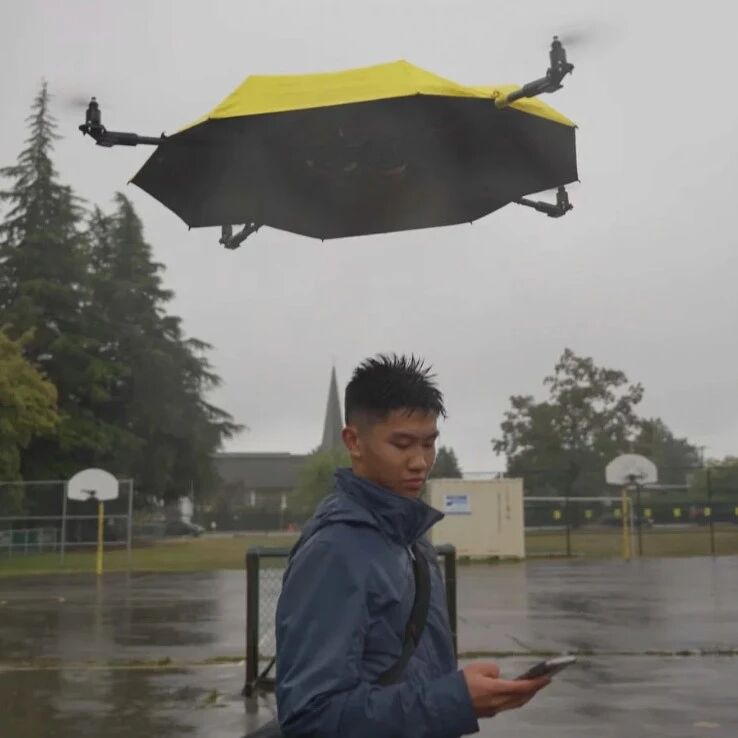
Group 1 - The article discusses the development of a flying umbrella by Canadian engineer John Tse, which autonomously hovers above the user to provide rain protection [1][5] - The umbrella utilizes drone technology, featuring four propellers for lift and a depth camera for tracking the user's head position, allowing it to maintain a stable hover [7][9] - Despite its innovative design, the umbrella's practicality is questioned, as it must hover several meters above the user, resulting in limited rain coverage [5][20] Group 2 - The second-generation flying umbrella improves upon the first by eliminating the need for manual remote control, which was criticized for being cumbersome [7] - The depth camera used in the umbrella can function effectively in low-light conditions, enhancing its tracking capabilities compared to standard cameras [9][12] - The umbrella's design includes a foldable mechanical arm structure, allowing it to be compact and portable when not in use [11][14] Group 3 - The development process involved numerous challenges, including hardware failures and software issues, extending the project timeline to nearly a year [18] - The umbrella's current battery life is limited to 10-15 minutes, similar to small consumer drones, raising concerns about its usability in crowded areas [20] - The project highlights the potential of personal creators to leverage existing drone technology and open-source hardware to create innovative solutions, even if they are not immediately practical [20]