
开源硬件

Search documents
黄仁勋也站台的抱抱脸机器人卖爆了,背后公司竟来自中国
量子位· 2026-03-30 02:35
Core Insights - Hugging Face's Reachy Mini has achieved impressive sales, surpassing $1 million in revenue within 5 days and shipping over 3,000 units [2] - The open-source philosophy is being effectively integrated into the embodied intelligence sector, with companies like Seeed Studio playing a crucial role [4][9] - Reachy Mini is positioned as both an AI companion and a platform for developers, emphasizing its dual functionality [27] Group 1: Product Overview - Reachy Mini is a highly open desktop robot with multimodal interaction capabilities, including vision and voice [12][18] - It features a nine-axis motion capability, allowing it to express emotions and states through physical movements [13][14] - The robot is designed for both entertainment and development, supporting various applications due to its open-source nature [15][19] Group 2: Company Role and Ecosystem - Seeed Studio is a key player in the hardware system platform, providing essential components like control solutions, sensors, and open-source robot kits [6][9] - The company is a premier partner in the NVIDIA Jetson ecosystem, enhancing its position in the embodied intelligence industry [8][9] - The collaboration between Hugging Face and Seeed Studio aims to connect models, hardware, and developer ecosystems, fostering innovation [9] Group 3: User Experience and Accessibility - Reachy Mini is designed to be user-friendly, with assembly instructions that allow even children to build it [45] - The robot's design includes customizable features, enabling users to modify its appearance easily [30][34] - The platform aims to lower barriers for developers and non-developers alike, promoting engagement in the field of embodied intelligence [86][90] Group 4: Market Position and Future Trends - The future of low-cost robots is not solely about price but about accessibility and usability for developers [75][77] - The industry is moving towards modularity and standardization, which will enhance the development of embodied intelligence [97][130] - The emphasis on community and open-source development is seen as vital for the growth and sustainability of the robotics ecosystem [94][138]


伞:我会飞了!人:我湿透了!这项硬核发明主打一个陪伴
机器人大讲堂· 2026-01-31 04:07
Group 1 - The article discusses the development of a flying umbrella by Canadian engineer John Tse, which autonomously hovers above the user to provide rain protection [1][5] - The umbrella utilizes drone technology, featuring four propellers for lift and a depth camera for tracking the user's head position, allowing it to maintain a stable hover [7][9] - Despite its innovative design, the umbrella's practicality is questioned, as it must hover several meters above the user, resulting in limited rain coverage [5][20] Group 2 - The second-generation flying umbrella improves upon the first by eliminating the need for manual remote control, which was criticized for being cumbersome [7] - The depth camera used in the umbrella can function effectively in low-light conditions, enhancing its tracking capabilities compared to standard cameras [9][12] - The umbrella's design includes a foldable mechanical arm structure, allowing it to be compact and portable when not in use [11][14] Group 3 - The development process involved numerous challenges, including hardware failures and software issues, extending the project timeline to nearly a year [18] - The umbrella's current battery life is limited to 10-15 minutes, similar to small consumer drones, raising concerns about its usability in crowded areas [20] - The project highlights the potential of personal creators to leverage existing drone technology and open-source hardware to create innovative solutions, even if they are not immediately practical [20]

程序员爆肝 6 个月从零手搓 486 主板,画原理图、焊芯片全搞定,Linux、DOOM、Win3.1 都跑起来了
程序员的那些事· 2026-01-29 04:30
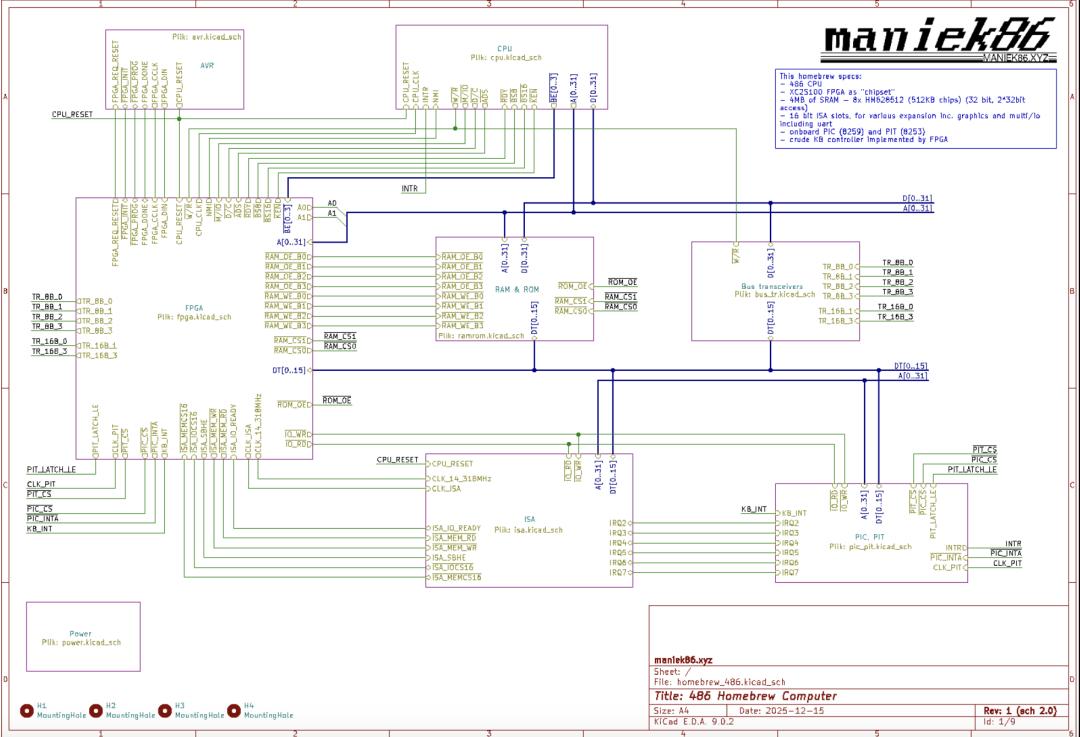
Core Viewpoint - The article highlights the impressive achievement of a programmer and electronics enthusiast, Maniek86, who designed and built a fully functional Intel 486 architecture motherboard from scratch in under six months, showcasing the potential of DIY electronics and open-source projects [1][3]. Group 1: Project Overview - Maniek86's project began with a simple goal of creating a retro motherboard capable of running Linux and the classic game DOOM, which is considered a benchmark in the hardware community [4]. - The project evolved into a comprehensive PC replication experiment as Maniek86 realized the motherboard could run various interesting software beyond just the initial goal [6][7]. Group 2: Technical Details - The M8SBC-486 motherboard is a custom design, not based on outdated reference designs, and includes detailed understanding of the 486 CPU's bus protocols, clock logic, and memory timing [9][10]. - The motherboard features a 150 × 150 mm four-layer PCB, a PGA-168 socket for 5V 486 processors, and supports a front-side bus frequency of 24 MHz, with a DX2 processor running at 48 MHz [20]. Group 3: Software Compatibility - The M8SBC-486 can successfully run operating systems such as MS-DOS, FreeDOS, and Linux, with specific configurations allowing it to partially support Windows 3.1 [21]. - Classic DOS games like Prince of Persia and DOOM run smoothly, demonstrating the motherboard's capabilities [23]. Group 4: Open Source Initiative - The project is fully open-source, with all schematics, PCB files, VHDL, and BIOS source code available on GitHub, encouraging community contributions and further development [25]. - Maniek86 aims to enhance PC compatibility and expand ISA support in future iterations of the project, indicating that M8SBC-486 serves as an open platform for ongoing improvements [26][27].
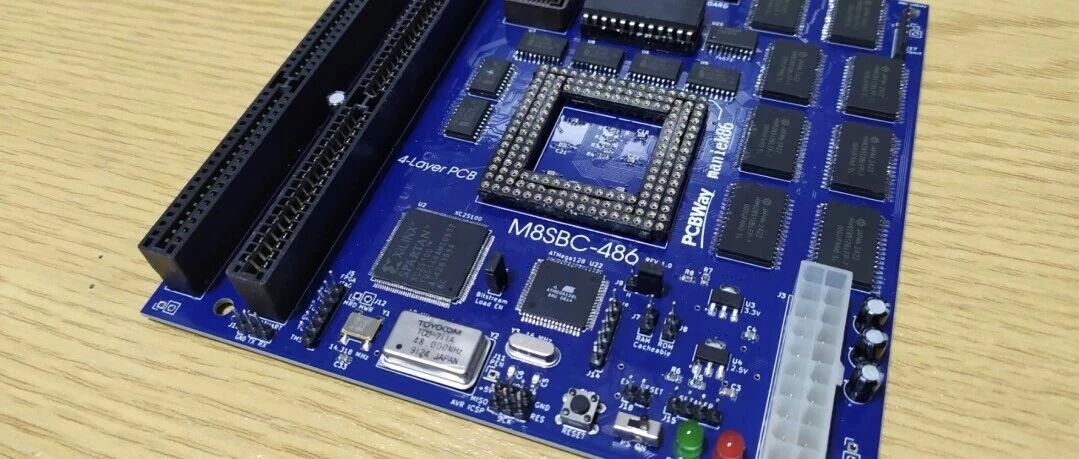
硬核:程序员爆肝6个月从零手搓486主板,画原理图、焊芯片全搞定,Linux、DOOM、Win3.1都跑起来了
3 6 Ke· 2026-01-26 13:25
Core Insights - The project led by Maniek86 resulted in the creation of a fully functional Intel 486 architecture motherboard, named M8SBC-486, designed from scratch in under six months [1][4][5]. Project Overview - The initial goal was to create a retro motherboard capable of running Linux and the classic game DOOM, which evolved into a comprehensive PC replication experiment [4][5]. - The M8SBC-486 motherboard is open-sourced, allowing enthusiasts to participate and contribute to its development on GitHub [3][13]. Technical Specifications - The M8SBC-486 measures 150 × 150 mm, smaller than the Mini-ITX standard, and features a PGA-168 socket supporting 5V 486 processors [9]. - It includes a Xilinx Spartan II XC2S100 FPGA as the chipset, 4 MB SRAM, and 256 KB ROM for BIOS [9]. Software Compatibility - The motherboard successfully runs various operating systems, including MS-DOS, FreeDOS, and Linux, and can partially support Windows 3.1 [10][11]. - Classic DOS games such as DOOM and Wolfenstein 3D run smoothly, demonstrating its capabilities [11][12]. Future Prospects - Maniek86 aims to enhance PC compatibility and improve ISA expansion in future iterations of the project [15].
RISC-V市占,直逼25%
半导体行业观察· 2025-12-28 02:49
Core Viewpoint - The global semiconductor landscape has reached a historic turning point with the RISC-V architecture achieving a 25% market penetration, signaling the end of proprietary architecture monopolies and the rise of open-source hardware as a core pillar of next-generation computing [1][13]. Group 1: Market Dynamics - Qualcomm's acquisition of Ventana Micro Systems for $2.4 billion and META's strategic acquisition of Rivos are pivotal moves towards a "no ARM" roadmap, allowing tech giants to control their chip destinies to meet the demands of generative AI and autonomous driving systems [1][3]. - The transition to RISC-V is seen as a key hedge against ongoing licensing disputes and rising ARM intellectual property costs, enabling Qualcomm to potentially become a major competitor to Intel in the server and personal computer markets [6]. Group 2: Technological Advancements - RISC-V's inherent modularity allows engineers to add custom instructions without licensing fees, contrasting with ARM's rigid licensing model, thus providing flexibility for companies like Qualcomm and META to develop tailored platforms [3]. - The integration of neural processing units (NPUs) directly into CPU pipelines in edge AI and IoT applications can reduce latency by up to 40%, showcasing RISC-V's advantages over traditional ARM designs [4]. Group 3: Competitive Landscape - The rise of RISC-V poses significant challenges to ARM Holdings, as its dominance in mobile and IoT markets is threatened by "free alternatives," forcing ARM to innovate rapidly in licensing terms and technical performance [7]. - The shift towards RISC-V-based custom chips by major companies like META, Google, and Amazon could diminish reliance on high-margin general-purpose GPUs, potentially saving billions in capital expenditures over the next five years [6]. Group 4: Geopolitical Context - RISC-V's emergence is intertwined with global geopolitical tensions, serving as a tool for countries seeking semiconductor independence amid trade restrictions and "chip wars," thus accelerating the restructuring of global supply chains [9]. - The demand for highly specialized, low-power chips in edge AI applications is driving RISC-V's growth, with projections indicating that total revenue from RISC-V intellectual property could reach $2 billion by 2031 [9]. Group 5: Future Outlook - Over the next 3-5 years, RISC-V is expected to penetrate high-performance computing (HPC) and server markets, with predictions suggesting it could capture over 30% of the data center chip market by 2031 [11]. - The industry is closely monitoring the potential for other major players like Microsoft or Amazon to follow suit in RISC-V acquisitions, which could further accelerate the transition [11].


高通收购Arduino,引发争议
半导体行业观察· 2025-12-15 01:33
Core Viewpoint - The acquisition of Arduino by Qualcomm has sparked discussions in the open-source hardware community regarding new terms and conditions that may threaten the principles of openness and user rights [2][3]. Group 1: New Terms and Conditions - Adafruit, a competitor, claims that Arduino's new terms restrict reverse engineering of cloud tools and impose permanent licensing on user-uploaded content, raising concerns about user rights [2][3]. - Arduino defends these changes, stating that the restrictions apply only to its SaaS cloud applications and that its commitment to open-source hardware remains unchanged [2][3]. Group 2: Reverse Engineering and User Rights - EFF's Mitch Stoltz confirms that Arduino has not imposed new bans on modifying or reverse engineering Arduino boards, countering some of the criticisms [4]. - Adafruit's founder, Limor Fried, argues that the cloud tools are central to the Arduino experience, and the restrictions on SaaS affect many new users [5][6]. - Arduino clarifies that users retain ownership of their uploaded content, but the new terms remove the ability to revoke licenses, which Stoltz finds disappointing [7][8]. Group 3: User Data and Privacy - Arduino states that users can request account and content deletion, and usernames will be anonymized after five years of inactivity [9]. - Adafruit expresses concern that retaining usernames instead of deleting them treats community identity and data as managed assets rather than user-controlled [9]. Group 4: AI Features and Monitoring - Arduino's new terms include monitoring user accounts and AI product usage to ensure compliance with laws and policies, which Adafruit criticizes as overly broad [10][11]. - Fried emphasizes that true open-source licenses should not impose restrictions on usage areas, arguing that such limitations contradict the essence of open-source [11]. Group 5: Future Directions - Arduino expresses a commitment to transparency and open dialogue with the community, while Adafruit plans to continue developing open-source hardware and software [12][13].

大动作!688521,筹划收购半导体公司
Zhong Guo Ji Jin Bao· 2025-08-28 14:32
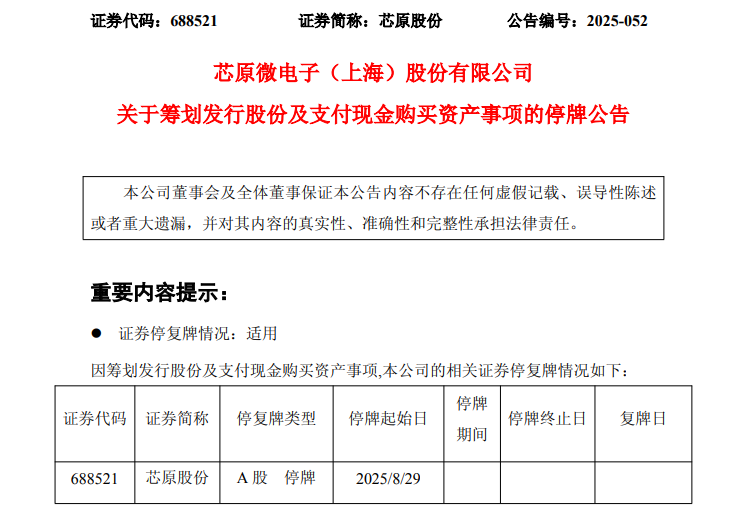
Group 1 - The core point of the article is that Chip Origin Co., Ltd. plans to acquire a controlling stake in Chip Lai Zhirong Semiconductor Technology (Shanghai) Co., Ltd. through a combination of issuing shares and cash payments, with trading suspension starting from August 29 [1][4] - Chip Origin currently holds 2.99% of Chip Lai Zhirong's shares and aims to acquire either all or a controlling stake in the company, with the transaction counterparties yet to be finalized [4][6] - Chip Lai Zhirong is recognized as one of the pioneering companies in China based on the RISC-V open instruction set architecture, which aligns with Chip Origin's strategic focus [1][7] Group 2 - Chip Lai Zhirong was established on September 20, 2018, and has completed six rounds of financing, with investors including Chip Origin and Xiaomi's investment platform [6] - The valuation of Chip Lai Zhirong is still under determination, which affects the classification of the transaction as a major asset restructuring or related party transaction [6] - The RISC-V architecture is gaining traction in various sectors such as AI, automotive electronics, 5G communication, and IoT, with a projected shipment of 80 billion chips based on RISC-V architecture by 2025 [7][9] Group 3 - In the first half of 2025, Chip Origin reported a revenue of 974 million yuan, representing a year-on-year increase of 4.49%, while the net profit attributable to shareholders was -320 million yuan, compared to -285 million yuan in the same period of 2024 [9][11]

中电港:上半年营收、净利大幅增长
Zheng Quan Shi Bao Wang· 2025-08-26 12:17
Core Insights - Company reported a significant growth in revenue and profit for the first half of 2025, with revenue increasing by 35.64% year-on-year and net profit attributable to shareholders rising by 92.80%, both reaching historical highs [1][3] Financial Performance - In the first half of 2025, the company achieved a revenue of 33.526 billion yuan and a net profit of 1.81 billion yuan [3] - Since its listing on April 10, 2023, the company has shown steady growth, with revenue and net profit growth rates of 57.45% and 37.50% respectively in the first half of 2024 [3] - The company maintained a dual growth trend, with revenue and net profit both reaching historical highs in the first half of 2025 [3] Operational Efficiency - The annualized inventory turnover rate for the first half of 2025 was 6.84 times, an increase of 1.96 times year-on-year, while accounts receivable turnover rate was 6.00 times, up by 0.27 times [3] - The performance reflects an improvement in operational quality and an optimized profit structure, achieving both scale and efficiency growth [3] Market Positioning - The company has integrated high-quality domestic resources and international brands, establishing long-term stable partnerships with over 5,000 quality clients across various fields [2] - The global semiconductor industry is experiencing a structural recovery, and the company has capitalized on market opportunities by increasing investments in strategic markets such as artificial intelligence, computing technology, and automotive electronics [2] Product and Service Innovation - The company reported a 144% year-on-year increase in revenue from artificial intelligence-related businesses, totaling 7.702 billion yuan in the first half of 2025 [4] - Revenue from processor business reached 13.673 billion yuan, growing by 77.33%, while other products like sensors and discrete devices saw a 102.07% increase in revenue [4] - The company has launched various innovative products, including AI intelligent computing modules and high-performance wireless modules, to support diverse applications [5] Supply Chain and Logistics - The company has established a modern supply chain collaborative service platform, "Yian Warehouse," providing comprehensive services including warehousing, transportation, and distribution [6] - The total warehouse area is 72,000 square meters, with a storage capacity of 22,500 pallets and the ability to handle over 3 million boxes annually [6] Data and Analytics Capabilities - The company has developed a big data platform, "Chip Check," which provides various services including supply chain fluctuation analysis and BOM management [7] - In the first half of 2025, the platform's PC access volume increased by 74%, indicating growing engagement and collaboration with leading manufacturers [7]
中电港(001287) - 2025年5月23日投资者关系活动记录表
2025-05-24 07:40
Group 1: Company Overview - Shenzhen Zhongdian Port Technology Co., Ltd. is the leading domestic distributor of electronic components, focusing on component distribution, design chain services, supply chain collaboration, and industrial data services [2][3]. - The company operates an automated three-dimensional warehouse of approximately 50,000 m² in Humen, with additional hubs in Hong Kong, Central China, South China, and East China, forming a comprehensive three-tier warehouse layout [3]. Group 2: Application Innovation - The "Firefly Workshop" is the company's application innovation platform, emphasizing technical services and innovation in key industries such as artificial intelligence, new energy, AIoT, automotive electronics, industrial electronics, and open-source hardware [3]. - The company provides technical support, reference designs, and solutions to drive growth in its distribution business and innovation in the upstream and downstream of the industry chain [3]. Group 3: Market Trends - According to SIA data, the global semiconductor market is projected to reach $626.9 billion in 2024, with a year-on-year growth of 19%. Growth rates are expected to be 38.9% in the Americas, 17.5% in Asia-Pacific, 1.4% in Japan, and a decline of 6.7% in Europe [3]. - WSTS forecasts an 11% growth in the global semiconductor market in 2025, reaching $697.1 billion, driven by structural high growth in domestic semiconductor demand, particularly in emerging fields such as AI computing power, robotics, and AIoT [3].