激光雷达技术路线之争

Search documents
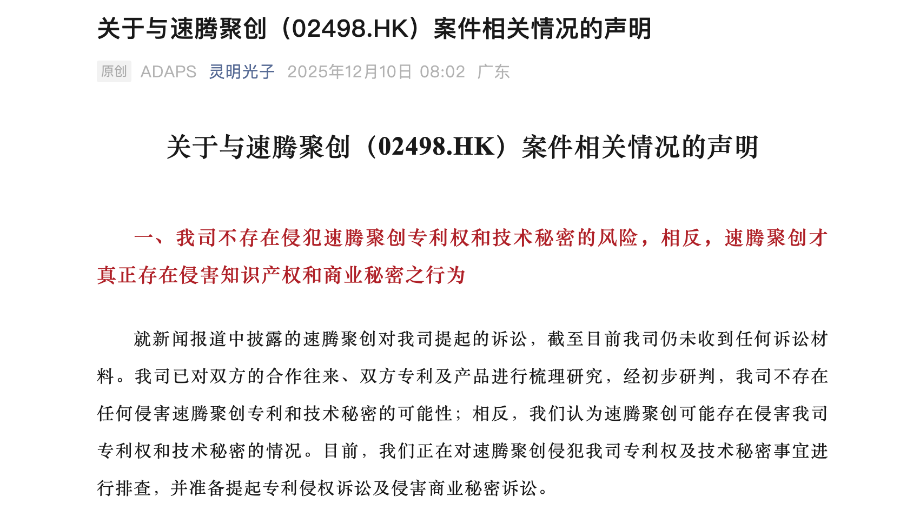
激光雷达芯片“疑云”:灵明光子称“不存在对速腾聚创侵权风险”
2 1 Shi Ji Jing Ji Bao Dao· 2025-12-11 08:49
Core Viewpoint - The legal dispute between Suoteng Juchuang and Lingming Photon over alleged infringement of self-developed SPAD chip technology has garnered significant industry attention [1]. Group 1: Company Background - Suoteng Juchuang has been focusing on the independent research and development of laser radar chips since 2017, aiming to achieve mass production of self-developed SPAD chips for digital laser radar by 2024 [1]. - Lingming Photon claims that it does not infringe on Suoteng Juchuang's patent rights and asserts that Suoteng Juchuang may be the one infringing on its intellectual property [5]. Group 2: Technology Comparison - Suoteng Juchuang specializes in digital laser radar, utilizing single-photon avalanche diodes (SPAD) that allow each detection pixel to independently receive single photons and generate digital pulse signals [3]. - The industry also recognizes an alternative technology route, analog laser radar, which relies on silicon photomultiplier tubes (SiPM) or traditional photodiodes (APD) that require signal processing before digital conversion [3]. Group 3: Industry Opinions - There is ongoing debate within the industry regarding the advantages of digital versus analog laser radar technologies [4]. - Suoteng Juchuang's CEO emphasizes the superiority of digital laser radar using SPAD architecture, claiming it leads to higher line density, resolution, and point cloud quality [4]. Group 4: Legal Developments - Lingming Photon has publicly stated that it has not received any legal documents related to the lawsuit as of December 1 [5]. - Following the initial statement, Lingming Photon reiterated on December 10 that it has not received any litigation materials and is preparing to investigate potential patent infringement by Suoteng Juchuang [5].

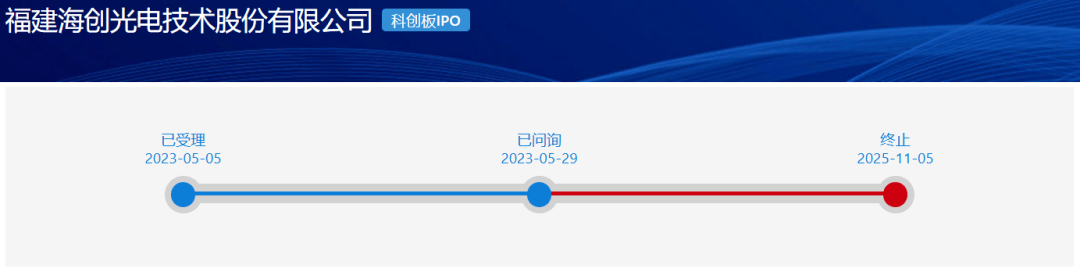
科创板IPO终止!删除5亿元募资补流计划,去年扣非净利润同比下滑45.60%
Sou Hu Cai Jing· 2025-11-11 01:46
Core Viewpoint - The sustainability of Haichuang Optoelectronics' lidar business growth and market space is under scrutiny due to intense market competition and the introduction of alternative suppliers by major clients, leading to a significant decline in the company's performance in 2024 [1][3][9]. Financial Performance - In 2024, Haichuang Optoelectronics experienced a revenue decline of 20.75% year-on-year, with a non-recurring net profit decrease of 45.60% [3][9]. - The company's revenue structure has shifted, with lidar business becoming the primary revenue source, accounting for 48.96% of total revenue in 2024 [11][12]. IPO and Fundraising - The company initially planned to raise 12.60 billion yuan through its IPO, with 5 billion yuan allocated for working capital, which has since been removed from the fundraising plan [4][8]. - The Shanghai Stock Exchange has terminated the review of Haichuang Optoelectronics' IPO application due to concerns over the sustainability of its business model and the stability of customer collaborations [1][3]. Production Capacity and Utilization - The production capacity utilization rates for 2023 were 94.39% for optical components, 63.33% for lidar light source modules, and 46.33% for lidar receiving modules, with a significant drop expected in 2024 [7][9]. - The company anticipates a further decline in utilization rates due to lower-than-expected demand and the introduction of alternative suppliers by clients [7][9]. Market Competition and Pricing - The lidar market is facing intense competition, leading to a significant drop in product prices; for instance, the average price of lidar light source modules fell from 1,281.72 yuan to 945.08 yuan from 2022 to 2024 [18][19]. - The company is positioned in a competitive landscape with two main technology routes in autonomous driving, which could impact its market share and revenue [19][20]. Customer Relationships - The company's revenue is highly concentrated, with two major clients, Tudatong and Luminar, contributing 78.40% to its lidar business revenue [17]. - There are uncertainties regarding the stability of relationships with major clients, as Tudatong has introduced alternative suppliers, and Luminar faces operational challenges [17][20].