
SPAD芯片

Search documents
斯坦福博士,把激光雷达芯片价格打到两成,今年将出货百万颗
创业邦· 2026-03-15 10:48
Core Viewpoint - The article highlights the significant advancements and market potential of SPAD chips in the LiDAR industry, particularly through the innovations of Lingming Photon, which has successfully reduced production costs and improved performance, positioning itself as a key player in the market [2][25]. Group 1: SPAD Chip Technology - SPAD chips are critical components in LiDAR systems, functioning as "photon catchers" that detect weak light signals even in dark environments [2]. - The production of SPAD chips has traditionally been costly and inefficient due to reliance on customized processes, but advancements by Lingming Photon have reduced the price from 5000 RMB to 800 RMB [2][14]. - Lingming Photon has developed a new "light capture" architecture that enhances the efficiency of SPAD chips, allowing for mass production using standard CMOS technology [15]. Group 2: Company Background and Development - Lingming Photon was founded in 2018 by Zang Kai, who aimed to apply his research in semiconductor technology to the production of LiDAR chips [10][24]. - The company has received significant funding from various investors, including Xiaomi and OPPO, and has achieved a valuation of approximately 20 billion to 30 billion RMB [7]. - Lingming Photon has been recognized as a future unicorn by 2025 Chuangye Bang, highlighting its potential for growth and innovation in the industry [3]. Group 3: Market Trends and Future Outlook - The demand for LiDAR technology is expected to surge as the automotive industry increasingly adopts advanced driver-assistance systems, with many manufacturers now integrating LiDAR as standard equipment in high-end models [25]. - Lingming Photon is preparing for the future of AR/VR technologies, anticipating a significant market shift towards 3D spatial computing devices that will require advanced LiDAR capabilities [25]. - The company is currently developing higher-resolution SPAD chips, aiming for 2 million to 48 million pixels, to enhance the imaging capabilities of LiDAR systems [18][20].


舒迅:南山沃土育 “芯片尖兵”,硬科技与万亿城区双向奔赴 —— 专访灵明光子 CFO,揭秘硬科技企业的 “南山成长加速度”
Sou Hu Cai Jing· 2026-01-29 03:42
Core Insights - Lingming Photon has evolved from a small team focused on SPAD chip technology to a leading global supplier in the SPAD chip sector, exemplifying the symbiotic relationship between the company and the thriving economy of Nanshan District, Shenzhen [1][3] Company Growth and Regional Development - The growth of Lingming Photon is closely tied to the GDP surpassing one trillion in Nanshan, with the company describing its role as both a builder and beneficiary of this economic landscape, akin to a "double helix" of mutual achievement [3] - Initially a startup focused on technology exploration, Lingming Photon has transitioned to an industry leader, supported by comprehensive resources from the Nanshan region [3][4] - The company has made significant technological advancements, including the launch of China's first solid-state LiDAR receiver chip in 2023, marking a pivotal leap from "0 to 1" in technology [4] Supportive Ecosystem - The Nanshan region provides a "triple support" system comprising talent policies, industry policies, and an integrated industrial chain, which collectively enhance the company's capabilities [4][5] - Talent policies in Shenzhen and Nanshan attract top researchers from prestigious institutions, ensuring the company has access to critical intellectual resources [4] - Industry policies offer financial relief through subsidies for research and development, alleviating the financial burden during the startup phase [4] - The local industrial ecosystem facilitates rapid application of technology, creating a closed loop from technology to product to market [4][5] Talent Attraction and Retention - Talent is identified as a core competitive advantage for hard-tech companies, with Nanshan's housing policies significantly improving the retention rates of overseas talent [5] - The region's appeal extends beyond financial incentives, encompassing a supportive environment for innovation and a high quality of life, which encourages talent to settle and thrive [5] Collaborative Innovation Network - Nanshan's innovation ecosystem fosters collaboration across the industry, academia, and research, creating a robust network that supports the growth of individual enterprises [6] - The local government actively facilitates resource exchange and collaborative development, providing platforms for companies to showcase their strengths and connect with potential partners [6] Strategic Recommendations - Lingming Photon aims to deepen its focus on core technologies while leveraging the regional industrial ecosystem to maintain its industry leadership [7] - The company suggests enhancing talent services by improving international education and healthcare resources to ensure top talent can thrive in Nanshan [7] - It also recommends increasing support for key segments of the smart sensor industry to attract more innovation resources, thereby promoting sustainable growth in the region [7]

国盛证券:高速率光芯片前景广阔 看好光芯片景气周期
Zhi Tong Cai Jing· 2025-12-29 06:53
Core Insights - The global Ethernet optical module market is expected to grow rapidly, with a projected increase of 35% to reach $18.9 billion by 2026, driven by strong demand for AI infrastructure and the application of optical interconnect technology in AI scale-up networks [3][1] - The demand for optical chips, which are essential components of optical modules, is expected to remain tight due to increasing requirements for high-speed optical communication [4][3] Group 1: Optical Chip Market Dynamics - Optical chips, consisting of laser and detector chips, are critical for optical modules, primarily used for optical signal conversion and processing [1] - The EML laser chip market is projected to reach $3.71 billion by 2024 and grow to $7.41 billion by 2030, with a compound annual growth rate (CAGR) of 12.23%, dominated by a few international giants [2][1] - Silicon photonic modules are driving demand for continuous wave (CW) lasers due to their high integration, low power consumption, and suitability for high-speed short-distance transmission [2][1] Group 2: Demand Drivers and Supply Constraints - The demand for optical modules is expected to continue rising, with the global Ethernet optical module market projected to exceed $35 billion by 2030, supported by AI infrastructure and cloud service providers increasing GPU purchases [3][1] - Major companies like Coherent and Lumentum are expanding their production capacities to meet the growing demand for high-speed optical components, with Coherent's production capacity expected to double within a year [4][5] - Tower's silicon photonic business is anticipated to exceed $220 million in revenue by 2025, driven by strong demand for 1.6T products and significant investments in capacity expansion [6][5] Group 3: Company-Specific Developments - Coherent is experiencing strong growth in orders for 800G and 1.6T transceivers, with plans to expand production capabilities in multiple locations [4][1] - Lumentum has set a record for EML laser shipments driven by demand for 100Gbps products and is beginning to deliver CW lasers to 800G optical module manufacturers [5][1] - Broadcom's AI network demand has led to a significant increase in orders for optical components, with a backlog of approximately $73 billion, including $20 billion from network and optical interconnect products [7][1]


“激光雷达芯片第一案”再起波澜,灵明光子反诉速腾聚创侵犯专利
经济观察报· 2025-12-19 10:15
Core Viewpoint - The ongoing legal disputes between Suoteng Juchuang and Lingming Photon revolve around allegations of technology secret infringement and patent rights, highlighting the competitive tensions in the laser radar and semiconductor industry [2][3][5]. Group 1: Legal Disputes - Suoteng Juchuang filed a lawsuit against Lingming Photon in November, claiming infringement of its self-developed SPAD chip technology secrets [2][5]. - Lingming Photon responded by filing a lawsuit regarding alleged patent infringements related to Suoteng Juchuang's E1 series products [3][4]. - Suoteng Juchuang stated that the core of the dispute is its accusation against Lingming Photon for infringing its technology secrets, while Lingming Photon has not provided a substantial response to these allegations [5][6]. Group 2: Company Backgrounds - Suoteng Juchuang, established in 2014 and headquartered in Shenzhen, is a leading player in the laser radar market with a global market share ranking first, serving over 3,400 clients in robotics and more than 350 automotive manufacturers [5][6]. - Lingming Photon, founded in 2018, specializes in chip design, particularly in SPAD dToF sensor chips, which are critical components in laser radar technology [5][6]. Group 3: Legal Proceedings and Responses - Suoteng Juchuang has initiated legal actions to counter Lingming Photon’s patent lawsuit and plans to utilize legal avenues such as patent invalidation [4][7]. - Both companies have filed multiple lawsuits against each other, with Suoteng Juchuang also pursuing claims of commercial defamation against Lingming Photon for its public statements related to the lawsuits [7].

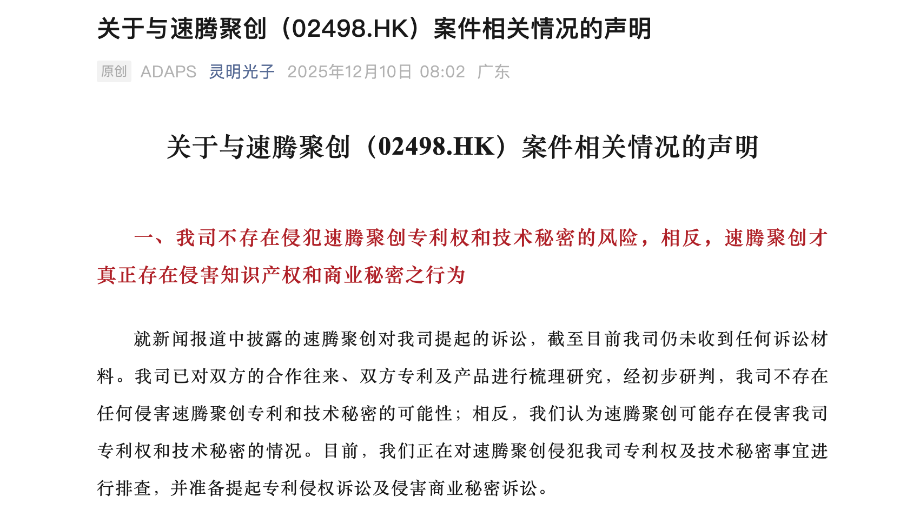
激光雷达芯片“疑云”:灵明光子称“不存在对速腾聚创侵权风险”
2 1 Shi Ji Jing Ji Bao Dao· 2025-12-11 08:49
Core Viewpoint - The legal dispute between Suoteng Juchuang and Lingming Photon over alleged infringement of self-developed SPAD chip technology has garnered significant industry attention [1]. Group 1: Company Background - Suoteng Juchuang has been focusing on the independent research and development of laser radar chips since 2017, aiming to achieve mass production of self-developed SPAD chips for digital laser radar by 2024 [1]. - Lingming Photon claims that it does not infringe on Suoteng Juchuang's patent rights and asserts that Suoteng Juchuang may be the one infringing on its intellectual property [5]. Group 2: Technology Comparison - Suoteng Juchuang specializes in digital laser radar, utilizing single-photon avalanche diodes (SPAD) that allow each detection pixel to independently receive single photons and generate digital pulse signals [3]. - The industry also recognizes an alternative technology route, analog laser radar, which relies on silicon photomultiplier tubes (SiPM) or traditional photodiodes (APD) that require signal processing before digital conversion [3]. Group 3: Industry Opinions - There is ongoing debate within the industry regarding the advantages of digital versus analog laser radar technologies [4]. - Suoteng Juchuang's CEO emphasizes the superiority of digital laser radar using SPAD architecture, claiming it leads to higher line density, resolution, and point cloud quality [4]. Group 4: Legal Developments - Lingming Photon has publicly stated that it has not received any legal documents related to the lawsuit as of December 1 [5]. - Following the initial statement, Lingming Photon reiterated on December 10 that it has not received any litigation materials and is preparing to investigate potential patent infringement by Suoteng Juchuang [5].
速腾聚创诉灵明光子,涉及激光雷达芯片
Di Yi Cai Jing· 2025-12-01 05:06
Core Viewpoint - Shenzhen SUTENG Juchuang Technology Co., Ltd. has filed a lawsuit against Shenzhen Lingming Photon Technology Co., Ltd. for alleged infringement of trade secrets related to its self-developed SPAD chip technology [1] Group 1: Legal Action - SUTENG Juchuang has submitted a case application to the Shenzhen Intermediate People's Court in Guangdong Province, awaiting court acceptance [1] - The lawsuit is based on accusations of trade secret infringement concerning the SPAD chip technology [1] - SUTENG Juchuang demands that Lingming Photon cease the manufacturing and sale of the involved chip products [1] Group 2: Product Information - The SPAD chip is referred to as the "digital heart" of LiDAR technology [1] - SUTENG Juchuang has previously launched a digital all-solid-state LiDAR E platform based on its SPAD-SoC chip, which has passed automotive certification and achieved mass production [1] Group 3: Company Responses - Lingming Photon has stated that it has not received any related correspondence regarding the lawsuit [1] - SUTENG Juchuang has not commented on the details of the lawsuit [1]
速腾聚创诉灵明光子 涉及激光雷达芯片
Di Yi Cai Jing· 2025-12-01 04:59
Core Viewpoint - Shenzhen SUTENG Juchuang Technology Co., Ltd. has filed a lawsuit against Shenzhen Lingming Photon Technology Co., Ltd. for alleged infringement of trade secrets related to its self-developed SPAD chip technology [3] Group 1: Company Actions - SUTENG Juchuang submitted a lawsuit application to the Shenzhen Intermediate People's Court in November, claiming that Lingming Photon infringed upon its SPAD chip technology secrets [3] - The lawsuit seeks to stop Lingming Photon from manufacturing and selling the involved chip products [3] Group 2: Industry Context - The SPAD chip is referred to as the "digital heart" of LiDAR technology, indicating its significance in the automotive and technology sectors [1] - SUTENG Juchuang has previously launched a digital all-solid-state LiDAR E platform based on its SPAD-SoC chip, which has achieved automotive certification and mass production [1]
奥比中光(688322):5月扭亏,“技术创新投入-商业成果转化”战略加速落地催化
ZHESHANG SECURITIES· 2025-06-30 09:43
Investment Rating - The investment rating for the company is "Accumulate" [8] Core Views - The company achieved a turnaround in profitability from January to May 2025, with revenue of 363 million yuan, a year-on-year increase of 117%, and a net profit attributable to shareholders of 55 million yuan, marking a return to profitability [1] - The company's strategy of "technology innovation investment - commercialization of results" is accelerating, providing a strong foundation for technological iteration and innovation across various sectors, including humanoid robots and AI hardware upgrades [1] - The humanoid robot industry is entering a rapid expansion phase, with an estimated demand of approximately 2.1 million units and a market space of about 314.6 billion yuan by 2030 [1][2] Summary by Sections Financial Performance - For the first five months of 2025, the company reported revenue of 363 million yuan and a net profit of 55 million yuan, indicating a significant recovery [1] - Revenue projections for 2025-2027 are estimated at 1.03 billion, 1.63 billion, and 2.16 billion yuan, with year-on-year growth rates of 82%, 58%, and 32% respectively [5][7] Market Position - The company is positioned in the top tier of global 3D vision technology, with a comprehensive R&D capability and a wide-ranging technology layout [3] - The demand for 3D vision sensors in humanoid robots is expected to grow from 14 million yuan in 2025 to 915 million yuan by 2030, with a CAGR of 132% [2] Product Development - The company has a strong product matrix that is widely recognized across various industries, serving over 1,000 clients including major players like Ant Group and China Mobile [3] - Continuous R&D investment has led to the development of advanced products such as the Femto series ToF cameras and Gemini series binocular structured light cameras [3] Strategic Partnerships - Ant Group has announced its entry into the humanoid robot sector, which may lead to deeper collaboration with the company in the field of robot vision sensors [4]
