火箭重复使用

Search documents
“为长征十号系列火箭首飞奠定重要基础”——访中国航天科技集团杨树涛
Xin Hua She· 2026-02-12 16:44
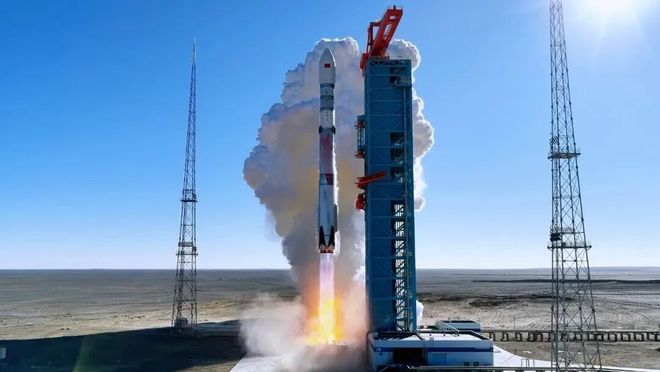
Core Viewpoint - The successful low-altitude demonstration flight test of the Long March 10 series rocket lays an important foundation for its maiden flight, which is tasked with carrying out China's manned lunar exploration mission [1][2]. Group 1: Rocket Specifications and Features - The Long March 10 series rocket, which includes the Long March 10 and Long March 10A configurations, is designed for China's manned lunar exploration and space station applications [1]. - The technical verification rocket measures approximately 55 meters in length, nearly 30 meters taller than during the tethered ignition test, due to the addition of structural components [2]. - It utilizes seven liquid oxygen-kerosene engines in parallel, producing nearly 1,000 tons of thrust, making it the largest single-module thrust rocket in China [2]. Group 2: Flight Test Details - The rocket successfully reached the maximum dynamic pressure escape condition, allowing the spacecraft to receive the escape command and successfully separate [2][3]. - The flight involves several phases, including a glide adjustment phase, a dynamic deceleration phase, and an aerodynamic deceleration phase, before entering the landing phase [3][4]. Group 3: Reusability and Future Implications - The Long March 10 series rocket is designed for reusability, which is essential for reducing launch costs and increasing launch frequency, supporting China's ambitions in space exploration [5]. - The rocket's recovery scheme involves a combination of on-board capture mechanisms and ground-based net systems, enhancing its payload capacity while simplifying on-board complexity [5].

向登月迈出关键一步!中国火箭上演“太空双考”
Yang Shi Wang· 2026-02-11 18:17
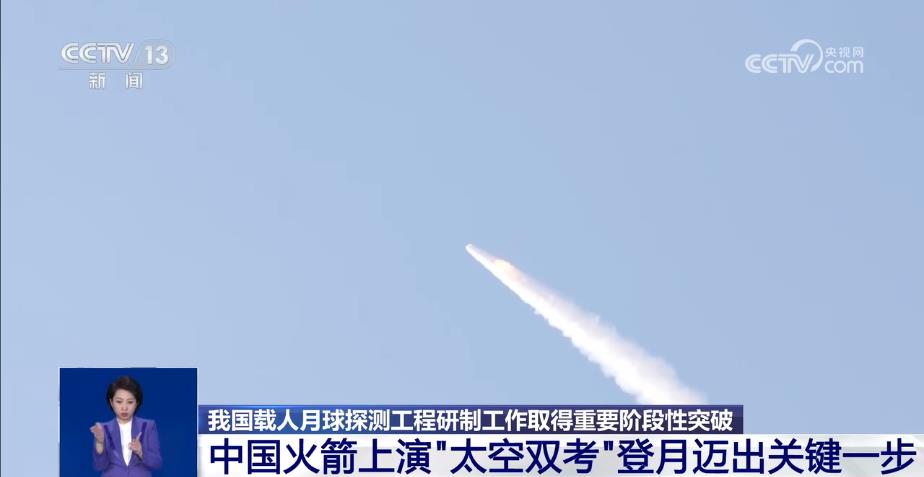
Core Viewpoint - The successful test of the Long March 10 rocket and the Dream Boat manned spacecraft marks a significant milestone in China's lunar exploration program, demonstrating advanced capabilities in spaceflight safety and technology [1][8]. Group 1: Test Objectives - The primary goals of this test are to verify the manned spacecraft's ability to safely escape during the maximum dynamic pressure phase of the rocket's flight [2][6]. - The test also aims to validate the rocket's autonomous navigation and precision return capabilities, paving the way for future reusable rocket technology [3][6]. Group 2: Technical Challenges - The maximum dynamic pressure phase is characterized by extreme conditions where the rocket experiences peak pressure, making it a critical moment for testing the spacecraft's escape system [4][6]. - Ensuring the rocket's engine can reliably reignite during descent, despite high-speed conditions and strong airflow, is one of the major technical challenges for successful recovery [6]. Group 3: Achievements - This test achieved five significant firsts, including the first ignition flight of the Long March 10 series, the first maximum dynamic pressure escape test for a spacecraft, and the first recovery of a manned spacecraft's return capsule at sea [8]. - The successful execution of complex maneuvers in a single flight is unprecedented in the history of global space exploration, providing valuable data for future missions and contributing to the goal of landing Chinese astronauts on the moon by 2030 [8].

朱雀三号成功入轨,中国离重复使用火箭时代还有多远?
Guan Cha Zhe Wang· 2025-12-04 00:49
Core Viewpoint - The successful launch of the Zhuque-3 rocket marks a significant milestone in China's reusable rocket technology, despite challenges in achieving its expected payload capacity and issues with engine performance [1][11][29]. Group 1: Launch Details - On December 3, the Zhuque-3 rocket was launched from the Jiuquan Satellite Launch Center, successfully completing its flight plan and delivering a simulated payload into orbit [1]. - The first stage attempted a landing but experienced engine failure during descent, resulting in a crash approximately 67.2 meters from the intended landing zone [1]. Group 2: Development Background - Blue Arrow Aerospace, established in 2015, focuses on developing medium to large launch vehicles using liquid oxygen and methane as propellants, aiming to provide cost-effective and reliable launch services [3]. - The Zhuque-2 rocket, which successfully entered orbit in July 2023, was the first liquid oxygen-methane rocket to achieve this milestone, establishing Blue Arrow as a key player in the commercial space sector [3][4]. Group 3: Technical Specifications - The Zhuque-3 rocket features a diameter of 4.5 meters, a total length of 76.6 meters, and a launch weight of approximately 660 tons, with a low Earth orbit payload capacity of 21.3 tons [5]. - The rocket's first stage is equipped with four Tianque-12 engines, providing a thrust of about 900 tons [5]. Group 4: Challenges and Innovations - The Zhuque-3 rocket is constructed from high-strength stainless steel, which reduces manufacturing costs and enhances thermal resistance for multiple reuses [8][9]. - However, the rocket's first flight revealed issues with payload capacity, primarily due to the weight of the stainless steel structure, prompting design modifications to alleviate this problem [11][20]. Group 5: Future Prospects - Blue Arrow plans to enhance the Zhuque-3's capabilities with the development of the Tianque-12B engine, aiming for a thrust increase to 100 tons by 2027, which would significantly improve the rocket's payload capacity [23]. - The company is also preparing for future missions, including the launch of the Haolong-1 cargo spacecraft, which will further test the Zhuque-3's operational capabilities [23].