燕京八绝

Search documents
春节在岗,只为观众不虚此行
Xin Lang Cai Jing· 2026-02-22 21:00
Core Viewpoint - The exhibition at the Beijing Arts and Crafts Museum, themed around the Chinese New Year and featuring over 120 exhibits, has attracted significant public interest, highlighting the importance of cultural heritage and traditional craftsmanship in contemporary society [3][4]. Group 1: Exhibition Details - The exhibition is titled "A Gathering of Seasons: Treasures of the Nation - The Essence of Beijing in Every Object" and is divided into four main sections: "Shared National Pulse," "Family Prosperity," "Seasonal Changes," and "Zodiac Guardianship," all of which are free to the public [3]. - The exhibition features various artifacts, including the cloisonné piece "Silk Road Divine Steed" and a lacquer jewelry box depicting a warhorse, showcasing the artistic representation of horses [3]. Group 2: Audience Engagement - The museum employs personalized storytelling techniques during tours, adapting explanations based on the audience's age and interests, such as focusing on animal and plant motifs for children and historical context for older visitors [4]. - The museum's collection primarily consists of works from the 1960s to 1970s, filling a historical gap in the development of Beijing's arts and crafts industry [4]. Group 3: Interactive Experience - During the exhibition, visitors can engage in hands-on experiences with various intangible cultural heritage crafts, such as making a cloisonné brooch, which enhances their understanding and appreciation of traditional techniques [5]. - The museum aims to transform its collection into a living culture that is tangible and participatory, encouraging more people to visit and celebrate a meaningful Chinese New Year [5].


“匠心匠艺·律动京华——新晋工艺美术大师作品展”开幕
Xiao Fei Ri Bao Wang· 2025-05-23 02:45
Core Viewpoint - The "Craftsmanship and Artistry: Rhythm of Beijing - New Craft Art Masters Exhibition" aims to promote traditional Chinese culture and showcase contemporary craftsmanship innovations, featuring works from various young masters and intangible cultural heritage inheritors [1][2]. Group 1: Event Overview - The exhibition was launched on May 17 at the Beijing Yanjing Eight Wonders Museum, organized by multiple cultural associations and supported by various institutions [1]. - The exhibition features 35 works from 23 emerging young craft art masters, showcasing a rich variety of themes and exquisite techniques [3]. Group 2: Cultural Significance - The Yanjing Eight Wonders represent a treasure of traditional Chinese craft art, embodying deep historical and cultural significance, and are seen as a vital carrier of excellent traditional Chinese culture [3]. - The event emphasizes the importance of combining traditional elements with modern aesthetics to promote the unique charm of Yanjing Eight Wonders and enhance the transmission of Chinese traditional culture [2]. Group 3: Contributions and Future Directions - The Beijing Craft Art Industry Association is committed to promoting the inheritance and development of traditional craft arts, facilitating exchanges and cooperation to contribute to the prosperity of cultural undertakings [3]. - Young inheritors, like Liu Xiaoyan, express a strong sense of responsibility and the need for innovation in their craft, aiming to create works that resonate with contemporary audiences while preserving traditional techniques [2].
从难得一见到融入生活(传承)
Ren Min Ri Bao· 2025-05-01 21:51
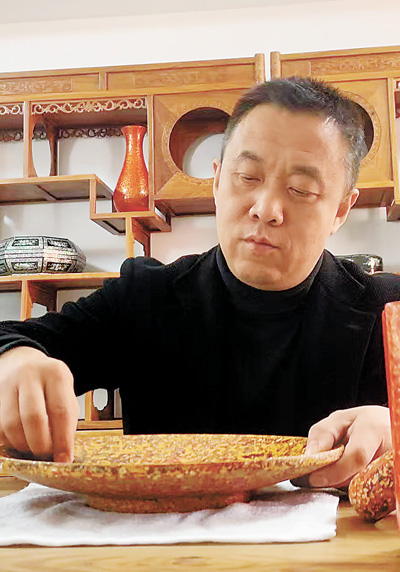
Core Viewpoint - The article highlights the efforts of Bai Qun in reviving and promoting the traditional craft of gold lacquer inlay, a significant part of Beijing's cultural heritage, through education, restoration projects, and the establishment of museums [2][4]. Group 1: Historical Context and Craft Description - Gold lacquer inlay is a traditional craft that involves complex techniques such as inlaying, carving, and applying lacquer, historically reserved for royal use and known for its luxurious finish [2]. - The Beijing Gold Lacquer Inlay Factory once employed over 2,000 workers and had a strong export market, but faced significant operational challenges in the 1990s leading to a loss of skilled artisans [2]. Group 2: Revival Efforts - Bai Qun, inspired by his father's legacy, became a non-material cultural heritage inheritor in 2003 and focused on reviving lost techniques, particularly the "plum blossom break" technique, which requires precise control of materials and lacquer thickness [2][3]. - A research team led by Bai Qun spent a year reviving this lost technique, utilizing multimedia technology to document the entire process, breaking away from traditional oral transmission methods [3]. Group 3: Restoration Projects and Museum Initiatives - In 2014, Bai Qun and a team of lacquer masters undertook the restoration of 17 precious artifacts for the Forbidden City, employing traditional techniques to restore the original appearance of the items [4]. - Bai Qun established the Beijing Yanjing Eight Wonders Museum in 2020 and the Beijing Gold Lacquer Inlay Art Museum in 2022, showcasing over 300 pieces of traditional and contemporary art [4]. - Since 2021, the Beijing Yanjing Eight Wonders Museum has set up four campus exhibition halls in Inner Mongolia, promoting traditional culture through activities like the "Eight Wonders Cultural Ambassador" competition for students [4]. Group 4: Personal Motivation and Legacy - The passing of Bai Qun's father in 2019 left a lasting impact, with Bai Qun finding motivation in a voice message from his father encouraging him to continue his efforts in preserving the craft [5].