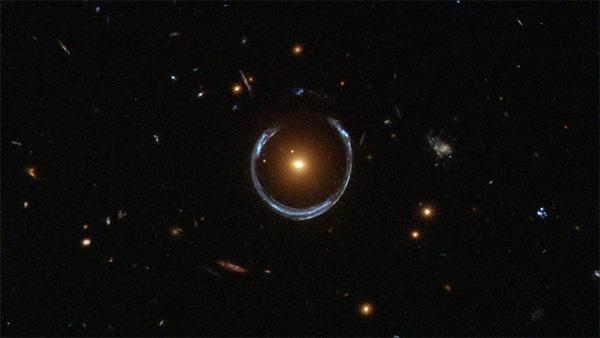
爱因斯坦环

Search documents
我用物理公式"造"了一个黑洞,结果和NASA拍的一模一样!
李永乐老师· 2026-02-15 09:30
从牛顿经典物体运动出发,深入广义相对论的光线弯曲原理,再通过光线追踪技术,在Blender中实现了完整的黑洞模拟——引力透镜、爱因斯坦环、光子球阴影、多普勒效应、引力红移,一个不落。最终渲染出的黑洞图像与M87*真实照片(Event Horizon Telescope拍摄)高度吻合,甚至还原了吸积盘的不对称亮度分布。这不是巧合,这是广义相对论的胜利。 章节时间轴: 00:00 开场 — 为什么要手搓黑洞 00:27 等效原理 — 光线为什么会弯曲 04:47 测地线和度规 — 时空的测量尺 07:45 史瓦西度规 — 黑洞的数学描述 12:21 光线偏折 — 广义相对论的核心公式 17:26 光线追踪 — 从理论到渲染 19:46 黑洞模拟 — Blender实现全流程 21:03 爱因斯坦环 — 引力透镜的震撼效果 23:35 黑洞吸积盘 — 最具美感的黑洞 26:58 多普勒效应 — 吸积盘的不对称亮度 27:39 引力红移 — 黑洞阴影的成因 28:05 对比M87 — 模拟vs真实照片 29:15 结尾 — 我们看到的不是黑洞本身 使用的工具与技术: • Blender(几何节点) • 广义相对论(爱 ...

迄今最大?科学家发现质量为太阳363亿倍的黑洞
Guan Cha Zhe Wang· 2025-08-08 06:56
Core Insights - Astronomers have discovered a black hole with a mass approximately 36.3 billion times that of the Sun, potentially the largest black hole detected to date [1][3] Group 1: Discovery and Measurement - The black hole is located in the "Cosmic Horseshoe" galaxy, which is one of the most massive known galaxies [1] - The research team, led by Professor Thomas Collett from the University of Portsmouth, measured the speed of stars orbiting the black hole and the degree of light bending caused by its gravity to confirm its existence [3] - The black hole's mass was determined through a combination of these measurements, with stars moving at speeds nearly reaching 400 kilometers per second [3] Group 2: Implications and Context - The discovery aligns with previous research indicating that a supermassive black hole must exist at the center of the "Cosmic Horseshoe" for the model of dark matter distribution to match observational data [3] - This black hole is categorized as a "sleeping" black hole, meaning it is not actively accreting material, and its detection relies solely on its immense gravitational influence [3][4] - The findings provide new insights into the relationship between supermassive black holes and their host galaxies, suggesting that the black hole may have formed from the merger of supermassive black holes from satellite galaxies [4]