
爱国者治港

Search documents
国务院新闻办公室 发布《“一国两制”下香港维护国家安全的实践》白皮书 - 西部网(陕西新闻网)
Xin Lang Cai Jing· 2026-02-12 09:14
Core Viewpoint - The white paper emphasizes the importance of maintaining national security in Hong Kong as a fundamental aspect of the "One Country, Two Systems" principle, highlighting the central government's responsibility in this regard [1][2]. Group 1: National Security Practices - The practice of maintaining national security in Hong Kong is fundamentally about adhering to and developing the "One Country, Two Systems" initiative, which protects the basic human rights, dignity, and welfare of the 7.5 million residents of Hong Kong [2]. - The central government firmly supports the Hong Kong Special Administrative Region (HKSAR) in accurately implementing the "One Country, Two Systems" policy and upholding constitutional responsibilities for national security [2]. Group 2: Governance and Legal Framework - The white paper outlines that the central government has implemented the National Security Law for the HKSAR to effectively prevent, stop, and punish actions that endanger national security, thereby ensuring comprehensive governance over the region [1]. - The principle of "patriots governing Hong Kong" is emphasized as a key aspect of the HKSAR's constitutional responsibilities in maintaining national security [1]. Group 3: Future Prospects - With a high level of security in Hong Kong, the region is expected to overcome risks and challenges, maintain stability, and create a new development landscape through social consensus and reform [2]. - The white paper asserts that a secure Hong Kong will better integrate and serve the national development agenda, contributing to the overall modernization and national rejuvenation efforts [2].
李家超:欢迎并全力支持和履行《“一国两制”下香港维护国家安全的实践》白皮书
Xin Lang Cai Jing· 2026-02-11 01:13
Core Viewpoint - The Hong Kong government fully supports the central government's white paper on maintaining national security under "One Country, Two Systems," emphasizing the need to uphold national sovereignty, security, and development interests [1][2]. Group 1: National Security and Legislative Actions - The white paper clarifies that the struggle to maintain national security in Hong Kong has never ceased, highlighting the challenges posed by anti-China elements and foreign interference since the handover [1]. - The implementation of the National Security Law in Hong Kong has effectively addressed security vulnerabilities that existed for over two decades, restoring order and allowing citizens to resume normal activities [2]. - The Legislative Council passed the "National Security Maintenance Ordinance" with unanimous support in March 2024, complementing the National Security Law to create a robust framework for safeguarding national security [2]. Group 2: Socioeconomic Stability and Development - Under the protection of the National Security Law and the National Security Maintenance Ordinance, Hong Kong has achieved social stability and prosperity, with international rating agencies providing positive evaluations [3]. - Hong Kong ranks first as the world's freest economy and third in global financial centers and competitiveness, indicating a successful transition from chaos to order and now towards growth [3]. - The government emphasizes that security is a prerequisite for development, and development in turn ensures security, aiming for high-quality development to provide better living conditions for citizens [4]. Group 3: Governance and Future Directions - The white paper outlines the necessity of integrating national security into the entire process of "One Country, Two Systems," ensuring that governance is firmly in the hands of patriots [3]. - The government is committed to maintaining the rule of law while enhancing the legal framework for national security, balancing development and security in the face of new challenges [3]. - The focus will be on high-level security to support high-level openness, ensuring that Hong Kong continues to thrive in a secure environment [3].
欢迎并全力支持和履行《“一国两制”下香港维护国家安全的实践》白皮书
Ren Min Ri Bao· 2026-02-10 19:57
Core Viewpoint - The Hong Kong government fully supports the central government's white paper on maintaining national security under "One Country, Two Systems," emphasizing the need to uphold national sovereignty, security, and development interests [1][2]. Group 1: National Security and Legislative Actions - The white paper clarifies that the central government holds fundamental responsibility for national security affairs in Hong Kong, with the Hong Kong National Security Law effectively addressing security vulnerabilities that existed for over two decades [2]. - The implementation of the National Security Law on June 30, 2020, has led to immediate results in restoring order and safety in Hong Kong, allowing citizens to return to normal life and economic activities [2][3]. - The Legislative Council passed the "National Security Maintenance Ordinance" with full support in March 2024, complementing the National Security Law to create a robust framework for safeguarding national security in Hong Kong [2]. Group 2: Socio-Economic Stability and Development - The white paper indicates that under the protection of the National Security Law and the National Security Maintenance Ordinance, Hong Kong has achieved social stability and prosperity, with international rating agencies providing positive evaluations [3]. - Hong Kong remains the world's most free economy and ranks third globally as an international financial center, with its talent competitiveness returning to the top ten worldwide [3]. - The government emphasizes that security is a prerequisite for development, and development in turn ensures security, aiming for high-quality development to provide better living conditions for citizens [4]. Group 3: Governance and Future Directions - The white paper outlines the necessity of adhering to a comprehensive national security perspective, ensuring that the responsibilities of the central government and the Hong Kong Special Administrative Region (SAR) are unified [3]. - The principle of "patriots governing Hong Kong" will be fully implemented to ensure governance is firmly in the hands of patriots, while maintaining respect for human rights and the rule of law [3]. - The government aims to balance development and security, emphasizing the importance of non-traditional security areas and maintaining security while promoting high-level openness [3].
“一国两制”下香港维护国家安全的实践白皮书|李家超:欢迎并全力支持和履行《“一国两制”下香港维护国家安全的实践》白皮书
Xin Hua She· 2026-02-10 09:01
Core Viewpoint - The Hong Kong government fully supports the central government's white paper on maintaining national security under "one country, two systems," emphasizing the importance of safeguarding national sovereignty, security, and development interests [1][2]. Group 1: National Security and Legislative Actions - The white paper clarifies that the central government holds fundamental responsibility for national security affairs in Hong Kong, with the Hong Kong National Security Law effectively addressing security vulnerabilities that existed for over two decades [2]. - The implementation of the National Security Law has led to a significant restoration of order in Hong Kong, allowing citizens to return to normal life and economic activities [2][3]. - The Legislative Council passed the "National Security Maintenance Ordinance" with unanimous support in March 2024, complementing the National Security Law to create a robust framework for national security in Hong Kong [2]. Group 2: Socio-Economic Stability and Development - The white paper indicates that under the protection of the National Security Law and the National Security Maintenance Ordinance, Hong Kong has achieved social stability and prosperity, with international rating agencies providing positive evaluations [3]. - Hong Kong ranks first as the world's freest economy and third in global financial center and competitiveness rankings, showcasing its recovery and growth trajectory [3]. - The government emphasizes that security is a prerequisite for development, and development in turn ensures security, highlighting a commitment to high-level security to support the high-quality development of "one country, two systems" [4]. Group 3: Governance and Future Directions - The white paper outlines the necessity of adhering to a comprehensive national security perspective, ensuring that the responsibilities of the central government and the Hong Kong Special Administrative Region (SAR) are unified [3]. - The principle of "patriots governing Hong Kong" will be upheld to ensure governance is firmly in the hands of patriots, while maintaining respect for human rights and the rule of law [3]. - The government aims to balance development and security, emphasizing the importance of non-traditional security areas and maintaining security while promoting high-level openness [3].
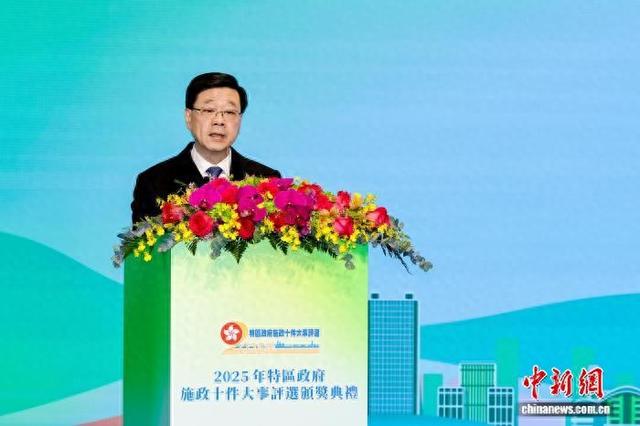
香港“2025年特区政府施政十件大事评选” “立法会选举成功举行”居首
Xin Lang Cai Jing· 2026-01-29 12:38
Group 1 - The "Top Ten Government Initiatives for 2025" award ceremony was held in Hong Kong, with the most notable initiative being the successful holding of the Legislative Council election, which reflects the public's interest in quality democracy [1][3] - The ten initiatives recognized cover various sectors including politics, economy, innovation and technology, public welfare, and Greater Bay Area integration, highlighting significant events such as a major fire incident, the hosting of sports events, and the establishment of an international mediation center [1][3] - The Chief Executive of Hong Kong, John Lee, emphasized the importance of the award as a platform for understanding public sentiment and outlined plans for 2026 to enhance governance and integrate with national development strategies [3] Group 2 - The event was organized by Hong Kong's Wen Wei Po and supported by 30 media outlets and 54 organizations, marking the 27th edition of this initiative since its inception in 1998 [3]

李家超:更好统筹发展和安全 主动融入和服务国家发展大局
智通财经网· 2026-01-14 06:00
Core Viewpoint - The Hong Kong government, led by Chief Executive John Lee, emphasizes the need for collaboration between the executive and legislative branches to address immediate issues such as post-fire support and reconstruction, while also focusing on long-term economic development and social welfare initiatives [1][2][4]. Group 1: Legislative and Executive Cooperation - The government aims to integrate and serve the national development agenda, aligning with the "14th Five-Year Plan" and enhancing Hong Kong's international competitiveness [1][3]. - There is a call for legislators to adhere to the Legislative Council's code of conduct, prioritizing national and societal interests over personal political gains [3][4]. - The government stresses the importance of balancing micro and macro interests in policy analysis, considering various systemic relationships [3][4]. Group 2: Post-Fire Support and Reconstruction - Immediate actions include addressing the aftermath of the fire at Hongfu Garden, with a focus on systematic reforms to prevent future tragedies [2][5]. - The government has established multiple working groups to coordinate emergency support, including financial aid and temporary housing for affected residents [5][6]. - A fund of HKD 4.3 billion has been raised to assist victims, with various forms of financial support being provided [6][9]. Group 3: Accountability and Systemic Reform - An independent committee has been formed to investigate the fire's causes and ensure accountability, with a commitment to reforming existing systems to prevent recurrence [7][9]. - The government is implementing targeted improvement measures across various sectors, including fire safety and building regulations, to enhance oversight and accountability [8][10]. - There is a strong emphasis on the need for systemic reforms to address long-standing issues revealed by the fire incident [9][10].
港澳平:香港特区第八届立法会主席选举成功再次证明新选举制度是一套好制度
Xin Lang Cai Jing· 2026-01-08 16:57
Group 1 - The successful election of the new Legislative Council Chairman reflects the effective implementation of the "patriots governing Hong Kong" principle and the new electoral system in Hong Kong [2][3] - The new electoral system, established in 2021, is deemed suitable for Hong Kong's actual conditions, balancing overall, sectoral, and regional interests while better reflecting public opinion and fostering a positive political culture [2] - The new electoral system aims to ensure that governance power remains firmly in the hands of patriots, safeguarding national sovereignty and the long-term stability of Hong Kong while promoting democratic rights and welfare for residents [2] Group 2 - The role of the Legislative Council Chairman is crucial, with expectations for the new chairman to lead the council in supporting the Chief Executive and the government in law-based governance [3] - The new chairman is anticipated to engage with the community and industries, enhancing high-level discussions and quality legislation to contribute to Hong Kong's development [3] - There is an emphasis on the Legislative Council's self-management and self-supervision, with a call for diligence and accountability from its members to showcase a new atmosphere in the council [3]
香港特区行政长官确定全体候任立法会议员宣誓有效
Xin Hua She· 2026-01-01 11:43
Core Viewpoint - The Hong Kong Special Administrative Region (HKSAR) government confirmed the validity of the oaths taken by all 90 incoming Legislative Council members during the swearing-in ceremony, emphasizing adherence to the Basic Law and loyalty to the People's Republic of China [1][2]. Group 1: Legislative Council Oath - The swearing-in ceremony was conducted under the supervision of Chief Executive John Lee, who affirmed that all oaths were valid according to the Basic Law and relevant legal provisions [1]. - The interpretation of Article 104 of the Basic Law, passed by the National People's Congress Standing Committee in November 2016, outlines the responsibilities of the oath-taker and the supervisor [1]. - The revised Oaths and Declarations Ordinance, effective from May 21, 2021, designates the Chief Executive or authorized persons as the oath supervisors for Legislative Council members [1]. Group 2: Responsibilities and Expectations - Chief Executive John Lee highlighted that the oath represents a solemn commitment from each Legislative Council member, marking the official start of their duties [2]. - He expressed the expectation that members would align with the principles of "patriots governing Hong Kong" and adhere to the Legislative Council Code of Conduct, considering the overall macro interests of society [2]. - Lee noted that this year marks the beginning of the national "14th Five-Year Plan" and emphasized the government's focus on deepening reforms, economic development, and improving people's livelihoods [2].
港澳平:不负期许创佳绩,乘势而上再扬帆
Xin Lang Cai Jing· 2026-01-01 06:24
Group 1 - President Xi Jinping emphasized the importance of the "One Country, Two Systems" policy and the integration of Hong Kong and Macau into the national development framework, expressing support for their long-term prosperity and stability [1] - The Hong Kong economy demonstrated strong resilience and vitality, ranking third in the Global Financial Centers Index and experiencing a 27.8% increase in the Hang Seng Index in 2025, with IPO activity doubling year-on-year [2] - Macau's economy is diversifying, with a 14.4% increase in inbound tourists in the first 11 months of 2025, and significant growth in industries such as traditional Chinese medicine and modern finance [3] Group 2 - The successful elections for the eighth Legislative Council in Hong Kong and Macau showcased the effectiveness of the new electoral system, with increased voter turnout and representation of public opinion [4] - Both regions are committed to maintaining national security, with strict enforcement of national security laws and significant legal actions against individuals threatening national stability [4] - The Hong Kong government effectively responded to a major fire incident in November 2025, demonstrating community solidarity and resilience, with support from various sectors and the central government [5][6] Group 3 - The development of the Northern Metropolis in Hong Kong is accelerating, with the establishment of the Hong Kong section of the Hong Kong-Shenzhen Innovation and Technology Park [2] - The Hengqin Guangdong-Macau Deep Cooperation Zone is making significant progress, with a 15.7% increase in Macau-invested enterprises and a 22.3% rise in youth entrepreneurship [3] - The implementation of social welfare improvements in both regions, including housing and healthcare reforms, has positively impacted the livelihoods of residents [3]
扎实推进“一国两制”实践和祖国统一大业
Jing Ji Ri Bao· 2025-12-29 22:17
Core Viewpoint - The article emphasizes the importance of the "One Country, Two Systems" policy as a strategic framework for national rejuvenation and unification, highlighting its role in maintaining stability and prosperity in Hong Kong and Macau while contributing to the overall development of the nation [1][2][7]. Group 1: Implementation of "One Country, Two Systems" - The "One Country, Two Systems" policy is a significant achievement of socialism with Chinese characteristics, aligning with the fundamental interests of the nation and the people, and is essential for the long-term stability of Hong Kong and Macau [2]. - The policy must be implemented accurately and unwaveringly, ensuring that it does not deviate from its original intent, with a focus on maintaining national sovereignty, security, and development interests [3][4]. Group 2: Integration with National Development - Hong Kong and Macau's integration into the national development framework is essential, providing them with unique advantages and aligning their interests with those of the nation [5]. - The construction of the Guangdong-Hong Kong-Macau Greater Bay Area enhances the resilience of Hong Kong and Macau's development, ensuring they have a solid backing from the nation amid global economic fluctuations [5]. Group 3: Achievements and Progress - Since their return to the motherland, Hong Kong and Macau have successfully implemented the "One Country, Two Systems" policy, leading to significant improvements in governance, economic growth, and social stability [7][8]. - Hong Kong's GDP has grown at an average annual rate of approximately 2.6% since its return, surpassing the average growth rate of developed economies during the same period [9]. Group 4: Strengthening National Identity and Values - There is a growing emphasis on patriotism and national identity in Hong Kong and Macau, with educational initiatives aimed at instilling a sense of belonging and understanding of national history among the youth [11]. - The promotion of core values related to patriotism is seen as essential for the long-term success of the "One Country, Two Systems" policy and for fostering a unified national identity [11]. Group 5: Future Directions and Challenges - The article outlines the need for continued exploration of the "One Country, Two Systems" framework as a model for peaceful unification with Taiwan, emphasizing the importance of addressing differences while promoting cooperation [12][16]. - It calls for deepening cross-strait integration and cultural exchanges to enhance mutual understanding and support for national rejuvenation efforts [14][15].