
行政主导

Search documents
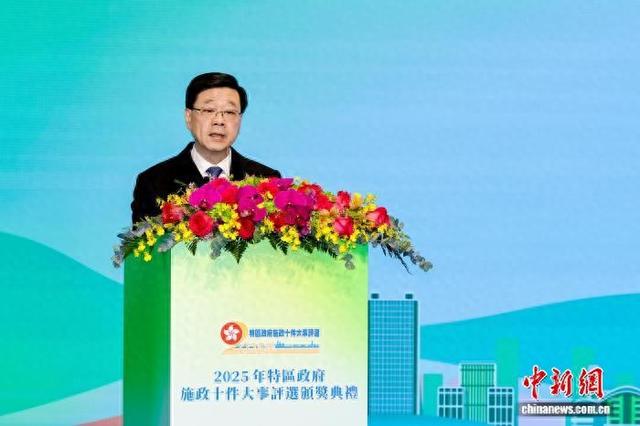
香港“2025年特区政府施政十件大事评选” “立法会选举成功举行”居首
Xin Lang Cai Jing· 2026-01-29 12:38
Group 1 - The "Top Ten Government Initiatives for 2025" award ceremony was held in Hong Kong, with the most notable initiative being the successful holding of the Legislative Council election, which reflects the public's interest in quality democracy [1][3] - The ten initiatives recognized cover various sectors including politics, economy, innovation and technology, public welfare, and Greater Bay Area integration, highlighting significant events such as a major fire incident, the hosting of sports events, and the establishment of an international mediation center [1][3] - The Chief Executive of Hong Kong, John Lee, emphasized the importance of the award as a platform for understanding public sentiment and outlined plans for 2026 to enhance governance and integrate with national development strategies [3] Group 2 - The event was organized by Hong Kong's Wen Wei Po and supported by 30 media outlets and 54 organizations, marking the 27th edition of this initiative since its inception in 1998 [3]

澳门各界人士:共同支持行政主导 实现澳门良政善治
Zhong Guo Xin Wen Wang· 2026-01-27 05:53
Core Viewpoint - The article emphasizes the importance of administrative leadership in ensuring good governance in Macau, with various stakeholders expressing their commitment to support the Chief Executive and the Special Administrative Region (SAR) government in this endeavor [1][2]. Group 1: Administrative Leadership - The National Hong Kong and Macau Research Association held a seminar discussing the need to uphold and improve administrative leadership as a system guarantee for accurately implementing the "One Country, Two Systems" principle [1]. - Macau's Legislative Assembly President, Zhang Yongchun, stated that the new Legislative Assembly will actively implement the principle of administrative leadership and enhance communication and collaboration with the SAR government [1]. - The Chief Justice of the Macau SAR, Song Minli, highlighted the judiciary's role as a crucial part of the administrative leadership system, emphasizing the need for independent judgment while cooperating with the government [1]. Group 2: Collaborative Governance - The Secretary for Administration and Justice, Huang Shaoze, mentioned that the administration will work under the Chief Executive's leadership to maintain and implement administrative leadership, aiming for good governance [1]. - Macau's National Committee member and Legislative Assembly member, Qiu Tingbiao, expressed his commitment to the "patriots governing Macau" principle, ensuring that he supports the government’s lawful administration and supervises it without overstepping [2]. - Suggestions were made for the SAR government to enhance its "householder awareness" and for the Legislative Assembly to support the government’s lawful administration, promoting a positive interaction between the executive and legislative branches [2].
香港各界:坚持和完善行政主导有利于香港长期繁荣稳定
Zhong Guo Xin Wen Wang· 2026-01-26 23:39
Core Viewpoint - The discussion emphasizes that adhering to and improving the administrative leadership system is crucial for Hong Kong's long-term prosperity and stability, promoting good governance [1][2]. Group 1: Administrative Leadership Benefits - The administrative leadership system helps consolidate consensus and efficiently align with national development strategies, enhancing Hong Kong's competitiveness [1]. - It is viewed as a means to unite various sectors of society, attract talent, and concentrate resources to address issues such as housing supply shortages, wealth disparity, and obstacles to youth upward mobility [1][2]. Group 2: Integration with National Development - The administrative leadership is seen as a safeguard against external interference, reinforcing national security and enabling Hong Kong to realize its strategic value in initiatives like the Belt and Road and the Guangdong-Hong Kong-Macao Greater Bay Area [2]. - The system is recognized as effective and aligned with the actual needs of Hong Kong, supporting the region's integration into the national development framework [2]. Group 3: Legislative Council's Role - The Legislative Council is tasked with supporting and supervising the government to enhance governance, ensuring a positive interaction between the executive and legislative branches [2]. - Council members are encouraged to engage with the community and fulfill their constitutional duties, fostering a collaborative environment under the administrative leadership system [2].
李家超:行政主导是实现特区高效治理、保障市民福祉的关键
Xin Lang Cai Jing· 2026-01-26 13:51
Core Viewpoint - The Chief Executive of Hong Kong, John Lee, emphasized that administrative leadership is essential for the practice of "One Country, Two Systems" and is key to efficient governance and the well-being of citizens [1][2] Group 1: Administrative Leadership - Administrative leadership is crucial for maintaining the constitutional order of the Special Administrative Region (SAR) and ensuring "Hong Kong people governing Hong Kong" with a high degree of autonomy [1] - It effectively safeguards national sovereignty, security, and development interests, ensuring long-term prosperity and stability for the SAR [1] - Administrative leadership is seen as a system that highlights the advantages of the "One Country, Two Systems" framework, providing solid support for the sustainable practice of this principle [1] Group 2: Governance Responsibilities - The SAR government will strengthen the awareness of local governance and take on the primary responsibility for governing Hong Kong, integrating administrative leadership into all aspects of governance [2] - The government aims to combine an active government with an efficient market to ensure that policy outcomes benefit the citizens [2] - The new Legislative Council is expected to support and oversee the government in its governance efforts, promoting economic development and improving the livelihood of the people [2] Group 3: Future Plans - The year 2026 marks the beginning of the national "14th Five-Year Plan" and is seen as a pivotal year for the SAR government to deepen reforms and focus on economic development and public welfare [2] - The SAR government will strive to align administrative leadership with the principle of "patriots governing Hong Kong" to contribute more significantly to national development and rejuvenation [2]
岑浩辉:将强化行政主导,凝聚合力推动良政善治
2 1 Shi Ji Jing Ji Bao Dao· 2026-01-26 11:37
Core Viewpoint - The seminar emphasized the importance of administrative leadership in ensuring good governance in the Macao Special Administrative Region (SAR), highlighting its role as a fundamental principle in the political system designed by the Basic Law and as a necessary requirement for effective governance [1][2]. Group 1: Administrative Leadership - Administrative leadership is crucial for maintaining the constitutional order of the SAR and ensuring "Macao people governing Macao" with a high degree of autonomy [1]. - The successful practice of the administrative leadership system in the SAR demonstrates its strong vitality and superiority [1]. - The Chief Executive and the SAR government must strengthen their sense of responsibility as the primary leaders in governance, supported by the legislative and judicial branches, to create a strong governance synergy [1][2]. Group 2: Economic Development and National Security - The SAR government will focus on economic development and improving people's livelihoods while maintaining the rule of law to safeguard national security [3]. - By leveraging administrative leadership, the SAR aims to effectively align with the national "14th Five-Year Plan," enhancing its proactive approach to future development [3]. - The government plans to enhance citizens' sense of participation and benefit in the economic diversification process through efficient governance and targeted policies [3]. Group 3: Social Collaboration - Strengthening and perfecting administrative leadership requires collaboration from all sectors of society to form a shared responsibility community [4]. - The SAR government is expected to govern according to the law, take responsibility, and make scientific decisions to improve governance effectiveness [4]. - The Legislative Assembly should actively supervise and support the government while reflecting public opinion and providing constructive suggestions to promote alignment between legislative and administrative goals [4].
“坚持和完善行政主导 促进特别行政区良政善治”专题研讨会在京举行
Xin Hua She· 2026-01-26 07:40
Core Viewpoint - The seminar emphasizes the importance of "administrative leadership" in enhancing governance efficiency and promoting high-quality development in Hong Kong and Macau, as directed by President Xi Jinping [2]. Group 1: Administrative Leadership - Administrative leadership is a fundamental principle in the political system of the Special Administrative Regions (SARs), rooted in the Constitution of the People's Republic of China, and serves as a system guarantee for the accurate implementation of the "One Country, Two Systems" policy [2]. - The successful practice of administrative leadership in Hong Kong and Macau demonstrates its strong vitality and superiority, highlighting the need for the Chief Executives and SAR governments to take responsibility for governance [2]. - The new Legislative Council is expected to fulfill its duties and support the Chief Executives and SAR governments in law-based governance, contributing to the construction of a better Hong Kong and Macau [2]. Group 2: Importance of the Seminar - Experts and scholars at the seminar unanimously agree that adhering to and improving administrative leadership is crucial for implementing the "One Country, Two Systems" policy, maintaining long-term prosperity and stability in Hong Kong and Macau, and promoting good governance [3]. - The seminar included remote participation from the Chief Executives of Hong Kong and Macau, indicating a collaborative approach to governance and policy implementation [3].
李家超:更好统筹发展和安全 主动融入和服务国家发展大局
智通财经网· 2026-01-14 06:00
Core Viewpoint - The Hong Kong government, led by Chief Executive John Lee, emphasizes the need for collaboration between the executive and legislative branches to address immediate issues such as post-fire support and reconstruction, while also focusing on long-term economic development and social welfare initiatives [1][2][4]. Group 1: Legislative and Executive Cooperation - The government aims to integrate and serve the national development agenda, aligning with the "14th Five-Year Plan" and enhancing Hong Kong's international competitiveness [1][3]. - There is a call for legislators to adhere to the Legislative Council's code of conduct, prioritizing national and societal interests over personal political gains [3][4]. - The government stresses the importance of balancing micro and macro interests in policy analysis, considering various systemic relationships [3][4]. Group 2: Post-Fire Support and Reconstruction - Immediate actions include addressing the aftermath of the fire at Hongfu Garden, with a focus on systematic reforms to prevent future tragedies [2][5]. - The government has established multiple working groups to coordinate emergency support, including financial aid and temporary housing for affected residents [5][6]. - A fund of HKD 4.3 billion has been raised to assist victims, with various forms of financial support being provided [6][9]. Group 3: Accountability and Systemic Reform - An independent committee has been formed to investigate the fire's causes and ensure accountability, with a commitment to reforming existing systems to prevent recurrence [7][9]. - The government is implementing targeted improvement measures across various sectors, including fire safety and building regulations, to enhance oversight and accountability [8][10]. - There is a strong emphasis on the need for systemic reforms to address long-standing issues revealed by the fire incident [9][10].
香港特区行政长官确定全体候任立法会议员宣誓有效
Xin Hua She· 2026-01-01 11:43
Core Viewpoint - The Hong Kong Special Administrative Region (HKSAR) government confirmed the validity of the oaths taken by all 90 incoming Legislative Council members during the swearing-in ceremony, emphasizing adherence to the Basic Law and loyalty to the People's Republic of China [1][2]. Group 1: Legislative Council Oath - The swearing-in ceremony was conducted under the supervision of Chief Executive John Lee, who affirmed that all oaths were valid according to the Basic Law and relevant legal provisions [1]. - The interpretation of Article 104 of the Basic Law, passed by the National People's Congress Standing Committee in November 2016, outlines the responsibilities of the oath-taker and the supervisor [1]. - The revised Oaths and Declarations Ordinance, effective from May 21, 2021, designates the Chief Executive or authorized persons as the oath supervisors for Legislative Council members [1]. Group 2: Responsibilities and Expectations - Chief Executive John Lee highlighted that the oath represents a solemn commitment from each Legislative Council member, marking the official start of their duties [2]. - He expressed the expectation that members would align with the principles of "patriots governing Hong Kong" and adhere to the Legislative Council Code of Conduct, considering the overall macro interests of society [2]. - Lee noted that this year marks the beginning of the national "14th Five-Year Plan" and emphasized the government's focus on deepening reforms, economic development, and improving people's livelihoods [2].
深信新一届立法会将与特区政府共同带领香港深化改革同创未来
Ren Min Ri Bao· 2025-12-08 20:36
Group 1 - The eighth Legislative Council election in Hong Kong was successfully held, with all 90 members elected, reflecting the community's support for the government's post-disaster reconstruction and reform efforts [1][2] - Chief Executive John Lee emphasized the significance of the election in demonstrating the unity and mutual support of the citizens during challenging times, as well as the adherence to constitutional order and the rule of law [1][2] - The election was characterized by active participation from candidates in 39 public forums, showcasing high-quality competition and adherence to principles of broad representation, balanced participation, and fair competition [1] Group 2 - The voting process was smooth, and the government plans to summarize experiences to further optimize future elections, acknowledging the efforts of the Election Management Committee and volunteers [2] - There is an expectation for the new Legislative Council members to collaborate with the government in promoting post-disaster support and reconstruction, as well as initiating debates and legislative reviews for systematic reforms [2] - The Chief Executive expressed confidence that the new council members will engage with communities, understand public sentiment, and contribute to deepening reforms and creating a better future for Hong Kong [2]