现代企业治理体系

Search documents
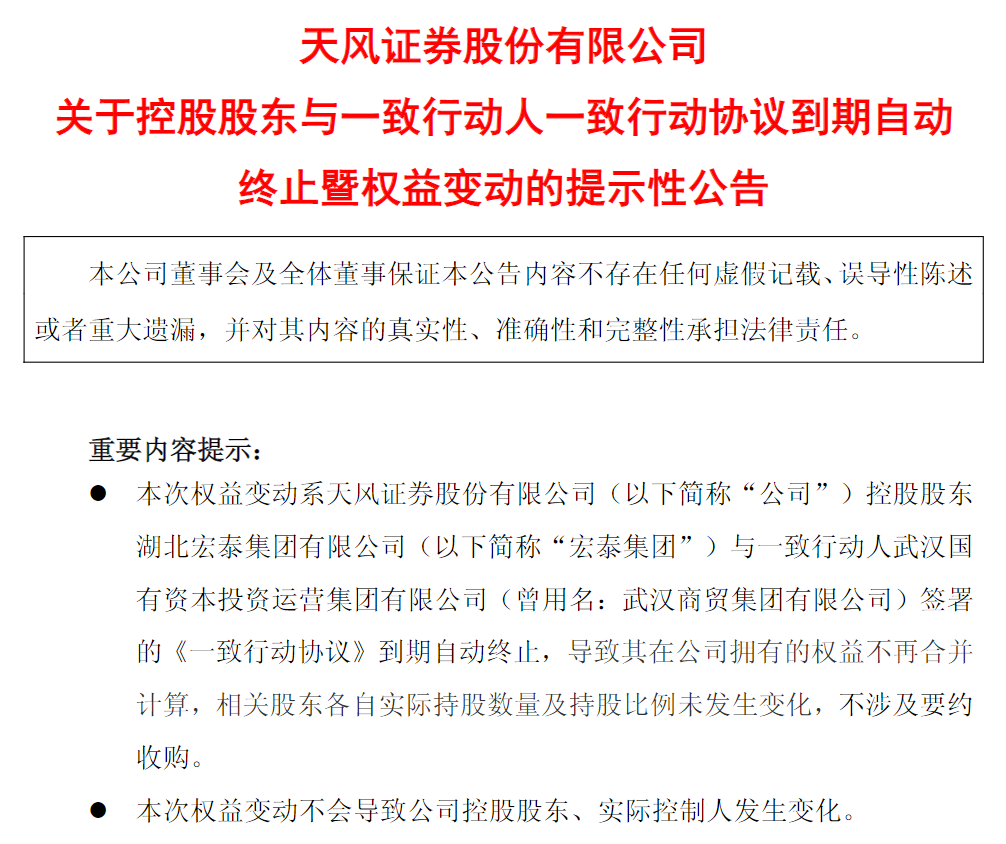
单一控股地位强化,天风证券控股股东持股比例已达28.33%
2 1 Shi Ji Jing Ji Bao Dao· 2025-12-30 03:02
Core Viewpoint - The termination of the "Joint Action Agreement" between Hubei Hongtai Group and Wuhan State-owned Capital Investment Operation Group does not affect the shareholding stability and governance structure of Tianfeng Securities, as Hubei Hongtai Group has increased its stake to 28.33% [1][2][6]. Group 1: Shareholding Changes - Hubei Hongtai Group's stake in Tianfeng Securities has increased to 28.33% as of 2024, surpassing both its previous holding and the combined holding with Wuhan State-owned Capital [2][9]. - The "Joint Action Agreement" initially allowed Hubei Hongtai Group and Wuhan State-owned Capital to collectively hold 22.62% of Tianfeng Securities, ending the situation of no controlling shareholder [6][10]. - Following the termination of the agreement, the shareholding rights of the related shareholders will no longer be combined, but their individual shareholdings remain unchanged [6][8]. Group 2: Financial Performance and Liquidity Issues - As of the end of Q3 2025, Tianfeng Securities' net stable funding ratio was 106.78%, falling below the regulatory warning line of 120%, raising concerns about liquidity [2][12]. - To address liquidity challenges, Tianfeng Securities has implemented several measures, including extending a 40 billion yuan subordinated debt and reducing its interest rate from 5% to 4% [12][10]. - The company has also issued three short-term financing bonds totaling 70 billion yuan to enhance its financing capabilities [14]. Group 3: Corporate Governance and Strategic Development - Since Hubei Hongtai Group took effective control of Tianfeng Securities in February 2023, the company has undergone systematic reforms aimed at establishing a modern corporate governance structure [15]. - In the first nine months of 2025, Tianfeng Securities reported a revenue of 21.12 billion yuan, a year-on-year increase of 57.53%, and achieved a net profit of 1.53 billion yuan, marking a turnaround from losses [15]. - Tianfeng Securities is focusing on high-quality development and has signed cooperation agreements with 22 local banking institutions to optimize its financial capital layout [16].


宗馥莉出走娃哈哈:国民品牌"分家"风波背后的商业博弈
Sou Hu Cai Jing· 2025-10-11 06:33
Group 1 - The core event is the resignation of Zong Fuli from all management positions at Wahaha Group, retaining only the status of the second-largest shareholder, marking a significant shift in the Chinese beverage industry [2] - This resignation is part of a deeper power struggle, as Zong Fuli has completely relinquished her 29.4% equity decision-making power, positioning herself as a pure financial investor due to her disappointment with the trademark control of Wahaha [3] Group 2 - The trademark "Wahaha" has become a major obstacle for Zong Fuli's ambitions, as the current system requires unanimous consent from three major shareholders for trademark authorization, limiting her operational control [4] - Zong Fuli has registered multiple defensive trademarks, including "Wawa Xiaozong" and "Wawa Xiaohar," indicating her long-term strategy for brand independence [4] Group 3 - The separation reflects a typical property rights dilemma, where the separation of trademark ownership and operational systems creates structural contradictions, leading to a potential dual loss for both parties involved [5] - Zong Fuli retains production capabilities but loses the brand premium valued in the billions, while Wahaha Group keeps its brand but loses its production backbone [5] Group 4 - Uncertainties remain regarding the future leadership of Wahaha Group and whether other "Zong faction" board members will follow suit in resigning, which could significantly impact the situation [6] - The departure of the last family manager from the Zong era places the "Wahaha" brand at a crossroads, highlighting the need for a modern corporate governance system to avoid conflicts in business decisions [6]