现时偏差

Search documents
应对长寿时代挑战 存钱养老观念亟须升级
Jin Rong Shi Bao· 2025-12-10 02:03
Core Insights - The article emphasizes the need for a comprehensive retirement planning approach that addresses financial, health, housing, and inheritance dimensions due to the increasing longevity risk faced by individuals [1][2]. Financial Dimension - The financial aspect focuses on balancing "future lifespan" with "asset lifespan" through diversified asset allocation, ensuring that asset consumption does not outpace life expectancy [2]. - The current low-interest environment has led to a scarcity of safe investment options, pushing individuals towards riskier financial products [1]. Health Dimension - The goal is to extend healthy life expectancy to align closely with natural lifespan, which requires both basic health insurance and proactive personal health management [2]. - This creates new opportunities for the integration of insurance and health management services [2]. Housing Dimension - Early planning for retirement living arrangements and care resources is essential, as many quality elderly care facilities are in high demand [2]. - Assessing and modifying existing housing for suitability for elderly residents is also crucial [2]. Inheritance Dimension - Inheritance planning involves not only wealth transfer but also arrangements for elder care and asset management oversight [2]. - The concept of "designated guardianship" is highlighted, allowing elderly individuals to appoint guardians for their care and financial matters, which is currently underutilized [2]. Age-Specific Planning - Different age groups should focus on varying aspects of retirement planning, with an emphasis on starting early, saving more, and diversifying assets [3]. - Regular financial health check-ups are recommended for all age groups to adjust planning according to changing family and economic conditions [3]. - Risk tolerance generally decreases with age, necessitating a more conservative asset allocation strategy [3].
“钱袋子”从储蓄转向投资理财市场
Sou Hu Cai Jing· 2025-12-09 23:11
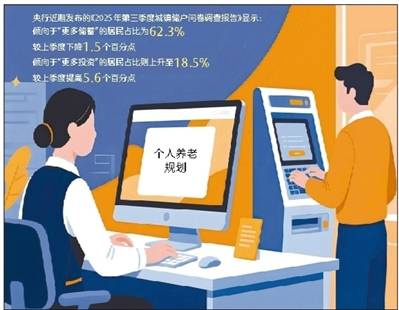
Core Viewpoint - The shift in deposit interest rates and the increasing focus on retirement planning among the younger generation highlight a significant change in financial behavior, with a move towards diversified investment strategies rather than traditional savings accounts [2][3][5]. Group 1: Deposit Rate Changes - Industrial and Commercial Bank of China raised the minimum deposit for three-year large-denomination certificates of deposit from 200,000 yuan to 1,000,000 yuan, while maintaining an interest rate of 1.55% [2]. - Major state-owned banks have removed five-year large-denomination certificates of deposit, and three-year deposit rates have generally fallen to a range of 1.5% to 1.75% [2]. Group 2: Changing Investment Behavior - A survey by the People's Bank of China indicated that the proportion of residents preferring "more savings" decreased to 62.3%, while those favoring "more investments" rose to 18.5% [3]. - Household deposits decreased by 1.34 trillion yuan in October 2025, while deposits in non-bank financial institutions increased by 1.85 trillion yuan, indicating a shift of funds from traditional savings to investment markets [3]. Group 3: Diversified Investment Strategies - Young individuals are increasingly adopting diversified investment strategies, with some opting for financial products with annualized returns of 2.25%, which are significantly higher than traditional savings interest [4]. - Investment in various products such as money market funds, bond funds, and gold ETFs is being pursued to preserve and grow wealth within acceptable risk levels [4]. Group 4: Retirement Planning Transformation - Experts suggest that young people need to adopt a proactive approach to retirement planning, focusing not only on monthly savings but also on the conversion of savings into passive income [5]. - The duration for personal retirement fund accumulation has extended from 15-20 years to 25-30 years or more, making reliance solely on savings insufficient to cover future needs [5]. Group 5: Personal Pension Products - As of December 3, 2025, there are 1,255 personal pension products available, with savings products making up 37.1%, insurance products 35.5%, and fund products 24.4% [6]. - The majority of available personal pension insurance products are annuity insurance, which accounts for 62.1% of the total [6]. Group 6: Performance of Pension Financial Products - Despite a decline in the yield of 10-year government bonds below 1.8%, certain insurance products maintain stable rates due to their guaranteed mechanisms, with some offering rates above 3% [7]. - Young individuals are increasingly interested in pension planning, with many evaluating the best personal pension products to purchase, considering tax benefits and long-term compounding advantages [7].