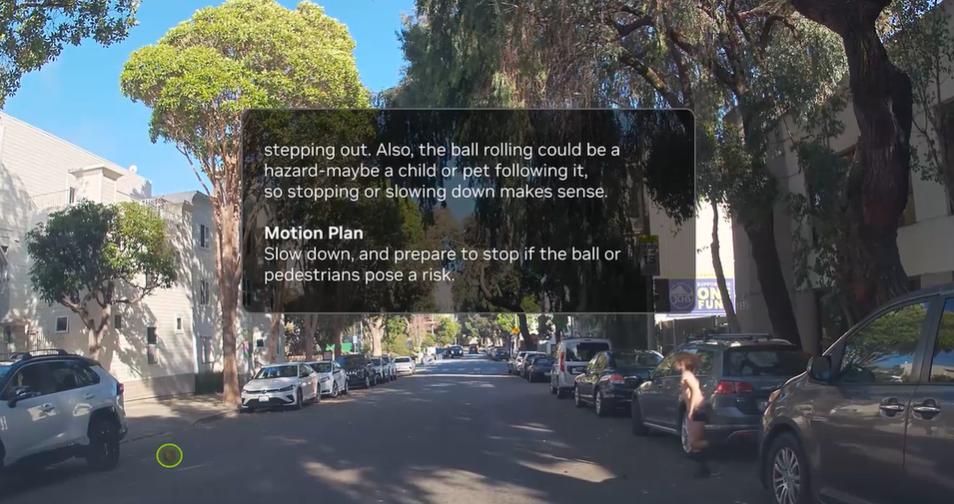
理解型自动驾驶

Search documents
英伟达开源自动驾驶软件,中国车企要接吗?
汽车商业评论· 2025-12-03 23:07
Core Insights - The article discusses the launch of the Alpamayo-R1 model by NVIDIA, which is the world's first open-source visual-language-action (VLA) model designed for autonomous driving scenarios, enhancing decision-making through "chain reasoning" [5][10][12] - The model significantly improves safety in complex long-tail scenarios, achieving a 12% increase in planning accuracy, a 35% reduction in accident rates, and a 25% decrease in near-miss incidents [10][12] - NVIDIA's strategy includes expanding its ecosystem influence by providing open-source technology, allowing automakers to quickly assemble autonomous driving systems [14][16] Technical Advancements - The Alpamayo-R1 model processes sensor data into natural language descriptions, enabling step-by-step reasoning similar to human drivers [5][10] - The model's low latency response of 99 milliseconds enhances its effectiveness in real-time decision-making [10] - The accompanying Cosmos developer toolchain offers resources for data construction, scene generation, and model evaluation, facilitating model fine-tuning and deployment [12] Strategic Considerations - NVIDIA's move to open-source its core algorithms is seen as a strategic effort to solidify its market position and drive demand for its hardware, such as the Orin/Thor automotive-grade chips [14][16] - The initiative is expected to establish industry standards for safety and evaluation, aligning with global regulatory demands for transparency in autonomous driving [19] - The shift from closed to open-source models in the autonomous driving sector may trigger a new wave of open-source development, as decision-making algorithms become critical competitive factors [24] Industry Impact and Opportunities - NVIDIA's open-source approach intensifies competition between open-source and closed-source ecosystems in the autonomous driving industry [21][24] - Chinese automakers, heavily reliant on NVIDIA's platforms, stand to benefit from the open-source tools for local algorithm development and scene tuning [26][27] - However, the industry faces challenges, including a significant talent gap in autonomous driving engineering, with a projected shortfall of over one million professionals by 2025 [29][30]


NVIDIA开源 Alpamayo-R1:让车真正“理解”驾驶
3 6 Ke· 2025-12-03 04:27
Core Insights - NVIDIA announced the launch of Alpamayo-R1, the world's first open-source Vision-Language-Action Model specifically designed for autonomous driving research, marking a shift from perception-driven systems to semantic understanding and common-sense reasoning [1][12] Group 1: Model Features - Alpamayo-R1 is built on the Cosmos-Reason architecture, introducing a "Chain-of-Thought" mechanism that allows the model to break down complex driving tasks into interpretable reasoning steps [4] - The model enhances robustness in operational design domain (ODD) boundary conditions, particularly addressing long-tail challenges faced by Level 4 autonomous driving [4][6] - Unlike traditional end-to-end models that map images directly to control signals, Alpamayo-R1 enables vehicles to "understand why" certain actions are taken, mimicking human-like multi-step reasoning in complex scenarios [6] Group 2: Open Source and Development Tools - NVIDIA has open-sourced the Alpamayo-R1 model weights and released the Cosmos Cookbook, a comprehensive AI development toolkit for autonomous driving [7] - The toolkit includes high-quality data construction standards, synthetic data generation pipelines, lightweight deployment solutions, and safety assessment benchmarks [7] Group 3: Collaborative Driving Systems - NVIDIA, in collaboration with Carnegie Mellon University, introduced the V2V-GoT system, the first framework applying Graph-of-Thought reasoning for multi-vehicle collaborative autonomous driving [9] - This system significantly reduces intersection collision rates from 2.85% to 1.83% and accurately predicts surrounding vehicles' movements within three seconds [9] Group 4: Synthetic Data Generation - The performance of Alpamayo-R1 is supported by NVIDIA's advanced synthetic data generation capabilities, utilizing the Cosmos world model trained on 20,000 hours of real driving footage [11] - This synthetic data addresses the scarcity of real-world long-tail distributions and supports closed-loop adversarial training for emergency response capability testing [11] Group 5: Strategic Implications - The release of Alpamayo-R1 represents a significant step in NVIDIA's "physical AI" strategy, moving beyond a perception-planning-control pipeline to create embodied agents that understand physical laws and social norms [12] - The open-source strategy is expected to accelerate global research and development in the next generation of autonomous driving technologies [13]