理财观念转变

Search documents
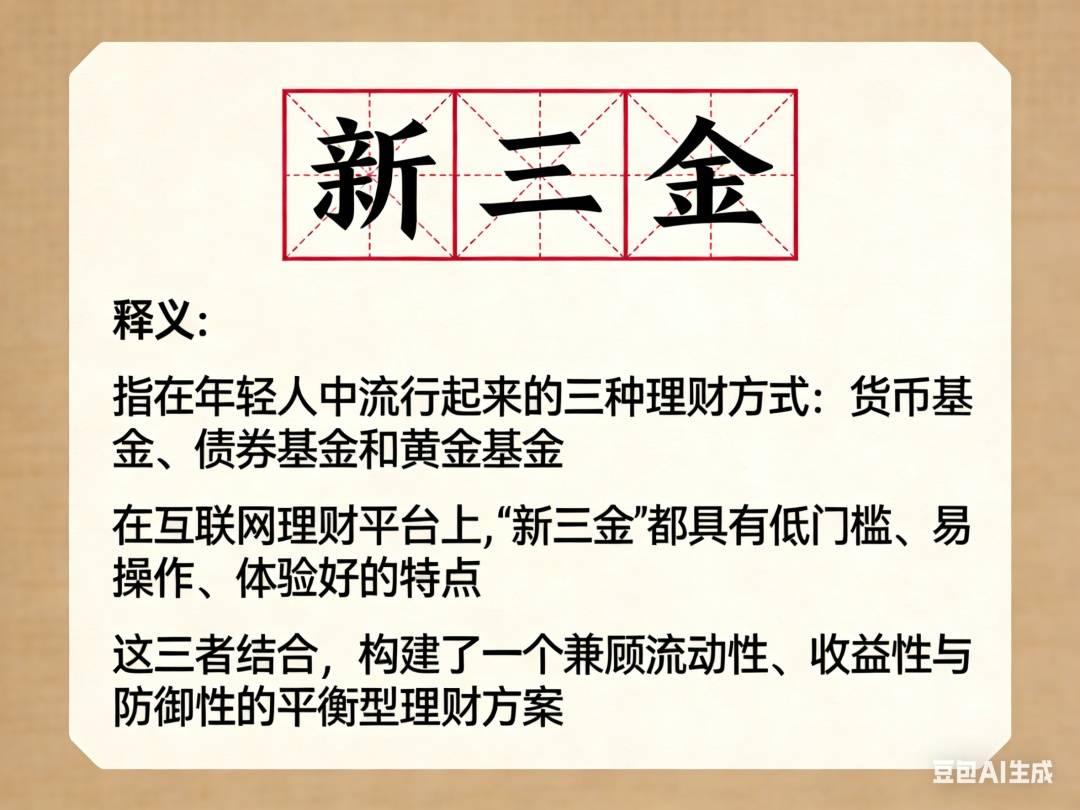
经济热点快评|理财观念进阶!年轻人青睐“新三金”
Sou Hu Cai Jing· 2026-02-05 14:51
Core Viewpoint - The rise of the "New Three Golds," consisting of money market funds, bond funds, and gold funds, reflects a shift in investment preferences among young people, moving away from traditional savings to diversified asset allocation [1][2][3] Group 1: Investment Trends - Over 21 million users are expected to adopt the "New Three Golds" by the end of 2025, with nearly half being young individuals [1] - The decline in bank deposit interest rates and the volatility of the stock market have led young investors to seek safer and more stable investment options [1][2] - The combination of high liquidity, stable returns, and defensive attributes in the "New Three Golds" creates a balanced investment strategy [1][2] Group 2: User Experience and Preferences - Internet financial platforms offer low entry barriers, ease of operation, and a user-friendly experience, making it easier for young investors to engage with these funds [2] - The design of these platforms enhances transparency and reduces the complexity traditionally associated with financial products, aligning with the preferences of younger investors [2] - Young investors are transitioning from passive savings to active investment strategies, focusing on long-term wealth accumulation and financial literacy [2][3] Group 3: Industry Implications - The emergence of the "New Three Golds" indicates a need for the financial industry to shift from a product-centric to a customer-centric approach [3] - Financial institutions are encouraged to innovate products, upgrade services, and refine risk management to meet the demands for safe, profitable, and liquid financial products [3]

别被误导!中国仍是全球储蓄第一,百姓的钱都转去这3处了
Sou Hu Cai Jing· 2025-08-27 22:31
Core Insights - The wealth allocation of Chinese households is shifting from traditional savings to diversified investment strategies, reflecting a growing financial awareness and maturity in asset allocation [1][5]. Group 1: Wealth Allocation Trends - In 2024, the scale of money market funds and cash management products surged by 2.3 trillion yuan, while bond funds grew by 1.2 trillion yuan, and insurance products increased by 2.8 trillion yuan, indicating a significant shift in wealth distribution [1]. - The traditional model of "putting all eggs in one basket" is being replaced by a more diversified approach, with investments spreading across various financial products such as funds, insurance, and other investment vehicles [1][5]. Group 2: Characteristics of Financial Products - Financial products have become more accessible, with lower entry thresholds such as money market funds starting at 1 yuan and bank wealth management products starting at 1,000 yuan, making them more appealing to the general public [3]. - The convenience of these products, along with their potential for steady growth, has led to their increased adoption among ordinary households [3]. Group 3: Demographic Differences in Investment Behavior - High-income families are more aggressive in their investment strategies, balancing between safety and high returns by investing in precious metals, commercial insurance, and mixed funds [3][5]. - Middle-income families prioritize stability, allocating 80% of their funds to low-risk products like money market and bond funds, while low-income families are beginning to adopt gradual investment habits, such as monthly contributions to money market funds [3][5]. - Younger generations (20-30 years) are more open to high-risk investments like stocks and index funds, while middle-aged individuals (30-50 years) focus on stable investments and insurance products for family security [5]. Group 4: Misconceptions about Debt Levels - Common misconceptions regarding high debt levels in China often stem from differences in statistical standards; when calculated similarly to Western countries, Chinese household debt-to-income ratios remain within safe limits [5].