
生活成本压力

Search documents
LVMH第四季度时装和皮具业务销售疲软 表明奢侈品公司继续承压
Xin Lang Cai Jing· 2026-01-27 19:38
Core Viewpoint - LVMH's fashion and leather goods division experienced a 3% decline in organic sales during the holiday season, indicating ongoing pressure from weak demand [1][4]. Group 1: Sales Performance - The organic sales decline in the fashion and leather goods sector was greater than the analyst expectation of a 2.94% drop [1][4]. - Despite the challenges in the fashion sector, LVMH's overall sales managed to achieve a slight increase due to better-than-expected performance in the watch and jewelry segment [3][7]. - In the fourth quarter, organic sales in the U.S. and regions including China grew by 1%, surpassing analyst forecasts, while Europe and Japan saw declines of 2% and 5%, respectively, both exceeding expectations [3][7]. Group 2: Financial Outlook - LVMH reported a recurring operating profit of €17.8 billion for the year, reflecting a 9.3% year-on-year decline, but still better than analyst expectations [3][7]. - CEO Bernard Arnault indicated that the company is facing a challenging operating environment and warned that 2026 is unlikely to be smooth, leading to spending restrictions for the year [1][4]. Group 3: Market Conditions - The luxury goods sector is struggling to rebound from a post-pandemic slump due to rising living costs and geopolitical uncertainties affecting consumer spending [5]. - Significant price increases have also led to strong consumer dissatisfaction, further complicating the market landscape for luxury brands [5].


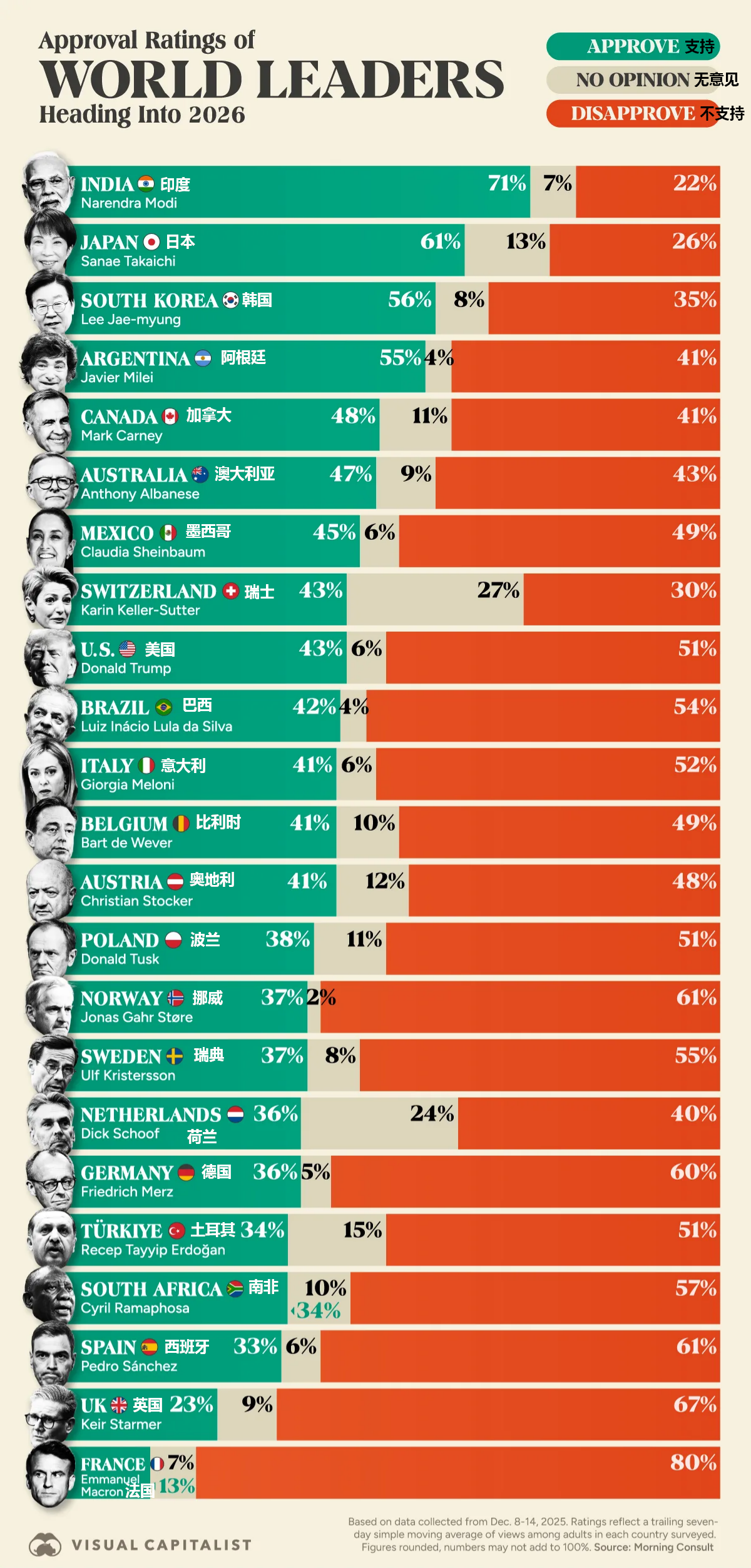
迈向2026年,全球多位主要领导人民调支持率一览
Ge Long Hui· 2025-12-27 01:44
Core Insights - The survey conducted by Morning Consult from December 8 to 14, 2025, indicates a decline in support rates for several global leaders, with Indian Prime Minister Modi leading at 71%, down from 75% in January 2025, reflecting ongoing inflation and political fatigue among voters [1][2]. Group 1: Leader Support Rates - Indian Prime Minister Narendra Modi holds the highest support rate at 71%, a decrease of 4% from earlier in the year [1][3]. - Japanese Prime Minister Sanae Takaichi and South Korean President Lee Jae-myung rank second and third with support rates of 61% and 56%, respectively [2][3]. - U.S. President Donald Trump has a support rate of 43%, with a disapproval rate of 51%, placing him in the middle of the rankings [2][3]. Group 2: Comparative Analysis - Leaders from Japan, South Korea, Canada, Austria, and Belgium have seen increases in their support rates, attributed to changes in leadership [1]. - French President Emmanuel Macron ranks lowest with a support rate of only 13% and a disapproval rate nearing 80% [2][3].
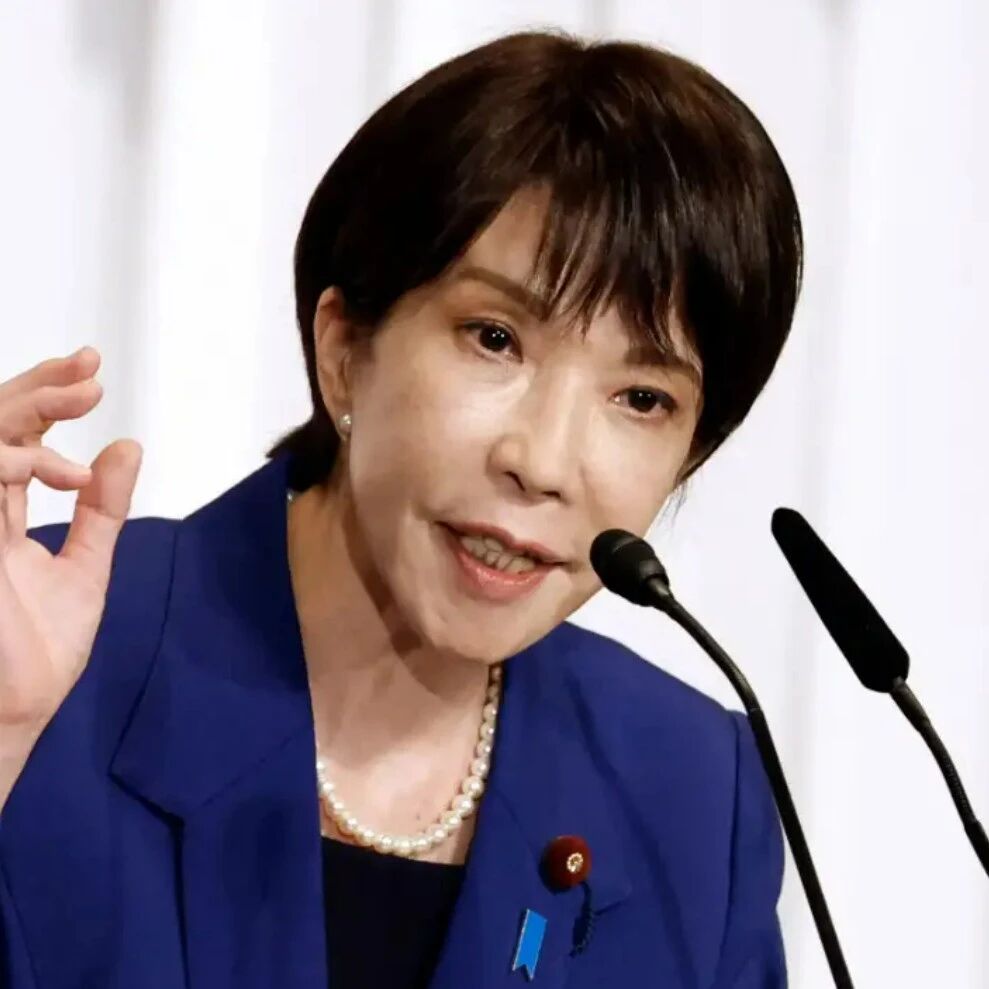
“高市得罪另一个邻国”
中国基金报· 2025-12-23 03:35
Group 1 - The article discusses the provocative remarks made by Japan's Minister of Internal Affairs and Communications, Takashi Sawa, regarding territorial disputes with South Korea, specifically about the islands known as Takeshima in Japan and Dokdo in South Korea, which he claims as Japanese territory [2] - The timing of Sawa's statements is questioned, suggesting they are politically motivated rather than based on policy considerations, potentially distracting from domestic issues in Japan [2] - The article emphasizes that public support is a fleeting snapshot of public sentiment and does not objectively measure policy effectiveness or governance, indicating that provocative rhetoric cannot replace tangible policy outcomes [2]
高市早苗得罪韩国
第一财经· 2025-12-23 01:16
Group 1 - The article discusses provocative remarks made by Japan's Minister of Internal Affairs, Takashi Saito, regarding the territorial dispute over the islands known as Takeshima in Japan and Dokdo in South Korea, labeling them as Japanese territory [1][3] - Saito's statements are seen as politically motivated rather than based on policy considerations, potentially distracting from domestic issues in Japan [1][3] - The article emphasizes that public support is a fleeting snapshot of sentiment and does not accurately reflect policy effectiveness or governance, suggesting that provocative rhetoric cannot substitute for tangible policy outcomes [1][3]

环联:香港家庭收入第四季仍维持稳定 信贷不再被视为“必需品”
智通财经网· 2025-12-19 02:49
Core Insights - The consumer survey by环联 indicates that despite ongoing pressure in the job market, household income in Hong Kong remains stable, reflecting resilience among consumers [1][2] - Consumers are adopting a more cautious approach towards credit, viewing it as a choice that requires careful consideration rather than a necessity [1][3] Group 1: Employment and Income Stability - The unemployment rate in Hong Kong reached a three-year high of 8% among youth by the end of Q3 2025, yet over half of consumers reported stable income over the past three months, an increase of three percentage points from the previous year [1] - The percentage of respondents reporting a decrease in income fell from 14% last year to 12% this year, indicating a generally stable financial situation for most households [1] Group 2: Consumer Sentiment and Financial Outlook - In Q4 2025, only a small percentage of consumers expressed concerns about being unable to pay at least one current bill or loan, dropping to a five-quarter low of 20% [2] - 54% of respondents expressed optimism about their household financial outlook for the coming year, a slight increase of two percentage points year-on-year [2] Group 3: Cost of Living and Financial Management - Over 60% of respondents identified inflation of daily necessities as the primary concern affecting their household finances in the next six months, followed by employment prospects [2] - Consumers are prioritizing emergency savings and retirement funds, with 38% and 20% respectively increasing these savings in the past three months [3] Group 4: Changes in Credit Perception - Less than half of respondents view credit and loan products as very or extremely important for achieving financial goals, a decrease from 53% in Q4 2024 [3][4] - Confidence in obtaining necessary credit has dropped significantly, with only 61% of Generation Z feeling confident about their credit applications being approved, a decline of 15 percentage points year-on-year [4]