
需求疲软

Search documents
黑色金属数据日报-20260318
Guo Mao Qi Huo· 2026-03-18 07:56
Group 1: Report Investment Rating - No information provided Group 2: Core Views - For steel, the unilateral market is expected to have a pulse rebound, and short - term participation is recommended. For the spot - futures relationship, it is recommended to focus on the opportunity of going long on the basis of hot - rolled coils [2][6]. - For ferrosilicon and silicomanganese, the cost support is limited, and weak demand restricts the upward space. The market is characterized by range - bound trading. It is advisable to adopt a low - buying short - term long strategy [2][4][6]. - For coking coal and coke, the spot market sentiment is temporarily stable. The futures market is mainly influenced by geopolitical conflicts. It is recommended to temporarily wait and see on the unilateral market and consider gradually establishing spot - futures arbitrage positions [6][7]. - For iron ore, recent market rumors have led to large price fluctuations. It is not advisable to chase high prices, and it is recommended to buy on dips [7]. Group 3: Content Summary by Categories Futures Market - On March 17, for far - month contracts, the closing prices of RB2610, HC2610, I2609, J2609, and JM2609 were 3168.00 yuan/ton, 3314.00 yuan/ton, 785.50 yuan/ton, 1809.50 yuan/ton, and 1282.00 yuan/ton respectively, with corresponding changes of 8.00 yuan, 14.00 yuan, 13.00 yuan, - 7.00 yuan, and 1.50 yuan, and percentage changes of 0.25%, 0.42%, 1.68%, - 0.39%, and 0.12% [1]. - For near - month (main) contracts, the closing prices of RB2605, HC2605, I2605, J2605, and JM2605 were 3148.00 yuan/ton, 3313.00 yuan/ton, 816.50 yuan/ton, 1732.00 yuan/ton, and 1176.00 yuan/ton respectively, with corresponding changes of 13.00 yuan, 19.00 yuan, 14.50 yuan, - 10.00 yuan, and - 5.00 yuan, and percentage changes of 0.41%, 0.58%, 1.81%, - 0.57%, and - 0.42% [1]. - The cross - month spreads and price differences such as the spread between RB2605 and RB2610, HC2605 and HC2610, etc., as well as the spread/ratio/profit data such as the coil - to - rebar spread, rebar - to - ore ratio, etc., also had corresponding changes on March 17 [1]. Spot Market - On March 17, the spot prices of Shanghai rebar, Tianjin rebar, Guangzhou rebar, Tangshan billet, and the Platts Index were 3260.00 yuan/ton, 3220.00 yuan/ton, 3430.00 yuan/ton, 2980.00 yuan/ton, and 110.00 respectively, with corresponding changes of 12.00 yuan, 20.00 yuan, 0.00 yuan, 10.00 yuan, and 1.20 [1]. - The spot prices of Shanghai hot - rolled coil, Hangzhou hot - rolled coil, Guangzhou hot - rolled coil, billet - to - product spread, and Rizhao Port PB ore were 3300.00 yuan/ton, 3320.00 yuan/ton, 3290.00 yuan/ton, 280.00 yuan/ton, and 790.00 yuan/ton respectively, with corresponding changes of 10.00 yuan, 0.00 yuan, 0.00 yuan, - 10.00 yuan, and 0.00 yuan [1]. - The spot prices of Qingdao Port super special powder, etc., also had corresponding changes on March 17 [1]. Specific Commodity Analysis - **Steel**: Spot prices rose slightly on Tuesday, and futures prices closed slightly higher. The industry is expected to enter a stage of strong supply and demand. High inventory restricts the rebound elasticity. There is an opportunity to go long on the basis or conduct spot - futures positive arbitrage [2]. - **Ferrosilicon and Silicomanganese**: The geopolitical conflict in the Middle East mainly affects through sentiment. The cost support is limited, and the demand is weak. The market is range - bound. It is recommended to operate within the range and not chase high prices [2][4]. - **Coking Coal and Coke**: The spot market sentiment is stable. The futures market is affected by geopolitical conflicts. The coking profit has been repaired. It is necessary to focus on geopolitical changes [7]. - **Iron Ore**: Market rumors have caused large price fluctuations. If the supply is restricted, there will be a supply gap. It is not advisable to chase high prices and it is recommended to buy on dips [7].
南华期货锡产业周报:宏观避险与降息不确定性加强,库存高企验证需求短期疲软-20260308
Nan Hua Qi Huo· 2026-03-08 11:04
1. Report Industry Investment Rating - No information provided in the report 2. Core Viewpoints of the Report - The tin market is currently in a deep contradiction between improved supply expectations and weak physical demand. In the short - term, the high inventory pressure will likely cause the price center to gradually decline [1]. - The micro - trading sentiment in the market is cooling rapidly from fanaticism to extreme wait - and - see. The market is at risk of a downward correction to test the core support level [3][7]. 3. Summary According to the Table of Contents 3.1 Core Contradictions and Strategy Recommendations 3.1.1 Core Contradictions - The tin market is dominated by macro - sentiment. The strong PMI data in the US in February increased inflation pressure and made the Fed's interest - rate cut path uncertain. Geopolitical tensions in the Middle East also affected the market [1]. - The supply - demand balance in the industry is weakening. The expected resumption of tin mining in Myanmar, the recovery of Indonesian exports, and the resumption of production by domestic smelters in March are increasing supply. High prices are suppressing downstream procurement demand [1]. - High inventory levels in both domestic and LME markets verify the weak demand. Domestic social inventory has climbed above 13,000 tons, and LME inventory is approaching 7,800 tons [1]. 3.1.2 Trading - Type Strategy Recommendations - Futures unilateral: It is recommended to wait and see or try short positions on rallies. Aggressive investors can short near the strong resistance level of 430,000 yuan/ton [10]. - Options strategy: Selling wide - straddle options (such as selling deep out - of - the - money call and put options) is recommended to profit from the time - value decay in a volatile and stalemate market [10]. - Arbitrage strategy: Focus on inter - period reverse arbitrage (buy far - month contracts and sell near - month contracts) [10]. 3.1.3 Industrial Customer Operation Recommendations - For inventory management: When the finished - product inventory is high and worried about price drops, sell 75% of the Shanghai tin main - contract futures near 460,000 yuan/ton and sell 25% of SN2604C call options when the volatility is appropriate [11]. - For raw - material management: When the raw - material inventory is low and worried about price increases, buy 50% of the Shanghai tin main - contract futures near 400,000 yuan/ton and sell 25% of SN2604P put options when the volatility is appropriate [11]. 3.2 This Week's Important Information and Next Week's Events to Watch 3.2.1 This Week's Important Information - **Positive drivers**: Strong US PMI data in February, stable low - level processing fees for 40% tin concentrate in Yunnan, and the implementation of a pumping - fee sharing mechanism in Myanmar's deep - mine caves [12]. - **Negative information**: Continuous accumulation of domestic tin ingot inventory, deep losses in tin ingot imports and exports, and the US plan to restrict the global shipment of unapproved AI chips [12]. - **Spot transaction information**: Prices of various tin - related products have declined to varying degrees [13][14]. 3.2.2 Next Week's Important Events to Watch - **Domestic**: The release of February's social financing scale and new RMB loan data in early March, and continuous tracking of the turning point of domestic photovoltaic cell and component production data [14]. - **International**: The release of the US February unadjusted CPI annual rate and core inflation data on March 11, and the Fed's FOMC interest - rate decision and Powell's press conference from March 18 - 19 [14]. 3.3 Disk Interpretation 3.3.1 Price - Volume and Capital Interpretation - **Tin futures data**: The prices of Shanghai tin and London tin have declined significantly this week. The Shanghai - London ratio has increased by 7.86% [15]. - **Inventory data**: Shanghai tin inventory has increased by 11.25%, LME tin inventory has increased by 2.64%, and social inventory has decreased by 1.13% [15]. 3.3.2 Domestic Market - **Unilateral trend and capital movement**: The weighted tin - price contract closed at 393,600 yuan/ton this week, and profitable positions are mainly long in net positions [16]. - **Basis and monthly - spread structure**: The domestic term structure is a C - structure this week, and LME tin has changed from a spot premium to a discount [19][24]. 3.3.3 Internal - External Price - Difference Tracking - Tin import losses have increased by 9.75%, and the processing fees for 40% and 60% tin ore have increased by 14.95% and 20.49% respectively [26]. 3.4 Valuation and Profit Analysis - The smelting - end processing fees remain at a low level, and downstream processing enterprises are increasingly reluctant to buy at high prices [28]. 3.5 Supply - Demand and Inventory Deduction 3.5.1 Supply - Side and Deduction - The supply of refined tin in Yunnan and the overall production of refined tin in China are presented in a seasonal pattern. The production of recycled refined tin also shows a certain seasonal characteristic [34]. 3.5.2 Demand - Side and Deduction - The monthly starting rate of SMM tin - solder enterprises and the monthly apparent consumption of tin ingots in China show seasonal patterns [39].
期铜因美元走软上涨,但需求疲软和高库存料将抑制看涨情绪【2月9日LME收盘】
Wen Hua Cai Jing· 2026-02-10 00:53
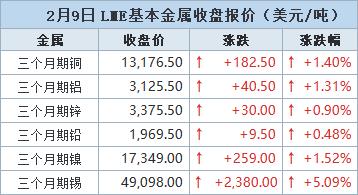
Group 1 - LME three-month copper prices increased by $182.5, or 1.4%, closing at $13,176.5 per ton on February 9, following a decline of 10% since reaching a historical peak of $14,527.50 on January 29 [1] - Other base metals also saw price increases, with three-month aluminum up by $40.5 (1.31%), zinc up by $30.0 (0.90%), lead up by $9.5 (0.48%), tin up by $2,380.0 (5.09%), and nickel up by $259.0 (1.52%) [2] Group 2 - A weaker dollar has made metals priced in dollars cheaper for holders of other currencies, prompting funds to generate buy and sell signals based on this relationship [3] - Market focus is shifting towards U.S. employment and consumer price data, which could influence U.S. interest rates and the dollar's trajectory [3] - Traders are increasing bets that the Federal Reserve will ease policies later this year, with a 19.9% probability of a 25 basis point rate cut at the March 18 meeting, up from 18.4% the previous week [3] Group 3 - Demand for copper remains weak, with high inventory levels suppressing bullish sentiment; LME certified copper inventories reached 184,300 tons, a 25% increase since January 9, while Shanghai Futures Exchange monitored inventories surged over 60% to 248,911 tons since December 19 [3] - Chinese copper buyers are extending their holiday shutdowns, and processing plants are reducing spot purchases due to profit pressures and high inventory levels [3] Group 4 - The Yangshan copper premium, which measures China's copper import willingness, has risen from $20 per ton on January 28 to about $37, but remains low and does not reflect strong demand [4] Group 5 - Chile's central bank reported that copper export revenues in January were $4.55 billion, a 7.8% increase compared to the same month last year; Chile is the world's largest copper producer [5]

巨头撤离!三菱化学宣布,全面退出焦炭及碳素业务!
Xin Lang Cai Jing· 2026-02-05 12:18
Core Viewpoint - Mitsubishi Chemical Group (MCG) has announced a significant decision to completely exit the coke and carbon materials business, including needle coke and pitch coke, due to ongoing global supply surplus and weak demand in the market [1][5][11]. Group 1: Business Exit Details - The exit from the coke and carbon materials business is expected to incur a one-time loss of approximately 85 billion yen (around 4 billion RMB) [2][11]. - The business involved approximately 600 employees as of February 2, 2026 [17]. - The production termination is planned for the second half of the fiscal year 2027, with sales gradually ceasing thereafter [6][16]. Group 2: Market Conditions - The decision is influenced by overcapacity in China and the commissioning of large new production lines in Indonesia, leading to a persistent oversupply in the global coke market [5][15]. - Despite efforts to improve profitability and enhance coke quality, MCG sees no prospects for resolving these structural issues, making long-term growth targets unattainable [5][15]. - The carbon materials sector is also affected by the oversupply and weak demand, with the production system relying on coke oven operations, meaning the cessation of coke production will directly impact the cost structure of carbon materials [5][15]. Group 3: Financial Performance - The sales revenue for the coke and carbon materials business was recorded at 115.79 billion yen for the fiscal year ending March 2025 [13][21].
头部养殖企业2025年业绩有望领跑农业板块
Zheng Quan Ri Bao Zhi Sheng· 2026-01-30 16:36
Group 1: Company Performance - Mu Yuan Food Co., Ltd. (牧原股份) expects a net profit of 14.7 billion to 15.7 billion yuan for 2025, representing a year-on-year decline of 12.20% to 17.79% due to lower average selling prices of live pigs and increased production management efficiency [1] - Wen's Food Group Co., Ltd. (温氏股份) anticipates a net profit of 5 billion to 5.5 billion yuan for 2025, reflecting a significant year-on-year decrease of 40.73% to 46.12% driven by lower sales prices of both live pigs and chickens [2] Group 2: Industry Trends - The overall pig farming industry is experiencing an increase in volume but a decrease in price, leading to a differentiated profitability landscape, with larger enterprises maintaining relative profitability due to scale advantages while smaller operators exit the market [3] - The phenomenon of "旺季不旺" (旺季不旺) in 2026 is attributed to a combination of supply-demand imbalance, weak demand, and cyclical mismatches, with high inventory levels of breeding sows contributing to increased output but lower prices [3] - Analysts predict that pig prices may stabilize and rebound in the second half of 2026, although the extent of the rebound may be limited due to improved production efficiency of sows and preemptive restocking behaviors among producers [3]


LVMH第四季度时装和皮具业务销售疲软 表明奢侈品公司继续承压
Xin Lang Cai Jing· 2026-01-27 19:38
Core Viewpoint - LVMH's fashion and leather goods division experienced a 3% decline in organic sales during the holiday season, indicating ongoing pressure from weak demand [1][4]. Group 1: Sales Performance - The organic sales decline in the fashion and leather goods sector was greater than the analyst expectation of a 2.94% drop [1][4]. - Despite the challenges in the fashion sector, LVMH's overall sales managed to achieve a slight increase due to better-than-expected performance in the watch and jewelry segment [3][7]. - In the fourth quarter, organic sales in the U.S. and regions including China grew by 1%, surpassing analyst forecasts, while Europe and Japan saw declines of 2% and 5%, respectively, both exceeding expectations [3][7]. Group 2: Financial Outlook - LVMH reported a recurring operating profit of €17.8 billion for the year, reflecting a 9.3% year-on-year decline, but still better than analyst expectations [3][7]. - CEO Bernard Arnault indicated that the company is facing a challenging operating environment and warned that 2026 is unlikely to be smooth, leading to spending restrictions for the year [1][4]. Group 3: Market Conditions - The luxury goods sector is struggling to rebound from a post-pandemic slump due to rising living costs and geopolitical uncertainties affecting consumer spending [5]. - Significant price increases have also led to strong consumer dissatisfaction, further complicating the market landscape for luxury brands [5].

油价大反转!1月23日后全国92、95汽油新售价,和预期天差地别
Sou Hu Cai Jing· 2026-01-23 18:12
Group 1 - The core viewpoint of the articles highlights a paradoxical situation where the Federal Reserve's interest rate cut has led to a significant drop in international oil prices, with WTI crude falling below $60 per barrel and Brent crude dropping over 1% [1][3] - The strong dollar has made oil more expensive for non-dollar buyers, contributing to a collective market concern about the global economic outlook and an oversupply in the oil market [1][3] - The U.S. crude oil inventory surged by 7.3 million barrels, far exceeding expectations, which shattered the illusion of supply-demand balance [3] Group 2 - OPEC's monthly report acknowledged that global oil production exceeds demand by 500,000 barrels per day, which has caught the market off guard [3] - The U.S. shale oil production remains at high levels, and some OPEC members are not adhering to production cuts, while Russian export levels remain elevated, creating a triple pressure on supply [3] - Demand-side indicators are also bleak, with manufacturing PMIs in Europe and the U.S. consistently below the growth threshold, indicating a slowdown in global economic growth [3] Group 3 - The decline in oil prices is triggering a chain reaction in the industry, with major oil companies reporting a 17.2% drop in profits year-on-year, and specific companies like Saudi Aramco and Chevron experiencing profit declines of 10% and 32%, respectively [8] - ConocoPhillips announced a 25% global workforce reduction, and Chevron is also implementing similar layoffs, marking the largest wave of layoffs in the U.S. shale oil sector since 2022 [9] - A total of 22 publicly listed oil companies have collectively cut $2 billion in spending, which may suppress future supply and set the stage for a potential rebound in oil prices [10] Group 4 - The risk of default on high-yield bonds in the energy sector is rising, reminiscent of the energy loan crisis triggered by the oil price crash in 2015-2016 [11] - Consumers may benefit in the short term from falling gasoline and diesel prices, which will lower transportation and logistics costs, thereby increasing disposable income [12] - The decline in oil prices is expected to ease inflationary pressures, as energy is a significant component of the Consumer Price Index (CPI), providing more room for central bank monetary policy [13] Group 5 - The significant drop in oil prices could signal a potential economic recession, as falling prices often reflect a contraction in global economic activity [14] - The OPEC decision regarding the continuation of the voluntary production cut agreement of approximately 2.2 million barrels per day will be crucial in determining the future direction of oil prices [14] - Morgan Stanley has revised its oil price forecast, predicting Brent crude will average $62.50 per barrel in the second half of 2025, which is $5 lower than previous expectations [14] Group 6 - Traders are focusing on the upcoming domestic oil price adjustment window on February 3, with expectations of a potential increase of 105 yuan per ton, although this is not yet a certainty [15] - There is a divergence in Wall Street analysts' views, with pessimists pointing to clear signs of a global economic recession and potential oil price drops to the $50 mark, while optimists believe that the supply-demand dynamics will shift back, allowing oil prices to return to $80 [15]
丙烯市场供应充裕价格难涨
Zhong Guo Hua Gong Bao· 2026-01-21 06:39
Group 1 - The global propylene market is expected to face weak demand, low prices, and high inventory pressures from 2025 to 2026, with a common issue of oversupply affecting various regions [1] - In Europe, propylene imports reached 1.46 million tons from January to September 2025, a 9% increase compared to the same period in 2024, which is expected to weaken local propylene consumption [1] - The price of polymer-grade propylene in Europe dropped significantly to €622.50 per ton by December 23, 2025, down from €781.50 per ton in early July [1] Group 2 - In North America, propylene inventory reached a historical high of 101.8 million barrels in the first week of December 2025, a 15.58% increase from 93.1 million barrels in the same period of 2024 [1] - The average variable profit for the propane dehydrogenation (PDH) industry in the U.S. fell to $122 per ton in December 2025, down from $254 per ton in the first eleven months of the year [2] - Despite market pressures, some companies maintain a positive outlook on propylene production, with a high operating rate of over 90% for two PDH units, although this has contributed to low propylene prices [2] Group 3 - The Asian propylene market is experiencing similar challenges, with prices declining due to weak downstream product profits and low polypropylene demand [2] - A Korean supplier indicated that the Asian propylene market lacks recovery momentum, with supply pressure from propane dehydrogenation units being significant [3] - The current situation suggests that any supply gap would quickly lead to the restart of idled propane dehydrogenation units, limiting the potential for price recovery in the propylene market [3]
渤海化学(600800.SH)发预亏,预计2025年度归母净亏损6.32亿元至6.65亿元
智通财经网· 2026-01-19 12:33
Group 1 - The company, Bohai Chemical (600800.SH), announced a projected net loss for the year 2025, estimated to be between -665 million and -632 million yuan for shareholders [1] - After excluding non-recurring gains and losses, the expected net loss for 2025 is projected to be between -799 million and -759 million yuan for shareholders [1] - The company is facing challenges due to the macroeconomic cycle in the chemical industry, with the PDH sector experiencing overcapacity and weak demand [1] Group 2 - The impact of the propane import tariff is increasing raw material procurement costs, leading to heightened operational pressure for the company [1]

生意社:本周环氧氯丙烷市场价格平稳(1.12-1.16)
Xin Lang Cai Jing· 2026-01-17 15:37
Core Viewpoint - The epoxy chloropropane market is experiencing price stability at a high level due to strong cost support, but low demand from downstream sectors is limiting actual transactions, resulting in a stalemate in price movements [1]. Price Influencing Factors - **Raw Material Side**: The continuous rise in raw material prices is the core factor supporting the high price of epoxy chloropropane. Recent tightness in domestic glycerin supply has strengthened traders' pricing sentiment. Additionally, the increase in propylene prices has provided certain support to epoxy chloropropane prices. As of January 16, the benchmark price of propylene was 6084.33 yuan/ton, up 6.41% from the beginning of the month (5717.67 yuan/ton) [3]. Demand Side - **Downstream Demand**: The demand in the downstream epoxy resin market is weak, with a lack of trading activity. Purchases are primarily limited to small orders driven by essential needs, leading to limited acceptance of high-priced epoxy chloropropane [5]. Market Outlook - **Future Predictions**: Analysts predict that while the cost side of epoxy chloropropane remains strongly supported at high levels, the weak downstream demand and cold trading atmosphere will likely lead to a market price that stabilizes and consolidates. Future attention should focus on changes in raw material prices and market supply-demand dynamics [5].
