时装和皮具

Search documents
路威酩轩集团去年第四季度核心业务超预期下滑3%
Sou Hu Cai Jing· 2026-01-28 11:43
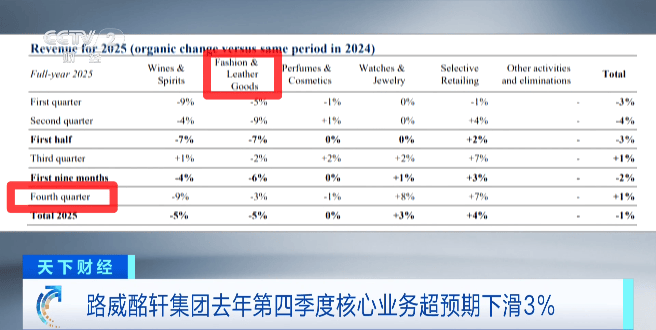
Core Viewpoint - LVMH reported its Q4 and full-year 2025 financial results, indicating pressure on core business operations due to weak consumer markets and global economic uncertainty [1]. Group 1: Financial Performance - In Q4 2025, LVMH's core business in Fashion and Leather Goods saw organic revenue decline by 3%, accelerating from the previous quarter and exceeding market expectations [3]. - For the full year 2025, organic revenue in the Fashion and Leather Goods category decreased by 5% [3]. - Overall, LVMH's total revenue for 2025 was approximately €80.81 billion, representing a year-on-year decline of about 4.6%, with an annual organic revenue drop of 1% [3]. Group 2: Market Conditions - The decline in revenue is attributed to weak demand in major consumer markets, changes in customer demographics, and macroeconomic uncertainties, limiting short-term growth flexibility for the group [5]. - Reports indicate that consumer confidence in the global luxury market is gradually recovering, suggesting that the industry may have passed its most challenging phase, with some brands entering an early recovery stage [5]. - Analysts note a shift in consumer behavior from "material possession" to "experiential consumption," leading to higher demands for creativity, craftsmanship, and emotional value in products, which may prompt a business realignment in the luxury sector [5].

LVMH2025年总营收降4.6% 符合预期
Sou Hu Cai Jing· 2026-01-28 01:47
Core Insights - LVMH's Q4 organic revenue grew by 1% year-on-year, slightly above market expectations; however, total annual revenue declined by 4.6%, in line with forecasts. Currency fluctuations negatively impacted annual revenue by approximately 3% [1] Revenue Breakdown - Fashion and Leather Goods: Q4 organic revenue decreased by 3%, accelerating the decline and slightly exceeding market expectations; annual organic revenue fell by 5%, yet maintained a high operating margin of around 35% [1] - Wines and Spirits: Q4 organic revenue plummeted by 9%, significantly underperforming expectations; annual recurring operating profit dropped by 25% [1] - Perfumes and Cosmetics: Q4 organic revenue unexpectedly declined by 1%, failing to achieve anticipated growth [1] - Watches and Jewelry: Q4 organic revenue increased by 8%, far surpassing analyst expectations; annual organic growth was 3%, serving as a crucial counterbalance to the weakness in other segments [1] - Selective Retailing (Sephora, DFS): Q4 organic revenue rose by 7%, with annual recurring operating profit soaring by 28%, driven by Sephora's global expansion and effective brand selection strategy [1]
LVMH第四季度时装和皮具业务销售疲软 表明奢侈品公司继续承压
Xin Lang Cai Jing· 2026-01-27 19:38
Core Viewpoint - LVMH's fashion and leather goods division experienced a 3% decline in organic sales during the holiday season, indicating ongoing pressure from weak demand [1][4]. Group 1: Sales Performance - The organic sales decline in the fashion and leather goods sector was greater than the analyst expectation of a 2.94% drop [1][4]. - Despite the challenges in the fashion sector, LVMH's overall sales managed to achieve a slight increase due to better-than-expected performance in the watch and jewelry segment [3][7]. - In the fourth quarter, organic sales in the U.S. and regions including China grew by 1%, surpassing analyst forecasts, while Europe and Japan saw declines of 2% and 5%, respectively, both exceeding expectations [3][7]. Group 2: Financial Outlook - LVMH reported a recurring operating profit of €17.8 billion for the year, reflecting a 9.3% year-on-year decline, but still better than analyst expectations [3][7]. - CEO Bernard Arnault indicated that the company is facing a challenging operating environment and warned that 2026 is unlikely to be smooth, leading to spending restrictions for the year [1][4]. Group 3: Market Conditions - The luxury goods sector is struggling to rebound from a post-pandemic slump due to rising living costs and geopolitical uncertainties affecting consumer spending [5]. - Significant price increases have also led to strong consumer dissatisfaction, further complicating the market landscape for luxury brands [5].
投资者预防“业绩杀”,欧洲奢侈品股绩前“先跌为敬”
Zhi Tong Cai Jing· 2026-01-27 11:08
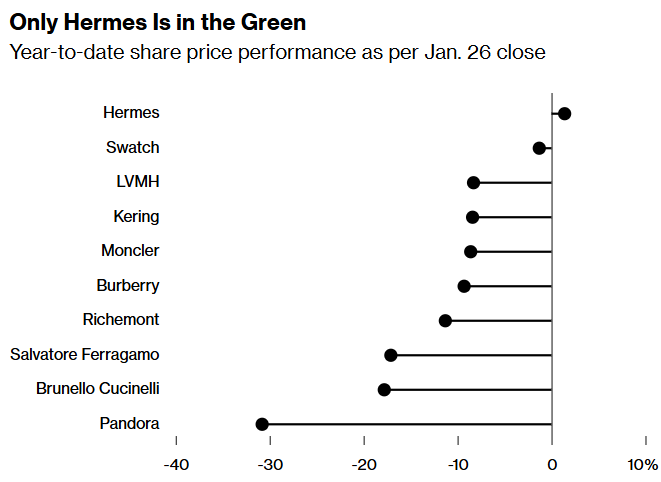
Core Viewpoint - Investors are preparing for a challenging earnings season for luxury goods manufacturers, with geopolitical tensions and uncertain consumer demand in China impacting stock performance, leading to an 8.1% decline in a basket of luxury stocks under Goldman Sachs this year, erasing much of the gains from the previous two quarters [1][3] Group 1: Earnings Expectations - LVMH is set to release its fourth-quarter results, which will serve as a test for the overall industry, with Kering SA and Hermes International also scheduled to report earnings soon [3] - Analysts expect an average decline of 6.1% in fourth-quarter earnings for LVMH, Hermes, Kering, and Moncler, significantly underperforming the MSCI Europe index's expected growth of 1.3% during the same period [3] - The key focus for this earnings season is whether these companies can express confidence in achieving a profit rebound by 2026 [3] Group 2: Market Dynamics - The luxury sector has been viewed as "Europe's large tech stocks" due to their size, rapid growth, and robust business models, but overall performance has lagged behind the market since rising interest rates and weakening demand in China began in 2022 [3] - Recent easing of tariff pressures, particularly after Trump abandoned plans for tariffs related to Greenland, has provided some relief to the industry, with North America expected to be a significant growth driver this year [4][10] - Analysts note that the luxury sector's recovery is crucial, with expectations of a 5% revenue growth for the industry this year, although a decline of 1% is anticipated from 2023 to 2025 [7] Group 3: Consumer Sentiment and Valuation - The upcoming Chinese New Year holiday is a critical sales period for luxury goods, allowing executives to comment on observed trends during earnings calls [10] - Despite a slight recovery in market sentiment and early signs of consumer recovery in China, high-end brands are expected to perform better than entry-level brands in 2025, while fashion-forward and entry-level luxury brands face long-term demand challenges [10] - Investor caution is attributed to high valuations, with luxury stocks trading at a 74% premium over the Stoxx Europe 600 index, despite a recent decline in expected price-to-earnings ratios [10]
LVMH 2025年上半年营收、净利润双降,中国市场跌幅收窄
Xi Niu Cai Jing· 2025-07-29 06:42
Core Insights - LVMH reported a 4% decline in revenue for the first half of 2025, totaling €39.81 billion, with organic revenue down 3% [2] - Operating profit decreased by 15% to €9.01 billion, while net profit fell by 22% to €5.69 billion [2] - The fashion and leather goods segment, including brands like LV and Dior, was the worst-performing area, with revenue of €19.11 billion and an organic revenue decline of 7% [2] Business Segment Performance - Fashion and Leather Goods: Revenue of €19.11 billion, organic revenue down 7%, with a significant decline in Q2 [2] - Selective Retailing: Revenue of €8.62 billion, organic revenue growth of 2% [2] - Watches and Jewelry: Revenue of €5.09 billion, organic revenue flat [2] - Perfumes and Cosmetics: Revenue of €4.08 billion, organic revenue flat [2] - Wines and Spirits: Revenue of €2.59 billion, organic revenue down 7% [2] Regional Performance - Other Asian regions, excluding Japan and including China, contributed 28% of total revenue [2] - The U.S. market accounted for 25% of revenue, while other European regions contributed 17% [2] - France and Japan each represented 8% of total revenue [2] - Japan experienced a 15% decline in organic revenue, while the Asian region's decline slowed down; the U.S. market saw a slight decrease of 1% [2] Management Commentary - LVMH's CEO Bernard Arnault emphasized the company's resilience and the strength of its iconic brands, despite the economic uncertainty impacting luxury demand [3] - The performance reflects the ongoing challenges in the luxury market, particularly in Asia, with LVMH's revenue and core business income decline exceeding Wall Street expectations [3]