生物治沙

Search documents
一片枣林,富了口袋防了风沙
Ren Min Ri Bao· 2026-02-05 06:34
Group 1 - The core idea of the articles revolves around the development of the jujube industry in Qemai County, Xinjiang, leveraging unique climatic conditions to enhance both agricultural productivity and ecological restoration [1][2][3] Group 2 - In 2002, Qemai County initiated a planned promotion of jujube cultivation, which has since gained recognition but faced challenges such as over-fertilization affecting fruit quality [2] - Since 2017, the county has focused on cultivating organic jujube brands, implementing measures like physical, biological, and agricultural pest control, and using organic fertilizers to improve quality [2] - The soil quality has improved significantly, with organic matter content increasing by 30% in sandy soils after five years of organic fertilizer application, enhancing water and nutrient retention [2] Group 3 - Jujube trees have strong root systems that effectively stabilize sand and reduce wind erosion, contributing to ecological balance [3] - By 2025, the jujube production in Qemai County is projected to reach 35,100 tons, with sales exceeding 462 million yuan [3] - Local enterprises are increasingly involved in ecological restoration efforts, with one company planning to convert 17,000 acres of land to jujube cultivation, thus supporting both sand control and industry growth [3] - The county has applied optimized jujube cultivation techniques over 70,000 acres, generating additional economic benefits of over 30 million yuan [3]
视频丨从“死亡之海”到“水产绿洲” 解锁新疆“点沙成金”的密码→
Yang Shi Xin Wen Ke Hu Duan· 2025-11-29 13:48
Core Viewpoint - The transformation of the Taklamakan Desert from a "sea of death" to a "green oasis" showcases innovative ecological farming practices in Xinjiang, highlighting the region's adaptive development strategies in the face of environmental challenges [2][17]. Group 1: Ecological Innovations - The introduction of desert plants like "Rou Cong Rong" (a parasitic plant) has led to increased income for local farmers, with an area of 22,900 acres cultivated, generating an annual income of 30,000 to 50,000 yuan per household [8][10]. - The local aquaculture industry has adapted to the saline-alkaline water conditions, producing unique seafood such as local crabs and Australian blue lobsters, which thrive in the desert environment [11][13]. - Advanced agricultural techniques, including vertical soilless cultivation and smart lighting, have enabled the production of 70,000 tons of fruits and vegetables annually in 1,000 greenhouses, significantly reducing costs by 60% to 80% [15][13]. Group 2: Cultural and Economic Development - The ancient village of Daliyabuyi has become a tourist attraction, with over 70,000 visitors this year, as it preserves its original charm while integrating modern amenities [34][32]. - The local economy has diversified, with traditional dishes like "Kumaiqi" made from local sheep, enhancing the culinary appeal for tourists and increasing local incomes [24][26]. - Infrastructure improvements, including new housing and access to utilities, have transformed the living conditions for residents, allowing them to engage in tourism and agriculture simultaneously [30][28]. Group 3: Environmental Restoration Efforts - Local initiatives led by figures like Aisikar Dawuti have resulted in the planting of 12,000 acres of protective forests, creating a green barrier against desert encroachment [41][45]. - The community has adopted a combination of biological and engineering methods for desertification control, successfully establishing 2,800 acres of artificial protective forests and 500 acres of grass grids [56][51]. - The introduction of "desert ginseng" (Rou Cong Rong) cultivation has provided a new revenue stream, with projected earnings of approximately 2,000 yuan per acre, contributing to sustainable economic development [58][61].


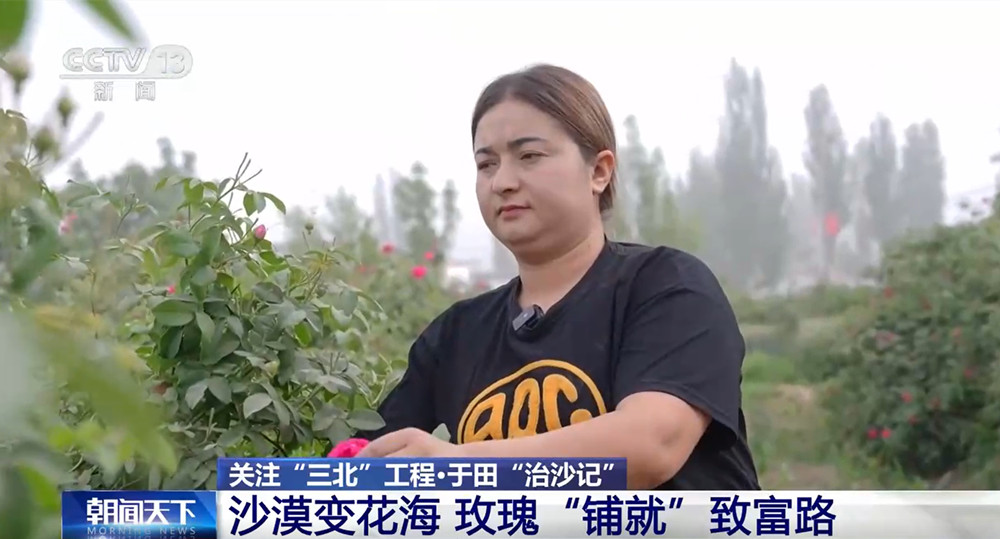
沙漠变花海 长出玫瑰“长”出新业态 生态环境改善带给群众实实在在的获得感
Yang Shi Wang· 2025-06-06 01:54
Core Insights - The "Three North" project is a significant ecological initiative in China, with over 10 million acres of construction tasks completed since its launch on June 6, 2023 [1] Group 1: Ecological Transformation - The area near the Taklamakan Desert, previously barren, has been transformed into a rose garden, showcasing successful biological sand control methods [2][4] - The rose industry has become a new income source for local residents, with significant economic benefits [6][14] Group 2: Economic Impact - The rose cultivation spans over 80,000 acres, yielding 11,397 tons annually, with a market value exceeding 200 million yuan [6] - In the village of Wan Fang, direct planting on sandy land yields over 3,000 yuan per acre [8] Group 3: Employment and Investment - The ecological improvements have attracted investments, such as a rose deep processing factory, enhancing local employment opportunities [15][16] - The number of enterprises in the region has increased from over 20 in 2015 to 89 currently, with significant job creation [17] Group 4: Environmental Benefits - Since 2020, dust storm days have decreased from 179 to 128, and sandstorm days from 24 to 7.5, indicating improved living conditions [14]