用户定价

Search documents
“滴滴订房”爆了!支付巨头上门密谈2小时,连李嘉诚都看好
首席商业评论· 2025-11-06 03:57
Core Viewpoint - The emergence of "Didi Booking" signifies a transformative shift in the hotel industry, challenging the dominance of traditional online travel agencies (OTAs) that have controlled pricing for over two decades [4][6][12]. Group 1: Market Dynamics - "Didi Booking" has launched a nationwide advertising campaign, investing over 100 million yuan to promote its "bid for hotel rooms" model across major high-speed rail stations [3][4]. - The company has expanded its operations to over 20 provinces and partnered with nearly 8,000 hotels within just one year of its launch [4]. - The founder, Ma Zhaode, identified a significant opportunity in the hotel industry, noting that with an average occupancy rate of only 50% across 360,000 hotels in China, there exists a substantial amount of unused capacity [6][12]. Group 2: Business Model Innovation - The "Didi Booking" model is inspired by Priceline's "Name Your Price" concept, allowing users to set their own prices for hotel rooms, which is facilitated by AI algorithms and mobile payment systems [10][12]. - The platform employs a "black box" pricing mechanism, ensuring that transaction prices are only visible to the buyer and seller, thus protecting brand value and preventing price wars [12][15]. - Users can either bid for rooms based on their budget or allow the AI to negotiate prices on their behalf, enhancing the user experience and potentially upgrading their accommodation [12][14]. Group 3: Technological Integration - The integration of AI technology allows hotels to set their own price ranges and manage bookings more efficiently, with funds being transferred to hotels immediately after guests check out [14][19]. - The system also incentivizes hotel staff to encourage guests to book through the platform, creating a revenue-sharing model that retains customer loyalty [14][15]. Group 4: Strategic Partnerships and Growth - A strategic partnership with Alipay has been established, enabling "Didi Booking" to leverage Alipay's platform resources to enhance its service offerings [19][21]. - The company is pursuing a city partner model to expand its reach, collaborating with local agents to penetrate various markets across China [21][23]. - By 2025, "Didi Booking" aims to establish 300 city service centers and 1,000 district service centers, partnering with 30,000 hotels and reaching 10 million users [25].

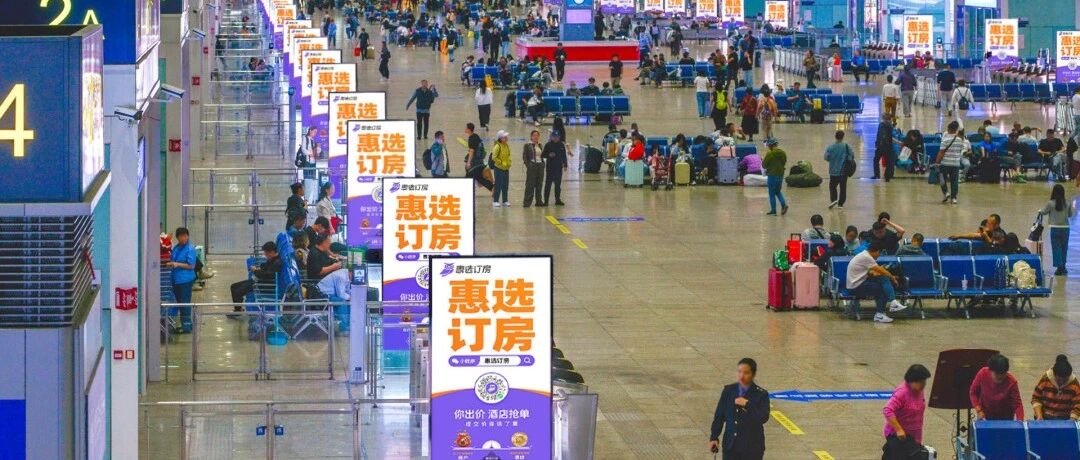
惠选订房与兆讯传媒达成亿级传播合作
Sou Hu Wang· 2025-05-20 07:55
Core Insights - The collaboration between Huixuan Booking and Zhaoxun Media is seen as a pivotal move for Huixuan Booking to transition from a disruptive player to a leading force in the hotel industry, marking a rare bold investment during a capital winter [3][4] - The partnership aims to leverage high-speed rail advertising to penetrate lower-tier markets while competing with established online travel agencies (OTAs) in first and second-tier cities [10][11] Group 1: Business Model and Strategy - Huixuan Booking adopts a C2B model similar to Priceline's "Name Your Price," allowing users to set their price while hotels bid for bookings, addressing the issue of low occupancy rates in China's hotel industry [5][6] - The company has already secured a strategic investment of 30 million yuan from Shanghai Muwang Capital within just 50 days of its launch, indicating strong market interest [6][10] - The partnership with Zhaoxun Media, a leader in high-speed rail digital media, is expected to enhance Huixuan Booking's visibility and reach, targeting 30,000 hotels and 10 million users by 2025 [10][11] Group 2: Market Dynamics and Impact - The collaboration is positioned as a challenge to traditional OTA business models, which often force hotels to offer the lowest prices, thereby diminishing their profitability [11][12] - Huixuan Booking's "black box trading" model allows hotels to maintain their pricing structure while maximizing revenue from unsold rooms, creating a win-win situation for both consumers and hotels [11][12] - The initiative is seen as a potential catalyst for the digital transformation of the hospitality industry, providing more choices for consumers and optimizing the booking ecosystem [12][14]