电商平台价格管控

Search documents
双11酒水捷报频传,为何抖音要出手“掀桌”?
Xin Lang Cai Jing· 2025-11-17 03:42
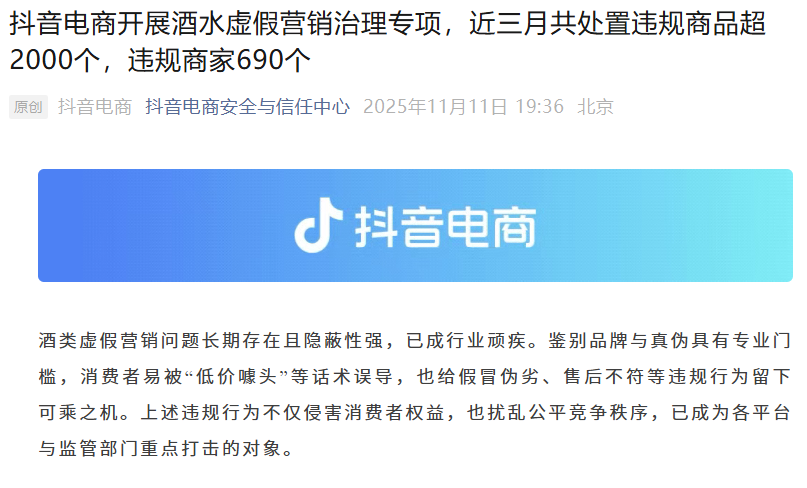
Core Viewpoint - The article discusses the recent crackdown by Douyin (TikTok) on low-price competition in the liquor market, initiated by a special governance announcement aimed at addressing false marketing and counterfeit sales, which has raised concerns among merchants and consumers alike [1][5][19]. Group 1: Douyin's Governance Actions - Douyin has reported handling over 2,000 violations and 690 merchants in the past three months related to liquor sales [5][8]. - The platform's recent announcement specifically targets malicious marketing practices, particularly concerning "overseas version" liquor products, which have led to numerous consumer complaints [5][19]. - The crackdown on low prices is seen as a shift from previous strategies that primarily focused on counterfeit goods, now categorizing "abnormal pricing" as a potential risk signal [11][19]. Group 2: Market Dynamics and Price Competition - During the Double 11 shopping festival, liquor sales on platforms like JD.com and Meituan saw significant growth, with JD's self-operated liquor sales increasing by 35% year-on-year [12][16]. - The ongoing price war in the liquor market is driven by structural contradictions within the e-commerce channels, where unauthorized sellers often resort to selling below cost to quickly recover funds [16][19]. - Major liquor brands, including Moutai and Wuliangye, have begun to publicly establish authorized sales channels to combat the negative effects of chaotic pricing [16][19]. Group 3: Future Implications for E-commerce Platforms - The article suggests that Douyin's actions may indicate a shift towards a business model that prioritizes trust and brand value over mere traffic and low prices [20][26]. - There is a growing trend of liquor companies collaborating with e-commerce platforms to create customized products and enhance their digital presence, indicating a more balanced relationship between brands and platforms [21][22]. - The challenge remains for e-commerce platforms to balance the interests of liquor companies, merchants, and consumers while ensuring a sustainable and healthy market environment [26].


电商平台价格体系怎么管控?
Sou Hu Cai Jing· 2025-07-14 12:18
Group 1 - The root cause of price chaos often lies in the distribution channel, where some sellers resort to informal channels to obtain goods at low prices, triggering price wars and exposing regulatory loopholes in the flow of goods [1] - A well-known beauty brand experienced a 40% drop in sales at its official flagship store due to ineffective channel management, leading to a significant influx of low-priced products through informal channels [1] - To address this issue, brands and manufacturers need to establish a comprehensive regulatory mechanism throughout the entire process, including real-time tracking of goods flow using digital tools [1] Group 2 - The implementation of strict pricing control agreements with distributors and agents is crucial, with penalties for violations including a 30% deduction of quarterly rebates for the first offense and cancellation of agency qualifications for repeated violations [1] - Collaborating with market regulatory authorities to create a blacklist system for counterfeit and illegal sales can help purify the market environment from the source [1] Group 3 - The low entry barriers of online platforms have allowed numerous unauthorized sellers to disrupt market order by selling infringing products at low prices, making intellectual property complaints an effective response [4] - A certain 3C brand successfully cleared over 200 non-compliant stores within six months through a systematic intellectual property complaint strategy, achieving an 85% recovery rate of online prices [4] Group 4 - Professional third-party price control agencies have become a strong support for brands facing complex pricing challenges, with over 150 such agencies operating in China [4] - A clothing brand that engaged a third-party price control agency reduced the average processing time for non-compliant links from 7 days to 48 hours, significantly improving pricing control efficiency [4] Group 5 - Brands must prepare comprehensive materials from three dimensions: trademark rights, copyright, and patent rights, including registration certificates and complete authorization chain documents [5] - Evidence of seller infringement can be supported by administrative penalty documents from regulatory authorities or judicial rulings, as well as through purchasing and expert appraisal of products [5]