电池价格下降

Search documents
技术路线转型+产能过剩 电池“低价时代”加速到来!储能与电动车有望加速普及?
智通财经网· 2025-12-09 11:29
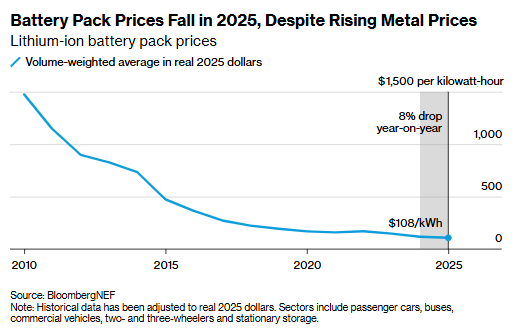
Core Insights - The average price of power battery packs is expected to decline by 3% in 2026, reaching $105 per kWh, although the decrease will be less than in 2025 [1] - The decline in battery prices is driven by an oversupply of battery capacity in China, increasing market competition, and a shift towards lower-cost and safer lithium iron phosphate technology [1][3] - Despite the price drop, the reduction is smaller compared to an 8% year-on-year decline in 2025, where prices fell to $108 per kWh amid rising battery metal prices [1][3] Industry Trends - The continuous decrease in battery prices is facilitating the global adoption of electric vehicles, with China leading this trend [3] - Lower battery prices are also energizing the large-scale application of stationary energy storage systems, which provide stability for intermittent renewable energy sources [3] - BNEF predicts that global energy storage installations will more than double over the next decade, supported by ongoing R&D investments, improved production efficiency, and expanded supply chain networks [3] Technological Advancements - Future battery price reductions will be driven by advancements in technologies such as silicon-based anodes, lithium metal anodes, solid-state electrolytes, new cathode materials, and innovative cell manufacturing processes [3]

2026年纯电重卡市场展望及重卡带电量分析
2025-11-26 14:15
Summary of Electric Heavy Truck Market Conference Call Industry Overview - The electric heavy truck market is projected to see sales of 210,000 units in 2025, representing a growth of over 150% compared to the previous year, with a penetration rate of 26% [1][2][3] - The market is shifting from being policy-driven to a dual-driven model due to declining battery prices and increased competition among manufacturers [1][4] Key Insights and Arguments - **Battery Price Decline**: The price of batteries has significantly decreased from 1,000 yuan per kWh to around 500 yuan, leading to a reduction in the price of electric heavy trucks from over 600,000 yuan to around 400,000 yuan [1][3][4] - **Government Subsidies**: The government has increased subsidies for replacing old National IV vehicles, providing an additional 30,000 yuan for electric vehicles compared to diesel ones, making the economic case for electric trucks more favorable [1][6] - **Cost Efficiency**: The cost per kilometer for pure electric heavy trucks is approximately 0.8 yuan, significantly lower than the 2.4 to 2.5 yuan for diesel trucks, leading to substantial savings over time [7][8] - **Market Dominance**: Pure electric heavy trucks dominate the market with over 95% share and are expected to remain the mainstream option until at least 2030, as hydrogen and hybrid models struggle with economic viability [1][7] Future Market Trends - **Sales Projections**: Sales of electric heavy trucks are expected to decline to 180,000-190,000 units in 2026 due to market saturation from the previous year's surge, but penetration rates are anticipated to approach 30% [8][19] - **Charging vs. Battery Swapping**: The market is transitioning from battery swapping to charging, with charging models accounting for 47% of the market in 2025, driven by lower costs and operational efficiency [12][13] - **Infrastructure Challenges**: The electric heavy truck market faces challenges in mid-to-long-distance transportation due to insufficient range, battery weight issues, and inadequate charging infrastructure, which need to be addressed over the next two to three years [9][10][18] Additional Important Points - **Market Segmentation**: Different battery capacities are emerging, with 400-500 kWh models becoming the mainstream choice, while smaller capacity models are declining [15][20] - **User Preferences**: High-end users prioritize brand reputation and total lifecycle costs, often opting for established brands like CATL, while mid-tier users focus on short-term costs and may choose cheaper alternatives [25][26] - **Supplier Diversification**: Manufacturers are increasingly collaborating with multiple battery suppliers to avoid dependency on a single source, enhancing their bargaining power and profit margins [27] This summary encapsulates the key points discussed in the conference call regarding the electric heavy truck market, highlighting growth trends, economic factors, and future challenges.
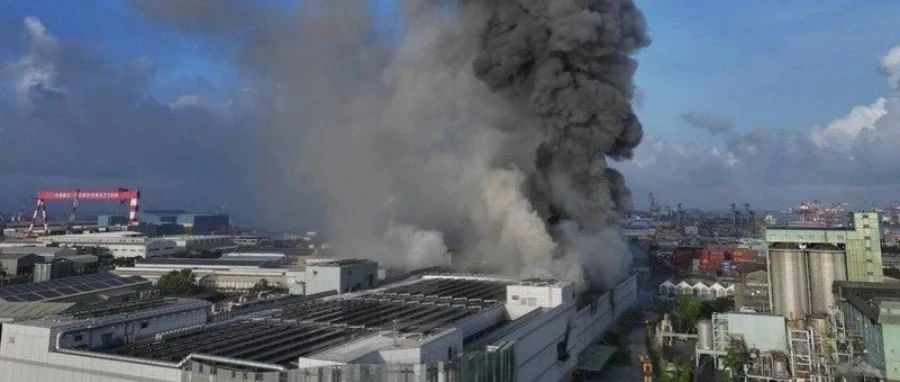
台湾一电池工厂突发火灾,现场传出爆炸声!背后公司股价一度暴跌
21世纪经济报道· 2025-07-14 07:41
Core Viewpoint - A fire broke out at the San Yuan Energy Technology lithium battery factory in Kaohsiung, Taiwan, causing injuries and impacting the stock price of the parent company, Taiwan Cement Corporation (台泥集团) [1][8]. Group 1: Incident Details - The fire occurred early in the morning, with significant smoke and explosions reported. Emergency services deployed 46 rescue vehicles and 91 personnel to the scene [1]. - The incident resulted in 12 employees sustaining minor injuries and 3 firefighters suffering minor burns, all of whom were treated at medical facilities [1]. - The cause of the fire and the extent of property damage are still under investigation [6]. Group 2: Company Background and Impact - San Yuan Energy Technology's Kaohsiung lithium battery factory is Taiwan's first super battery factory, with an annual production capacity of 1.8 GW, sufficient to produce batteries for 24,000 electric vehicles [4]. - The factory is part of Taiwan Cement Corporation's strategic shift towards energy technology, having been established with an investment of nearly NT$20 billion in 2021 [8]. - Following the fire, Taiwan Cement's stock price fell significantly, dropping over 3% and reaching a new low since Q2 2009, although it later recovered somewhat [8]. Group 3: Production and Market Challenges - Despite stable output capabilities and certifications from major international clients, the company has not yet achieved profitability, producing approximately 7 to 8 million batteries monthly, with a potential capacity of 20 million [8]. - The company faces challenges due to a significant decline in battery prices and increased competition in the international market, making it difficult to maintain a competitive edge despite product quality and efficiency [8]. Group 4: Share Buyback Activity - Taiwan Cement Corporation has been actively repurchasing shares, having bought back 10 million shares between July 1 and August 1, and plans to repurchase an additional 28 million shares from August 4 to August 29, aiming to protect company credit and shareholder interests [9].