电池出口退税调整

Search documents
涨停开局、跌停收尾:碳酸锂本周高位震荡
高工锂电· 2026-01-16 12:58
Core Viewpoint - High volatility in lithium carbonate prices may become the new normal due to fluctuating demand and supply dynamics, alongside regulatory changes impacting trading behavior [2][3]. Group 1: Market Dynamics - Lithium carbonate experienced extreme fluctuations this week, starting with a price surge followed by a significant drop, indicating a rapid withdrawal of funds and a decrease in positions [3][4]. - The market initially focused on demand driven by export opportunities and inventory replenishment, but later shifted attention to seasonal demand weakness and ongoing supply pressures [4][5]. - The price of lithium carbonate reached a peak of 156,060 yuan/ton, marking a 9% increase, attributed to the announcement of reduced export tax rebates [5][6]. Group 2: Supply and Demand Factors - The Chinese government announced a reduction in the export value-added tax rebate for batteries, which is expected to influence upstream lithium demand as battery manufacturers rush to fulfill overseas orders [6][7]. - Despite the price increase, supply remained stable, with lithium carbonate production rising by 70 tons to 22,605 tons, indicating no significant contraction in supply [14][15]. - Seasonal demand is expected to weaken, with production of ternary materials projected to decrease by 5% and lithium iron phosphate by 10% [18][19]. Group 3: Regulatory Impact - New regulations on battery recycling are set to be implemented in April 2026, aiming to enhance the management and traceability of used batteries, which may influence long-term resource dynamics in the lithium market [22][23]. - The anticipated increase in waste battery generation by 2030, projected to exceed 1 million tons, could shift market perceptions regarding lithium resource scarcity [24][25]. - The ongoing policy and supply-demand fluctuations are leading to greater market volatility as the industry transitions between old and new resource management paradigms [26].


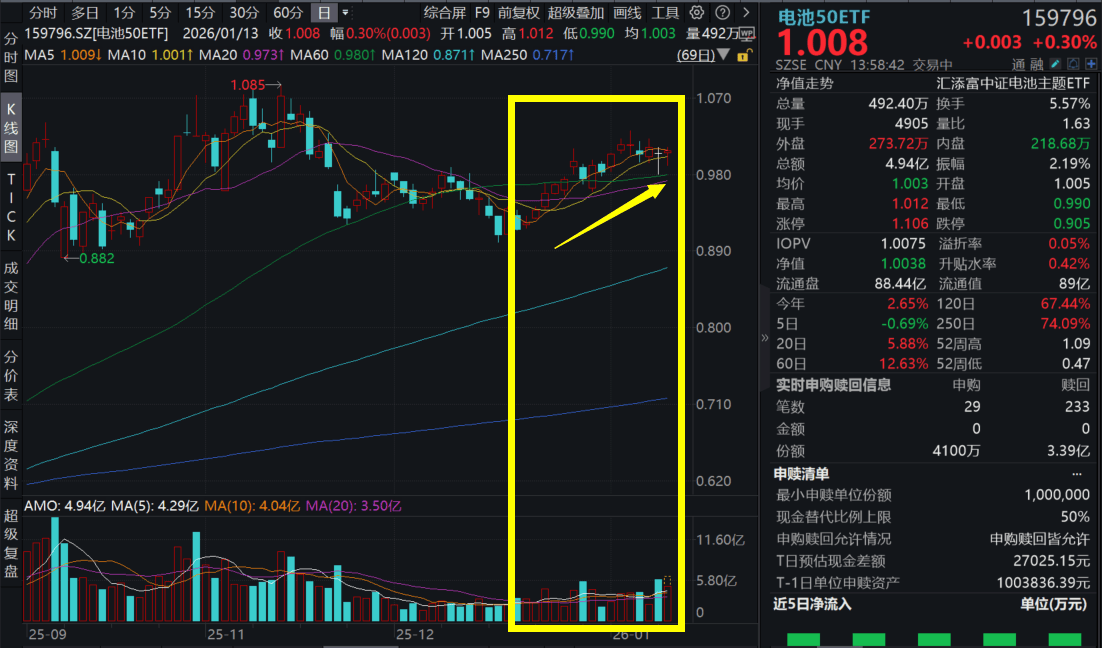
碳酸锂期货暴涨9%,一度涨12%涨停!电池50ETF(159796)窄幅震荡,电池出口退税调整,有何影响?全产业链解析!
Sou Hu Cai Jing· 2026-01-13 06:46
Core Viewpoint - The A-share market showed mixed performance on January 13, with the Battery 50 ETF (159796) experiencing a slight increase of 0.3% amid fluctuations in trading [1] Group 1: Market Performance - The Battery 50 ETF (159796) recorded a trading volume of 4.94 billion CNY, with a price range between 0.990 and 1.012 CNY [1] - The ETF's net asset value was reported at 1.0038 CNY, with a premium rate of 0.42% [1] - The ETF's five-day net inflow was noted at 2.65% [1] Group 2: Component Stocks - Major component stocks of the Battery 50 ETF included Sanhua Intelligent Controls, which rose by 1.05%, and multiple fluorine, which increased by 1.26% [2] - Notable declines were observed in XINWANDA, which fell by 2.40%, and other key players like Yangguang Electric and Ningde Times also experienced slight declines [2] Group 3: Policy Impact - The recent adjustment in export tax rebates for battery products is expected to lead to a surge in exports in 2026, tightening supply and demand in the lithium battery industry [4] - The tax rebate for battery products will decrease from 9% to 6% starting April 1, 2026, and will be eliminated entirely by January 1, 2027 [5] Group 4: Industry Outlook - The battery sector is anticipated to benefit from increased demand driven by both domestic and international markets, with projections indicating a significant rise in global demand for power batteries from 1,253.4 GWh in 2025 to 1,834.2 GWh by 2027 [5] - The storage demand is also expected to grow substantially, with domestic installations projected to reach 265 GWh in 2026, reflecting a 60% increase [5] Group 5: Investment Strategy - The Battery 50 ETF (159796) is highlighted as a leading option for investors due to its significant exposure to the storage sector, which accounts for 18.7% of its index, and a high proportion of solid-state battery technology at 45% [6][8] - The ETF's management fee is noted to be the lowest in its category at 0.15% per year, making it an attractive investment vehicle for capturing opportunities in the battery sector [11]