疫苗接种率提升

Search documents
华兰疫苗:收入恢复性增长,期待持续修复-20260331
HTSC· 2026-03-31 02:45
Investment Rating - The report maintains a "Buy" rating for the company [4][6]. Core Insights - The company reported a revenue of 1.2 billion RMB in 2025, representing a 7% year-over-year increase, while the net profit attributable to the parent company was 180 million RMB, a decrease of 11% year-over-year [1][4]. - The revenue from flu vaccines was 1.12 billion RMB, reflecting a 4% year-over-year increase, despite a 27% decrease in production volume [2][4]. - The company is expected to see a steady recovery in vaccine sales in 2026, driven by government support and increased public awareness of vaccination [2][4]. Summary by Sections Financial Performance - In 2025, the gross margin was 77.8%, down 3.4 percentage points year-over-year, primarily due to decreased production volume affecting economies of scale [3]. - The net profit margin for 2025 was 15.2%, a decline of 3.0 percentage points year-over-year [3]. - The company adjusted its profit forecasts for 2026-2027, expecting net profits of 220 million RMB and 260 million RMB, respectively, which are reductions of 74% and 75% from previous estimates [4][11]. Market Outlook - The overall vaccine shipment rate improved to 83%, an increase of 16 percentage points year-over-year, indicating better market conditions towards the end of 2025 [2]. - The report anticipates significant growth potential in the Chinese flu vaccine market, supported by government initiatives and rising vaccination awareness among the public [2][4]. Valuation - The target price for the company is set at 23.68 RMB, reflecting a price-to-earnings ratio of 65 times for 2026, which is a premium compared to the median of comparable companies at 49 times [4][12].

专访冯子健:疫苗行业严重内卷、公众接种意愿下降,如何破局
第一财经· 2026-03-17 12:11
Core Viewpoint - The recent expansion of the National Immunization Program (NIP) in China, as outlined in the 15th Five-Year Plan, is expected to significantly benefit the vaccine industry, which is currently facing challenges such as declining vaccination rates and intense competition [3][5]. Group 1: National Immunization Program Expansion - The NIP aims to dynamically optimize the types of vaccines included, which is a cost-effective measure to combat infectious diseases and will be funded by the government [3][4]. - The inclusion of vaccines like the HPV vaccine in the NIP marks a significant step, but many internationally recommended vaccines for children and adults are still not covered in China [5][6]. - Current spending on childhood vaccines in China is only $50 per capita annually, compared to $585 in Argentina and $336 in Brazil, indicating a substantial gap in investment [5]. Group 2: Industry Challenges and Competition - The domestic vaccine industry is currently in a downturn, characterized by fierce price competition that has not led to increased vaccination rates [7][8]. - The issue of homogenized competition is identified as a root cause of the industry's "involution," where multiple companies produce the same vaccine, leading to market saturation [8]. - The global vaccine market is highly concentrated, with major companies like Merck, Pfizer, GSK, and Sanofi controlling 71% of the market share, suggesting a need for similar consolidation in China [8]. Group 3: Public Perception and Vaccination Willingness - Public willingness to vaccinate is declining, potentially due to trust issues regarding vaccine safety and effectiveness, necessitating deeper investigation into these concerns [9]. - Transitioning from self-paid to publicly funded vaccinations is expected to significantly increase vaccination rates by removing financial barriers and enhancing public trust [9]. Group 4: Improving Vaccination Accessibility - The vaccination system in China is shifting towards covering all life stages, but there are still barriers to increasing adult vaccination rates [10][11]. - The ideal model for increasing vaccination rates involves integrating vaccination services into family doctor systems, which have proven effective in other countries [11]. - Current regulations on vaccination service points may hinder the expansion of vaccination services, suggesting a need for more flexible requirements to encourage participation from healthcare providers [12].

13周岁女孩可免费接种!HPV疫苗纳入国家免疫规划
Bei Jing Shang Bao· 2025-10-30 14:05
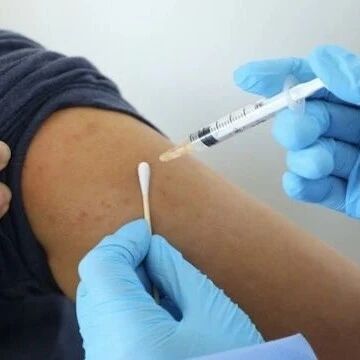
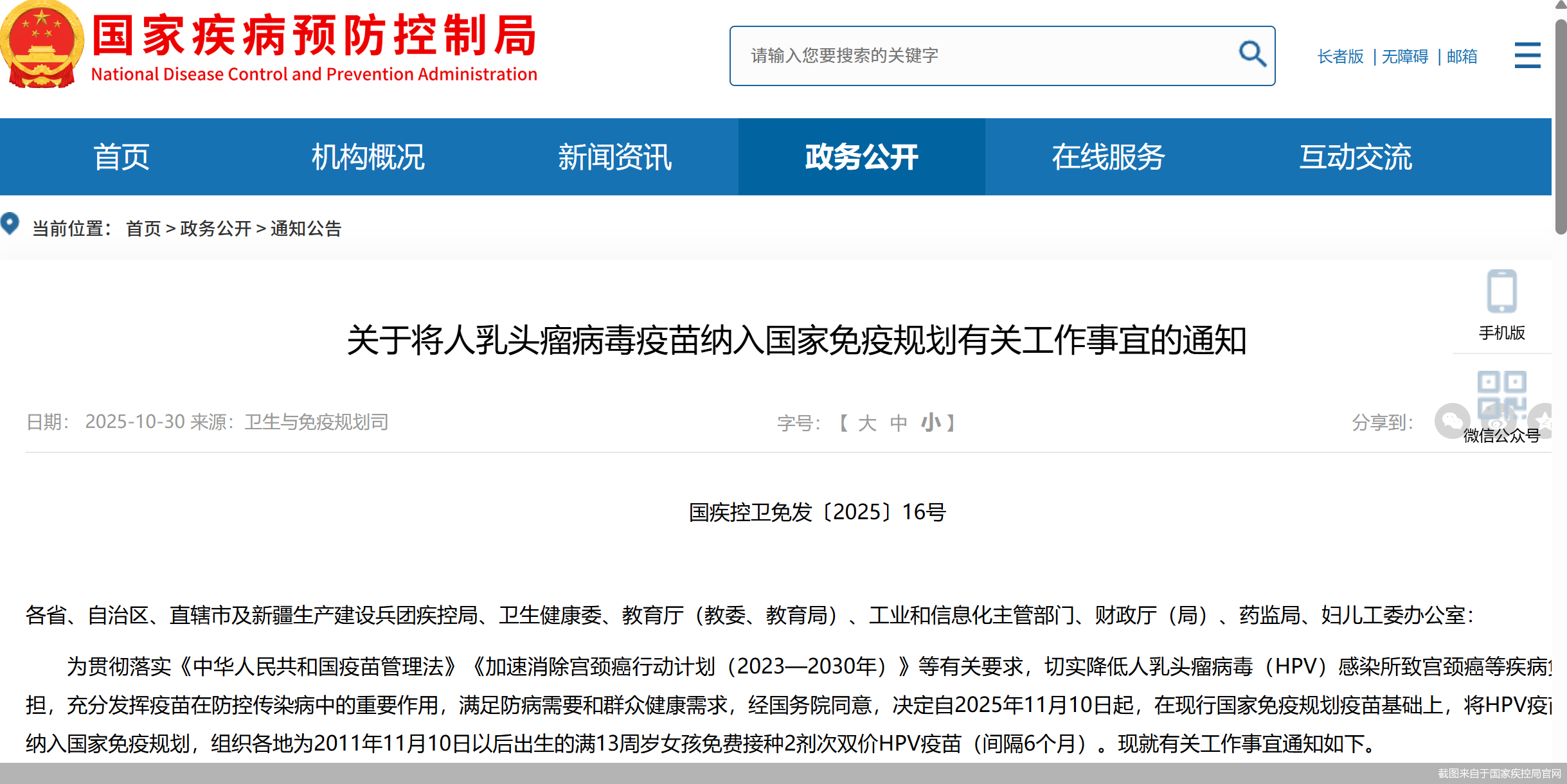
Core Viewpoint - The HPV vaccine has been officially included in the National Immunization Program, allowing free vaccination for girls born after November 10, 2011, who are 13 weeks old or older, with two doses of the bivalent HPV vaccine administered six months apart [1][4]. Group 1: Health Impact - The incidence and mortality rates of cervical cancer in China have been rising, with younger age groups increasingly affected. Vaccination against HPV can effectively prevent high-risk HPV infections and reduce the occurrence of cervical cancer and related diseases [4]. - The inclusion of the HPV vaccine in the National Immunization Program aims to lower the disease burden caused by HPV infections and meet public health needs [4]. Group 2: Implementation and Monitoring - Various departments, including the Ministry of Industry and Information Technology and the National Medical Products Administration, are tasked with monitoring the production and supply of the HPV vaccine, ensuring stable production and timely resolution of issues faced by manufacturers [4][5]. - Local health authorities are required to establish management systems for vaccine storage and distribution, ensuring compliance with quality standards and preventing misuse [5]. Group 3: Demand and Accessibility - Health departments are to assess the target population and previous vaccination rates to accurately gauge vaccine demand [6]. - As of June 2025, 18 provinces in China have implemented policies for free HPV vaccinations or subsidies for eligible girls, laying a practical foundation for the national inclusion of the vaccine [6]. - The inclusion of the bivalent HPV vaccine in the National Immunization Program is expected to enhance vaccination rates and reduce disparities in access among different regions and income groups [6]. Group 4: Market Implications - The approval of domestic bivalent HPV vaccines from companies like Wantai Biological Pharmacy and Watson Bio is significant, as national procurement is likely to increase vaccine sales [6].
重庆建成900余家数字化疫苗接种门诊——打疫苗有了信息化“管家”(民生改善在身边)
Ren Min Ri Bao· 2025-10-23 22:07
Core Viewpoint - The digital immunization planning information system in Chongqing has significantly improved vaccine coverage and efficiency, maintaining a vaccination rate of over 98% for children in the past three years [1][4]. Group 1: Digital Transformation in Vaccination - Chongqing has established over 900 digital vaccination clinics, enabling information management throughout the entire vaccination process, which enhances efficiency [2]. - The system provides smart reminders for vaccinations, electronic consent forms, and dual verification of vaccination information, streamlining the vaccination process [1]. Group 2: Community Engagement and Accessibility - Special vaccination sessions are organized on specific days to facilitate access for rural populations, ensuring higher vaccination rates [2]. - Extended service hours and holiday vaccination options have been introduced to accommodate working individuals and students [3]. Group 3: Targeted Vaccination Initiatives - The government has implemented a subsidy program for HPV vaccinations, benefiting over 300,000 girls since 2022 [3]. - A three-tier referral mechanism has been established to address vaccination challenges for children with special health conditions, ensuring their rights to vaccination are protected [3]. Group 4: Public Health Outcomes - The vaccination efforts have led to significant disease control, with no cases of polio for over 30 years and a sustained low incidence of other diseases like diphtheria and measles [4]. - Future plans include optimizing vaccination unit layouts and developing electronic vaccination certificates to further enhance public health initiatives [4].
复星医药疫苗事业部总裁张继国:做大中国疫苗市场关键在提升接种率 疫苗竞争激烈程度不如药品
Mei Ri Jing Ji Xin Wen· 2025-04-08 15:13
Core Insights - The human rabies vaccine market in China is saturated with 13 manufacturers having approved products, with Vero cell vaccines accounting for approximately 90% of the market share [1][3] - Fosun Pharma launched a lyophilized human rabies vaccine, indicating a product upgrade from its previous liquid formulation, aiming to enhance market competitiveness [1][2] - The company believes there is significant growth potential in the rabies vaccine market, as current vaccination rates among exposed individuals are below one-third, despite 100-200 annual deaths from rabies in China [1][3] Company Developments - Fosun Pharma's lyophilized rabies vaccine utilizes the CTN-1 strain and is the first in China to implement serum-free virus culture technology on a large scale, improving cell culture efficiency and vaccine efficacy [2] - The vaccine has received registration approval in March 2024 and offers two vaccination schedules, both validated through Phase III randomized controlled trials [2] - Phase III trial results showed a 76.06% seroconversion rate at 7 days for the 2-1-1 schedule, outperforming a comparable product's 47.81% rate, indicating faster immune response and reduced vaccination frequency [2] Industry Context - The rabies vaccine market is characterized by intense competition, with multiple manufacturers and various vaccine types available, including Vero cell, human diploid cell, and hamster kidney cell vaccines [3] - Despite the competitive landscape, the overall market space remains large, and there is a call for increased public awareness and vaccination rates to expand the market [3] - Fosun Pharma is also exploring international markets, particularly in the Middle East, Southeast Asia, and South America, while emphasizing the need to improve domestic vaccination rates as a priority [4]