白酒去金融化

Search documents
库存积压!茅台价格遭遇滑铁卢,年轻人不爱喝,中年人不敢喝
Sou Hu Cai Jing· 2025-12-14 13:36
Core Viewpoint - The recent decline in Moutai prices is attributed to excessive inventory and changing consumer preferences, leading to a significant market disruption in the Chinese liquor industry [1][3]. Inventory Issues - The inventory of Moutai has reached 120 million bottles, equivalent to two to three times the annual market sales [3]. - There is an additional 290,000 tons of base liquor stock, which could produce 560 million bottles of finished liquor, indicating that even if production stopped immediately, it would take over three years to sell off the existing inventory [3]. Consumer Behavior - Young consumers are increasingly avoiding Moutai due to its high price, with a 28-year-old internet worker having only 3,000 yuan available for discretionary spending after expenses, making Moutai's price of over 2,000 yuan unappealing [3][5]. - Only 7% of the post-90s generation have purchased Moutai, with 60% of those consuming it only during business occasions [5]. - The preference for whiskey and other lower-priced alcoholic beverages among younger consumers is growing, with Moutai struggling to innovate and attract this demographic [5]. Middle-aged Consumer Trends - Middle-aged consumers, once loyal to Moutai, are now drinking less due to health concerns, with 62% of individuals over 60 reducing alcohol consumption due to chronic illnesses [5]. - Policy restrictions, such as the prohibition of Moutai in business settings, have further diminished its consumption among middle-aged individuals [5]. Company Response - In response to the crisis, Moutai plans to reduce base liquor production by 900 tons in 2024, marking its first production cut in five years [7]. - The company is introducing unconventional product sizes and focusing on niche markets like dining and collectibles, while also managing prices through its i Moutai direct sales platform [7]. - Despite these efforts, Moutai's net profit growth has slowed to 5.2%, the lowest since 2016, indicating that the measures taken have not yet reversed the downward trend [7]. Future Outlook - Analysts suggest that Moutai needs to undergo three major transformations: de-financialization, utilizing blockchain technology to combat hoarding, and appealing to younger consumers by developing new product categories [7]. - Moutai's chairman emphasized that the brand's value lies in the quality of the liquor itself, suggesting that the current price decline may represent a turning point for the Chinese liquor market to return to its consumer-focused roots [7].



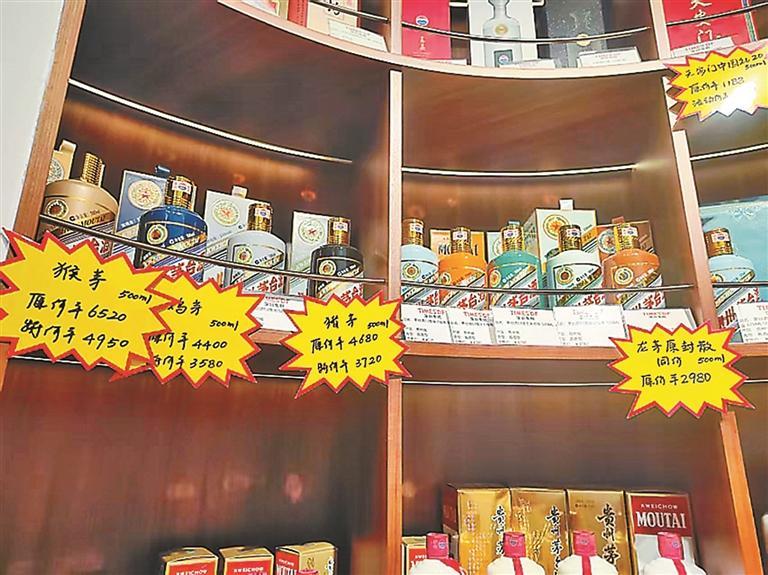
飞天茅台价格下探
Shen Zhen Shang Bao· 2025-09-10 18:03
Core Viewpoint - Despite the stable performance of Kweichow Moutai in the secondary market, the market price of its core product, Feitian Moutai, continues to decline, contrary to expectations for the traditional sales peak during the Mid-Autumn and National Day holidays [2][5]. Group 1: Price Trends - As of September 9, 2023, the wholesale price of 2025 Feitian Moutai has dropped to 1790 yuan per bottle, falling below the critical 1800 yuan mark [5]. - In March 2023, the price of Feitian Moutai reached an annual high of approximately 2300 yuan per bottle for a full box and 2200 yuan for a single bottle, but prices have steadily decreased since then [5]. - The current retail prices for 2025 and 2024 Feitian Moutai are reported at 1880 yuan and 1920 yuan respectively, with some stores not stocking the 2025 vintage due to price volatility [3][5]. Group 2: Market Dynamics - The continuous price decline has led to significant losses for some distributors, with monthly losses reaching tens of thousands of yuan due to the volatile pricing environment [6]. - The high-end liquor market is facing multiple pressures, including weakened demand during the off-season and a noticeable trend of "de-financialization" in the industry, leading to reduced speculative enthusiasm among investors [6]. - The current market transaction volume has significantly shrunk, prompting distributors to adopt a wait-and-see approach and halt inventory accumulation, reflecting a deep adjustment in the high-end liquor market [6].