白酒市场结构性调整

Search documents
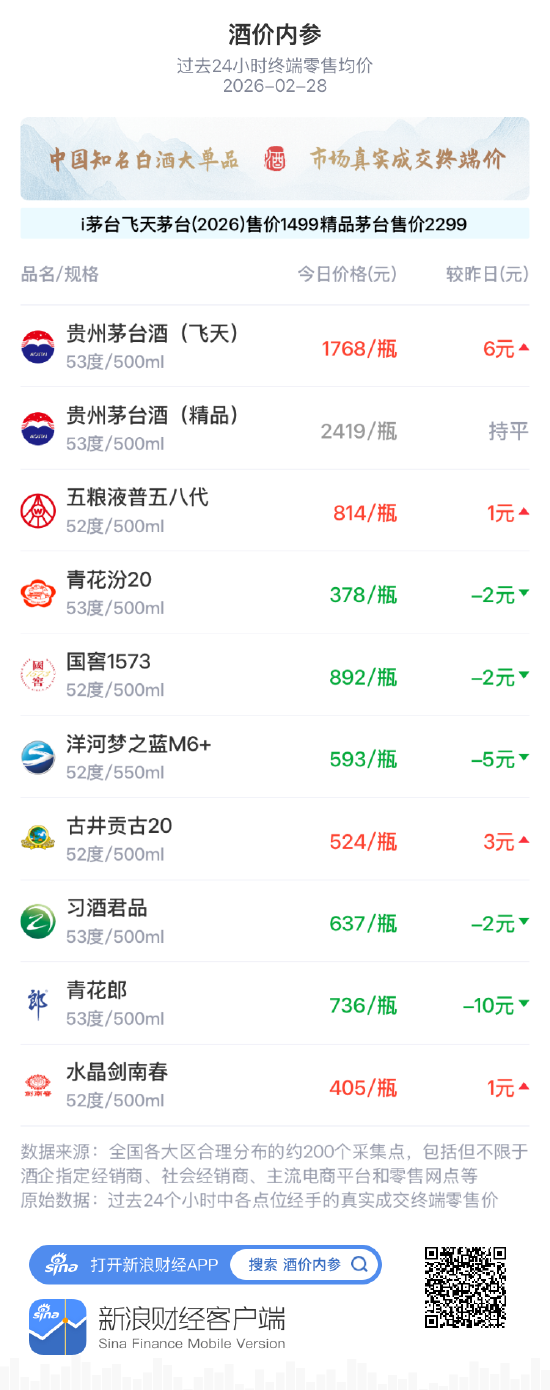
酒价内参2月28日价格发布,五粮液普五八代小幅上行1元
Xin Lang Cai Jing· 2026-02-28 01:14
Core Insights - The Chinese liquor market is experiencing a price adjustment, with the average retail price of the top ten liquor products at 9,166 yuan as of February 28, marking a decrease of 10 yuan from the previous day, reaching a new low since early February [1][6][7] - The market shows a structural adjustment with four products increasing in price, five decreasing, and one remaining stable, indicating resilience in core products [1][7] Price Movements - The price of Feitian Moutai increased by 6 yuan per bottle, supported by solid demand and tight supply [1][7] - Other products that saw price increases include Gujing Gong and Shui Jing Fang, which rose by 3 yuan and 1 yuan respectively [1][7] - Notable price declines were observed in Qinghua Lang, which dropped by 10 yuan, and Yanghe Dream Blue M6+, which fell by 5 yuan [1][7] Market Analysis - The data is sourced from approximately 200 collection points across various regions, ensuring a comprehensive and objective representation of retail prices [2][8] - The introduction of new sales channels for Moutai products has begun to influence market prices positively [2][8] - The market is expected to see a structural recovery during the 2026 Spring Festival, particularly for sauce-flavored and budget-friendly liquors, with a noted increase in sales for these categories [2][8] Industry Outlook - Despite some signs of recovery, the industry is still facing weak demand, particularly due to reduced business banquets [2][8] - Analysts suggest that Moutai's price stabilization and double-digit sales growth could support the industry, with potential for a seasonal rebound [2][8] - The overall performance during the Spring Festival is characterized by structural differentiation and a phase of rebound, with a full recovery dependent on further demand restoration [2][8]



生存与重构:2026年白酒春节市场的双重变奏!
Sou Hu Cai Jing· 2026-02-07 08:17
Core Insights - The white liquor market for the 2026 Spring Festival is characterized by a mix of concerns and confidence, with strong brands showing resilience amidst a challenging economic environment [3] - Structural adjustments are subtly permeating the market dynamics, indicating a reshaping of the internal landscape [3] Group 1: Sales Trends - There is a widespread perception of slowing sales momentum, with consumer behavior becoming more cautious [4] - The decision-making cycle for end customers has significantly lengthened, leading to increased inquiries but fewer transactions, as consumers seek higher cost-performance alternatives [6] - Inventory turnover for some premium brands has extended by 15 to 20 days compared to last year, with certain mid-tier products experiencing inventory buildup [6] Group 2: Price Segment Performance - Despite an overall market downturn, different price segments are experiencing divergent fates, highlighting a pronounced structural characteristic [7] - The high-end price segment (above 1,000 yuan) shows strong resilience, supported by brand and collectible attributes, with Moutai series products maintaining high demand [7] - The low-end price segment (below 100 yuan) remains relatively stable due to rigid demand, while the mid-tier segment (300-600 yuan) faces significant pressure, particularly for business gifting and banqueting [7] Group 3: Promotional Strategies - Manufacturers' promotional strategies have shown a lack of innovation, failing to effectively stimulate market activity [8] - Simple and direct discount methods are preferred by retailers, with cash discounts and practical gifts being the most effective [8] Group 4: Regional Market Dynamics - Market conditions are not uniformly distributed, with regions possessing strong local brands showing defensive resilience [9] - Effective price management and maintaining dealer confidence are crucial for local brands to stabilize their market positions [9] Group 5: Future Market Expectations - Post-Spring Festival market expectations are generally cautious, with many businesses adjusting their strategies accordingly [10] - The shift from broad market approaches to focused strategies on specific consumption scenarios indicates a pragmatic response to anticipated market conditions [10] - The era of universal price increases has ended, giving way to a period of differentiation, where brand value, pricing health, channel cohesion, and understanding of core consumption scenarios are key to navigating through cycles [10]