白酒行业拐点

Search documents
酒价内参2月6日价格发布 洋河梦之蓝M6+上涨12元
Xin Lang Cai Jing· 2026-02-06 01:24
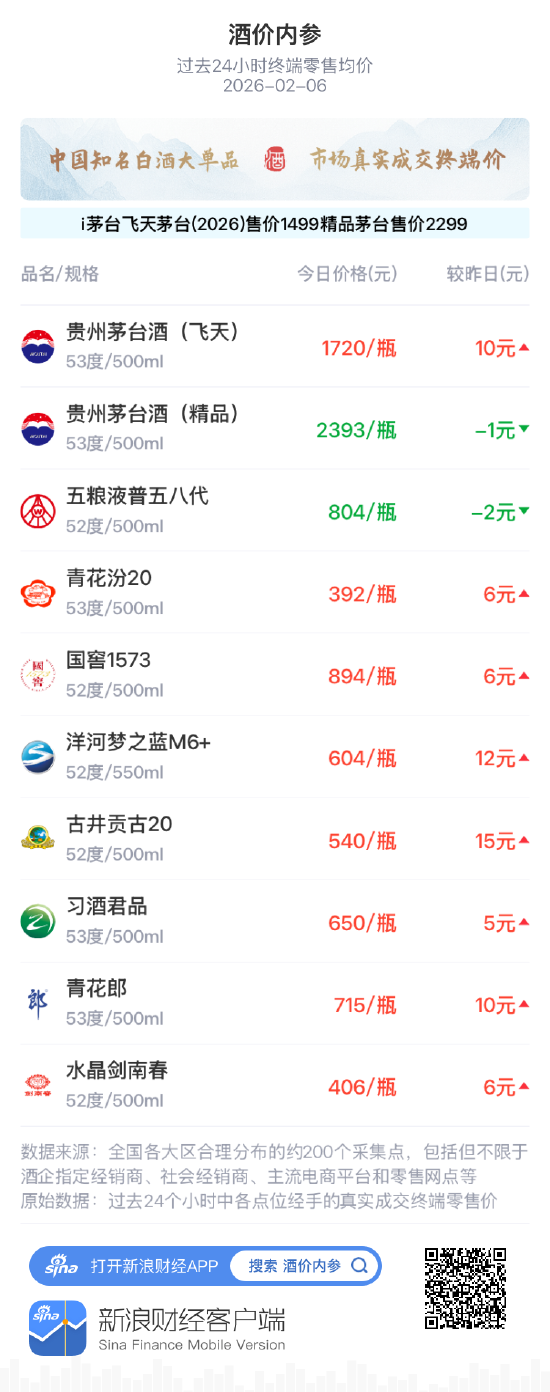
Core Insights - The core point of the news is the significant increase in the retail prices of major Chinese liquor brands, with the average price of the top ten products reaching a new high since 2026, indicating a recovery in the market driven by seasonal demand and improved macroeconomic conditions [1][6]. Price Trends - The average retail price of the top ten liquor products rose to 9118 yuan, an increase of 67 yuan from the previous day [1][6]. - Eight out of the ten products saw price increases, with notable rises including: - Gujinggong 20, up 15 yuan per bottle, reaching a 30-day high [1][6]. - Yanghe Dream Blue M6+ increased by 12 yuan per bottle [1][6]. - Both Feitian Moutai and Qinghua Lang rose by 10 yuan per bottle [1][6]. - The only two products that experienced price declines were: - Wuliangye Pu 58th generation, down 2 yuan per bottle [1][6]. - Premium Moutai adjusted down by 1 yuan per bottle, maintaining a high price level [1][6]. Market Analysis - The data for the "Liquor Price Reference" is collected from approximately 200 sampling points across various regions, ensuring a comprehensive and objective representation of the market [2][7]. - The recent performance of the liquor sector has been buoyed by three main factors: 1. The upcoming Spring Festival, which traditionally boosts consumption [8]. 2. Improved macroeconomic policies that enhance domestic demand [8]. 3. A shift in capital market dynamics, with institutional holdings at historically low levels [8]. - The current state of the liquor industry is characterized by a "five-bottom phase" in terms of policy, inventory, sales, wholesale prices, and production-sales dynamics, suggesting a potential turning point in the market [8].





18只个股涨停,白酒板块提前过年
Xin Lang Cai Jing· 2026-01-30 09:29
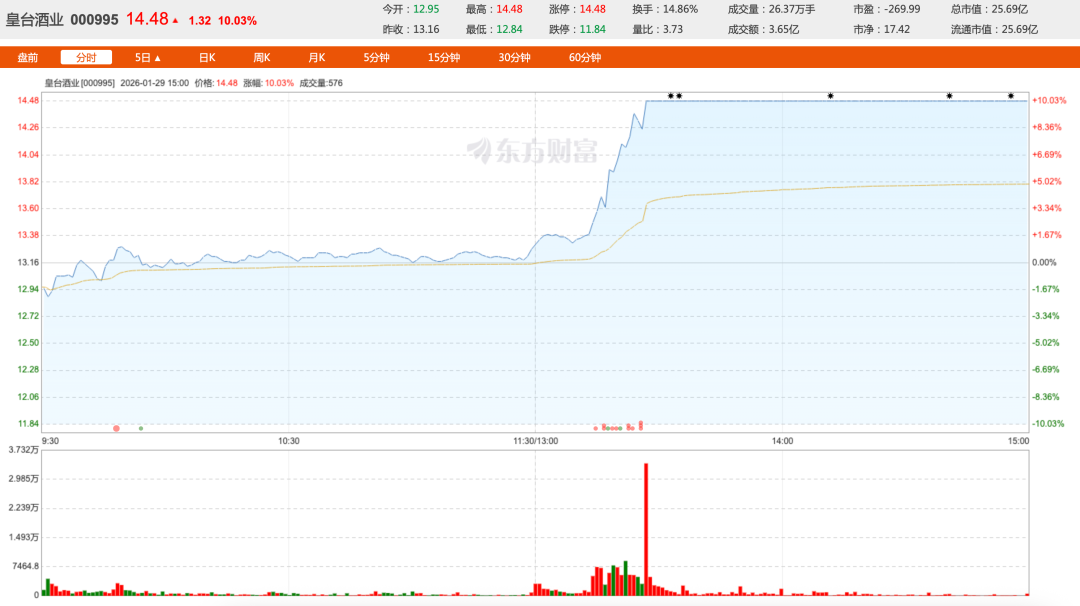
Core Viewpoint - The white liquor sector experienced a significant collective surge on January 29, 2026, with 18 out of 20 stocks reaching their daily limit, resulting in a total market value increase of over 252.6 billion yuan, primarily driven by the performance of Kweichow Moutai, which alone saw a market value increase of over 140 billion yuan [1][2][5]. Group 1: Market Performance - On January 29, 2026, the white liquor stocks initially opened flat but later exhibited a strong upward trend, with all 20 stocks showing a "climbing" pattern throughout the day [3][6]. - Kweichow Moutai and Shunxin Agriculture, while not hitting the limit, recorded significant gains of 8.61% and 9.96%, respectively, with Moutai's stock closing at 1437.72 yuan per share [5][6]. - The surge in the white liquor sector was unexpected for investors, who expressed surprise at the sudden rise after a prolonged period of low performance [6][10]. Group 2: Industry Turning Point - The collective rise in white liquor stocks has led to speculation about a potential turning point for the industry, attributed to factors such as the price increase of Moutai and the upcoming Spring Festival consumption peak [7][10]. - The price of Moutai's original box has risen to 1610 yuan per bottle, indicating a recovery from previous lows [7][9]. - Analysts from CITIC Securities have optimistic expectations for the Spring Festival sales, predicting stable sales performance due to various favorable factors [7][10]. Group 3: Valuation Recovery Logic - The current valuation of white liquor stocks is at a low point, with the China Securities White Liquor Index reflecting a price-to-earnings ratio of 18.85, close to historical lows [10][11]. - The market's expectation for a rebound is growing, especially as leading white liquor companies have adjusted their profit forecasts for 2025-2026, enhancing the perceived safety margin for investors [10][11]. - Structural changes within the industry, such as inventory clearance and price control mechanisms, are crucial for sustaining the recovery of white liquor stocks [11][12][16]. Group 4: Structural Changes - The pressure on leading liquor companies regarding inventory has eased, with companies like Wuliangye managing to reduce channel inventory to 1-2 months [11][12]. - Price control reforms are being implemented, with Moutai and Wuliangye adopting strategies to stabilize prices and support distributors [12][16]. - The effectiveness of these structural reforms will be essential for validating the recovery of demand in the white liquor sector [11][17].
中央汇金新动向:上半年加仓白酒和化工ETF
Shang Hai Zheng Quan Bao· 2025-08-28 09:43
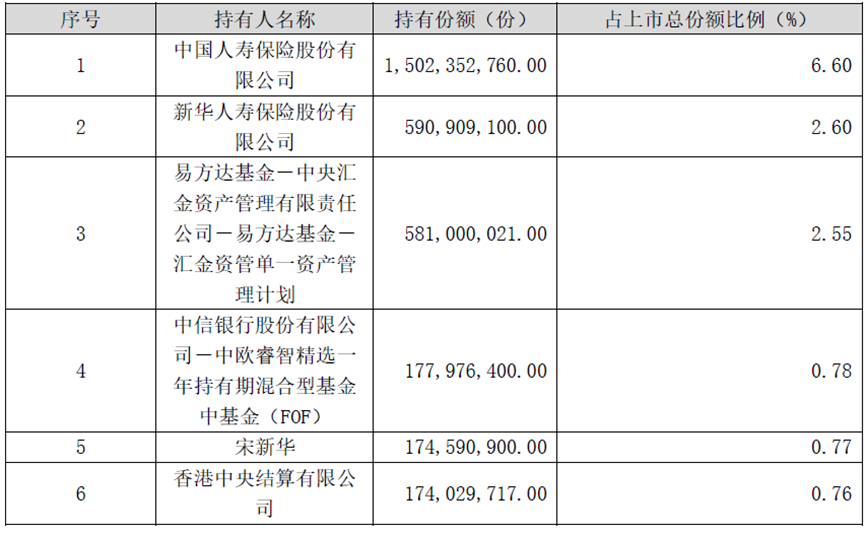
Group 1 - Central Huijin increased its holdings in various ETFs, including liquor and chemical sectors, during the first half of this year, demonstrating a commitment to stabilizing the market [1][2] - In Q2, Central Huijin purchased approximately 150 billion yuan worth of ETFs, including four Hu-Shen 300 ETFs and the Huaxia Shanghai 50 ETF, becoming a key stabilizing force in the market [1] Group 2 - Central Huijin's asset management plan increased its holdings in the Penghua Liquor ETF by 121 million shares, making it the third-largest holder with a total of 581 million shares as of the end of Q2 [2][3] - The Penghua Liquor ETF saw a net subscription of 5.75 billion yuan this year, with a significant acceleration in subscription flow in Q3, totaling 4.547 billion yuan since the beginning of Q3 [9] Group 3 - Central Huijin also increased its holdings in the Penghua Chemical ETF, holding 248 million shares, which accounts for 10.02% of the ETF's total shares, although this figure remained unchanged from the end of last year [6][7] - The white liquor sector has attracted renewed investment interest as valuations have significantly compressed after a prolonged downturn, with institutional investors starting to recognize potential opportunities [9][12] Group 4 - The white liquor industry is currently perceived to be at a bottom, with expectations of a recovery as companies release their semi-annual reports, which may alleviate market concerns regarding sales and pricing [12][13] - The valuation of the white liquor sector has decreased by 72% since February 2021, with fund holdings in the sector dropping to levels not seen since 2017 [13]