
监管协同

Search documents
大连在全国率先试点食品生产领域跨部门互认
Liao Ning Ri Bao· 2026-02-05 01:18
Core Viewpoint - Dalian City has initiated a pioneering regulatory model in the food production sector, focusing on collaborative governance and mutual recognition of inspections between the Dalian Market Supervision Administration and Dalian Customs, covering 115 inspection items [1][2]. Group 1: Regulatory Model - The new regulatory model transitions from "separate inspections" to "collaborative governance," encompassing key aspects such as personnel management, production environment, raw material verification, production process control, product inspection, and storage transportation [1]. - A unique "Cross-Department Mutual Recognition Supervision Inspection Form" has been developed, which integrates inspection standards from the National Market Supervision Administration and the General Administration of Customs, resulting in a two-tier inspection system [1]. Group 2: Inspection Details - The inspection form consists of three categories: fully recognized items (75.7%), negotiated recognized items (13%), and assessed accepted items (10.4%), ensuring comprehensive coverage of core regulatory projects and addressing domestic and international standard discrepancies [1]. - The pilot program will initially involve 30 enterprises in Ganjingzi District and Jinpu New Area that hold both food production licenses and export food production enterprise registration certificates [2]. Group 3: Implementation and Support - The inspection process allows one party to complete the on-site inspection and share the report with the other party, which must confirm within five working days, eliminating the need for duplicate inspections and reducing compliance costs for enterprises [2]. - Alongside regulatory collaboration, both departments will enhance service measures, including policy promotion, training, registration guidance, and market connection support [2].
筑牢不敢假、不能假、不想假防线
Sou Hu Cai Jing· 2026-01-10 23:19
Core Viewpoint - The Chinese capital market is intensifying efforts to combat financial fraud, with multiple departments collaborating to establish a comprehensive prevention and punishment system, signaling a strong regulatory stance against fraudulent activities [2][3]. Group 1: Regulatory Actions - Since July 2024, the China Securities Regulatory Commission (CSRC) has handled 159 financial fraud cases, imposing fines totaling 8.1 billion yuan, and has held major shareholders and actual controllers accountable in 43 cases [3][4]. - The regulatory approach has shifted from a single agency (CSRC) to a collaborative effort involving 12 departments, enhancing the overall enforcement capability [4]. - The comprehensive punishment and prevention system has evolved from post-incident penalties to a full-chain governance model that includes preemptive measures, ongoing supervision, and post-incident punishment [4][5]. Group 2: Accountability and Governance - The accountability framework has expanded from solely focusing on listed companies to include major shareholders, actual controllers, intermediary institutions, and third-party collaborators, addressing the low cost of illegal activities and high cost of rights protection for investors [4][5]. - The regulatory bodies are emphasizing a multi-faceted approach to accountability, ensuring that both primary offenders and accomplices are held responsible, thereby promoting fairness in the market [5][6]. - The role of intermediary institutions is being reinforced, with a shift in their responsibility from merely serving listed companies to protecting the interests of investors and maintaining market integrity [5][6]. Group 3: Preventive Measures - The construction of a comprehensive prevention and punishment system is entering a critical phase, focusing on enhancing legal frameworks and improving regulatory collaboration across administrative, criminal, and civil domains [6][7]. - There is a push for internal controls within listed companies and a call for the activation of independent directors to ensure that investors have rights and powers to supervise and voice concerns [6][7]. - The future direction includes leveraging technology, such as big data and artificial intelligence, to improve the detection and early intervention of fraudulent activities, thereby creating a more robust regulatory environment [7].


证监会年中工作会议系列解读:持续提升监管执法效能 净化资本市场生态
Shang Hai Zheng Quan Bao· 2025-07-29 23:16
Core Viewpoint - The China Securities Regulatory Commission (CSRC) emphasizes enhancing regulatory enforcement effectiveness to strengthen market governance and purify the market ecology [1][2]. Group 1: Regulatory Focus - The CSRC's meeting outlines a focus on "cracking down on major cases, serious violations, and key targets," aiming to improve regulatory collaboration and enhance technological regulatory capabilities [1][3]. - The meeting stresses the importance of precise and targeted measures to avoid one-size-fits-all approaches, ensuring that enforcement is strict yet reasonable and effective [1][5]. Group 2: Legal Framework and Accountability - Significant progress has been made in establishing a comprehensive accountability system, integrating administrative enforcement, criminal justice, and civil compensation [2][3]. - The increase in administrative penalties, the introduction of harsher criminal penalties, and the establishment of a collective lawsuit system have all contributed to a more robust deterrent effect against market violations [2][3]. Group 3: Technological Integration - The need for enhanced regulatory collaboration, particularly between judicial and administrative bodies, is highlighted as essential for high-quality capital market development [3][4]. - The use of big data and artificial intelligence is being implemented to create a comprehensive monitoring network that can automatically identify abnormal trading patterns and improve the efficiency of case detection and resolution [4]. Group 4: Balancing Regulation and Market Vitality - The challenge remains to enforce strict regulations while preserving the vitality and innovation of the market, suggesting the introduction of a "regulatory sandbox" to allow for some flexibility [4]. - The notion that strict regulation does not contradict market activation is emphasized, as it helps to recognize and favor quality market participants, fostering a shift towards innovation and long-term investment [4][5]. Group 5: Future Outlook - Future regulatory enforcement will focus on balancing stability, strictness, functionality, and the competency of regulatory teams, with an emphasis on targeted and effective measures to maintain a stable and active capital market [5].
团播为何这么火?
Xin Lang Cai Jing· 2025-07-20 01:26
Core Viewpoint - The group broadcasting (团播) industry has experienced explosive growth since its emergence in 2022, evolving from grassroots activities to industrial-scale operations, with a projected market size exceeding 200 billion yuan by 2025 [1][2]. Group 1: Industry Growth and Dynamics - Group broadcasting has become a popular format, with over 15,000 group broadcasts occurring simultaneously on platforms like Douyin daily, indicating intense competition [1]. - The topic of group broadcasting has garnered over 450 million views on social media since late June, highlighting its widespread appeal [1]. - The industry is driven by multiple factors, including technological advancements, user demand upgrades, and strategic adjustments by short video platforms [2]. Group 2: Technological and Content Innovations - The proliferation of 5G networks and advancements in live streaming technology have made real-time interaction more accessible, attracting a larger audience to group broadcasting [2]. - The entry of MCN institutions and professional production teams has shifted group broadcasting from a grassroots phenomenon to a more professional and industrialized format [2]. - Innovative engagement methods, such as "idol cultivation" and "team PK," cater to the social participation and emotional resonance needs of Generation Z [2]. Group 3: Challenges and Issues - Despite its popularity, the group broadcasting industry faces challenges such as content homogenization, the use of misleading personas, and copyright issues [3]. - Income distribution within the industry is imbalanced, with top broadcasters capturing over 70% of revenue, while many lower-tier broadcasters earn less than 10,000 yuan per month [3]. - The industry is at a critical juncture, transitioning from a focus on "traffic dividends" to "value dividends," necessitating content innovation and regulatory collaboration for sustainable growth [3].
债券市场是建设我国国际金融中心的“核心引擎” |金融百家
2 1 Shi Ji Jing Ji Bao Dao· 2025-07-10 12:49
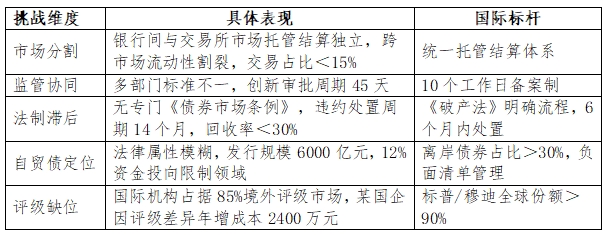
Group 1: Current Status of Bond Market Development - China's bond market has achieved significant progress in scale, innovation, and infrastructure, with a total custody balance expected to reach 158.8 trillion yuan by the end of 2024, making it the second largest globally [2][3] - The internationalization of the bond market is accelerating, with foreign institutions holding 4.1 trillion yuan in Chinese bonds, reflecting strong confidence from international investors [2][3] - Shanghai has introduced innovative bond mechanisms, leading to a green bond issuance scale of approximately 1.2 trillion yuan in 2024, positioning it as a global leader [3][4] Group 2: Challenges Facing the Bond Market - The bond market suffers from segmentation, with independent custody and settlement systems for interbank and exchange markets, leading to liquidity issues and a trading share of less than 15% [4][5] - Regulatory coordination is lacking, with multiple departments having inconsistent standards and lengthy approval processes, averaging 45 days [5][6] - The legal framework is underdeveloped, lacking a dedicated "Bond Market Regulation," resulting in lengthy default resolution processes averaging 14 months [6][7] Group 3: Recommendations for Enhancing Bond Market and International Financial Center - Expand market openness by simplifying foreign investment procedures and encouraging the inclusion of Chinese bonds in international indices [8][9] - Improve market liquidity and product diversity by developing high-yield bonds and green bonds, and optimizing trading platforms [8][9] - Optimize market structure by promoting a more integrated approach between interbank and exchange markets to enhance efficiency and risk control [9][10] Group 4: Pathways for Shanghai as an International Financial Center - Promote market integration by establishing a unified custody and settlement system, allowing investors to participate in the entire market with a single account [12][13] - Enhance regulatory coordination by forming a bond market regulatory coordination committee to unify standards and policies [13][14] - Strengthen legal frameworks by legislating a "Bond Market Regulation" to standardize the entire bond issuance and trading process [14][15]
财政部会计司与中国证监会会计司签署合作备忘录
news flash· 2025-06-19 08:06
Core Viewpoint - The Ministry of Finance and the China Securities Regulatory Commission have signed a memorandum of cooperation to enhance the management of accounting firms engaged in securities services [1] Group 1: Regulatory Framework - The memorandum aims to establish a joint working mechanism to implement various regulatory documents, including the State Council's opinions on regulating financial auditing and promoting the healthy development of the CPA industry [1] - It emphasizes the importance of regulatory collaboration to achieve system integration and data sharing among relevant authorities [1] Group 2: Implementation Measures - The parties will work on developing procedures for the filing management of accounting firms engaged in securities services, in line with the requirements set forth in the memorandum [1]