目标波动率策略

Search documents
湘财证券晨会纪要-20251218
Xiangcai Securities· 2025-12-18 00:50
Financial Engineering - The report emphasizes a risk-based asset allocation strategy, contrasting it with traditional methods that focus on expected returns. This approach quantifies the investor's risk tolerance and sets a clear risk budget, aiming for a diversified risk contribution from various assets to achieve better risk-adjusted returns over the long term [2][3]. Risk Parity Model - The risk parity model is highlighted as a key strategy, optimizing asset contributions to total portfolio risk equally, thus avoiding the dominance of equities in traditional stock-bond portfolios. Backtesting results show an annualized return of 6.1% with a maximum drawdown of 3.4% and a Sharpe ratio of 3.62, indicating strong robustness [3][4]. Asset Allocation Insights - The report notes a persistent higher allocation to corporate bonds over government bonds since 2017, attributed to increased interest rate volatility in government bonds post "financial deleveraging" in China. This reflects the model's disciplined dynamic adjustment to real market risk structures [3][4]. Enhanced Strategy for Returns - A target volatility strategy is proposed, which dynamically adjusts portfolio leverage to maintain a preset volatility level. This strategy shows high sensitivity to financing costs of leveraged funds and is practical for investors with flexible capital. It aims for a higher Sharpe ratio by setting a target slightly above the full allocation portfolio volatility [5]. - Additionally, a risk budgeting strategy based on Sharpe squared is introduced, focusing on efficient risk allocation to assets with historically higher Sharpe ratios. While it achieves similar absolute returns to risk parity, it offers lower volatility and the highest Sharpe ratio among strategies, though it is dependent on the continuation of historical patterns [5].
提高、降低集中度的产品同时发行——海外创新产品周报20250728
申万宏源金工· 2025-07-31 08:01
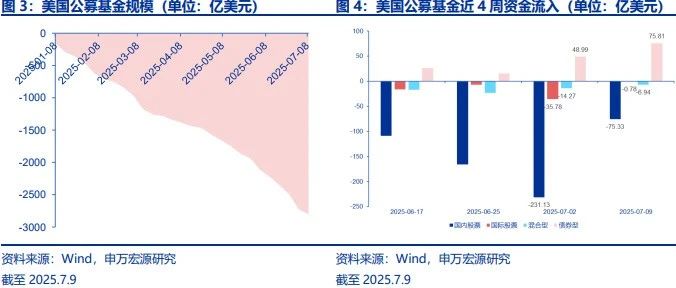
Group 1: ETF Innovations in the US - The US saw the launch of 37 new ETF products last week, with a focus on both increasing and decreasing concentration in portfolios [1] - Direxion, Leverage Shares, Defiance, and Rex Shares expanded their single-stock leveraged inverse products, covering companies like UnitedHealth Group, JPMorgan, and Ford [1] - WEBs introduced a Defined Volatility series that targets a specific volatility level based on historical data, with leverage adjustments made according to the product's recent performance [1] Group 2: New ETF Products - Crossmark launched two ETFs focusing on large-cap growth and value, utilizing a combination of fundamental and quantitative methods [2] - Defiance released an ETF targeting AI and power infrastructure, tracking companies with over 50% revenue from AI-related sectors [2] - Roundhill expanded its weekly leveraged and dividend ETFs linked to major tech companies, providing 1.2x weekly returns [2] Group 3: ETF Market Dynamics - Stock ETFs experienced inflows exceeding $16 billion last week, with domestic and international stocks seeing similar levels of investment [5] - Factor rotation ETFs saw inflows surpassing $1 billion, with total assets exceeding $20 billion [7] - The top inflow products included Vanguard's broad-based ETFs and BlackRock's factor rotation ETF, while major outflows were seen in SPDR's S&P 500 ETFs [7] Group 4: Performance of Digital Currency ETFs - The total size of US digital currency ETFs has surpassed $150 billion, with BlackRock's Bitcoin ETF nearing $90 billion [10] - Bitcoin products have outperformed Ethereum, with Bitcoin ETFs showing a year-to-date increase of approximately 25% compared to Ethereum's less than 10% [10] Group 5: Fund Flow Trends - As of May 2025, the total amount of non-money market mutual funds in the US reached $21.91 trillion, reflecting a slight increase from April [11] - During the week of July 2-9, domestic equity funds experienced outflows of about $7.5 billion, while bond products saw inflows of $7.58 billion [11]