
社会诚信体系建设

Search documents
年夜饭预订需双方共同守约
Xin Lang Cai Jing· 2026-02-11 23:56
Core Viewpoint - The article emphasizes the importance of understanding the difference between "deposit" and "booking fee" in the context of New Year's Eve dinner reservations, highlighting the need for both consumers and businesses to adhere to contractual agreements to foster trust and protect rights [1][2]. Group 1: Consumer Behavior and Market Trends - There is a growing trend among families to book New Year's Eve dinners at hotels due to the convenience, festive atmosphere, and quality of service [1]. - Issues related to reservation disputes have become common, including sudden price increases, changes in menu items, and unilateral order cancellations by businesses [1]. Group 2: Contractual Obligations and Trust - The article discusses the concept of a special contract in the context of New Year's Eve dinner reservations, stressing that both parties must uphold their agreements to ensure a smooth and warm reunion experience [1]. - The breach of contracts not only affects specific interests but also undermines trust between individuals, with businesses risking long-term consumer loyalty if they default on agreements [1]. Group 3: Regulatory and Institutional Support - There is a call for enhanced regulatory oversight of the New Year's Eve dinner market, including the clarification of reservation rules and standardization of contract terms [2]. - Industry associations are encouraged to establish self-regulatory agreements, while consumer organizations should play a supervisory role to ensure compliance with contractual obligations [2].
免申即享!个人征信一次性修复
Shen Zhen Shang Bao· 2025-12-22 18:49
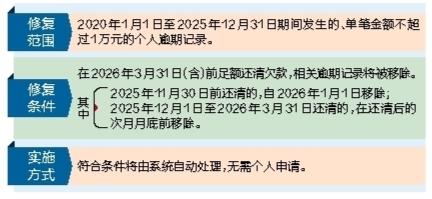
Core Viewpoint - The People's Bank of China (PBOC) has announced a one-time credit repair policy aimed at supporting individuals with damaged credit who actively repay their debts, effective from January 1, 2026 [2][3] Group 1: Policy Details - The policy will be implemented in an "automatic recognition" mode, where the PBOC's credit center will automatically identify and adjust overdue records without requiring individual action [2] - Individuals who fully repay overdue debts by November 30, 2025, will have their overdue information not displayed in the financial credit information database starting January 1, 2026 [2] - For those who repay overdue debts between December 1, 2025, and March 31, 2026, the overdue information will not be displayed by the end of the following month [2] Group 2: Implications for Individuals - The policy is seen as a win-win for the public, allowing individuals to break free from the cycle of lifelong restrictions due to past credit issues [3] - It sends a clear message that credit can be repaired if individuals fulfill their obligations within a specified timeframe, encouraging proactive debt repayment [3] - Repairing credit is viewed as restoring an individual's financial "passport," which can improve their quality of life and personal development [3] Group 3: Implications for Financial Institutions - The credit repair policy encourages borrowers to repay overdue debts, potentially improving banks' asset quality and promoting inclusive finance [4] - Financial institutions can re-engage with previously "defaulted" individuals who have repaired their credit, expanding their customer base with growth potential [4] - The policy is expected to enhance the social credit system and stimulate consumer spending and economic vitality, benefiting the overall economy [4] Group 4: Clarifications on the Policy - The credit repair initiative is not a "credit washing" scheme; it involves a conditional, procedural, and time-limited process aimed at educating and assisting non-malicious defaulters [4] - The system will automatically process eligible individuals without any fees or third-party involvement, emphasizing the need for residents to be cautious of potential scams [4]

央行一次性信用修复政策来了,哪些人可“免申即享”?
Guo Ji Jin Rong Bao· 2025-12-22 15:41
Core Viewpoint - The People's Bank of China has implemented a one-time credit repair policy aimed at supporting individuals with damaged credit who are actively repaying their debts, allowing them to efficiently restore their credit status [1][4] Group 1: Policy Details - The credit repair policy adheres to three principles: a specific time frame (2020 to 2025), a maximum amount (individual overdue amounts not exceeding 10,000 RMB), and specific conditions (debts must be repaid by March 31, 2026) [2] - Individuals who repay overdue debts by November 30, 2025, will have their overdue information removed from the credit database starting January 1, 2026 [2] - The policy applies to various types of loans, including personal loans, housing loans, consumer loans, and credit cards, without charging any fees or requiring third-party agents [2] Group 2: Impact on Individuals - The policy aims to break the cycle of "once untrustworthy, always restricted," providing a pathway for those who have made mistakes but are willing to correct them [5][6] - It is expected to improve the core qualifications for personal credit applications, potentially increasing approval rates for housing and consumer loans [4][5] - The policy targets non-malicious, long-tail credit users, particularly benefiting young workers, individual business owners, and flexible employment individuals [6] Group 3: Benefits for Financial Institutions - The credit repair initiative encourages borrowers to repay overdue debts, which may help banks recover overdue loans and improve asset quality [7] - It establishes an incentive mechanism for debtors to repay their debts by setting a repayment deadline of March 31, 2026, aiding financial institutions in quickly recovering non-performing assets [7] - The policy also aims to eliminate illegal credit repair intermediaries by providing a free, automatic system for credit information processing [7][8] Group 4: Broader Social Implications - The credit repair mechanism is expected to enhance the social credit system by balancing punitive measures for dishonesty with benefits for trustworthiness [8] - It can alleviate social tensions caused by long-term credit issues, providing hope and promoting social harmony [8] - The policy is anticipated to stimulate consumer potential and economic vitality, allowing millions to access reasonable financial services, thereby boosting consumption and internal demand [8]
【市局动态】来宾市市场监管局开展“入企问需、信用赋能”活动
Sou Hu Cai Jing· 2025-12-06 17:13
Core Viewpoint - The market supervision bureau of Laibin City is actively enhancing the social credit system by addressing the urgent needs of business entities, implementing four key measures to promote credit awareness and compliance among enterprises, resulting in positive outcomes [1]. Group 1: Credit Policy Promotion - Market supervision personnel are conducting credit policy knowledge promotion activities in various industrial parks [3]. - Staff members are engaging with business leaders to promote integrity in operations [4]. - Credit policy education is being delivered in industrial parks, focusing on various regulations to strengthen the awareness that "credit is an asset" and encouraging businesses to shift from "I have to operate with integrity" to "I want to operate with integrity" [5]. Group 2: Tailored Services for Enterprises - A credit supervision service team has been established to provide on-site consultations and educational activities regarding annual reports, contract compliance, and credit restoration, fostering a comprehensive credit supervision and service mechanism [6]. - Collaboration with rural commercial banks has led to the establishment of a "credit restoration service station," facilitating efficient processing of credit restoration applications and creating a new service model that integrates credit and finance [6]. Group 3: Encouraging Credit Restoration - An innovative mechanism has been introduced to simultaneously deliver administrative penalty notices and credit restoration guidance, promoting a shift from reactive to proactive credit restoration [7]. - As of now, the bureau has engaged with 115 enterprises, addressing 65 credit-related inquiries, effectively delivering credit support to businesses and receiving widespread positive feedback [7].
用人工智能造假骗退款,别耍小聪明
Ren Min Ri Bao· 2025-11-26 23:35
Group 1 - The core issue is the misuse of AI technology by some buyers to create fake images of product defects in order to fraudulently obtain refunds from e-commerce platforms [1] - This behavior reflects a lack of integrity and poses a risk to the legal framework, as it constitutes civil fraud and could lead to criminal charges if the amounts involved are significant [1] - The "refund only" policy of e-commerce platforms, intended to enhance consumer experience and protect rights, is being exploited by opportunists, which could harm merchants and hinder the healthy development of the platform economy [1] Group 2 - The regulation of AI technology usage requires collaborative efforts from the government, platforms, merchants, and consumers [2] - The implementation of the "Artificial Intelligence Generated Synthetic Content Identification Measures" in September prohibits malicious actions such as deleting, altering, or fabricating synthetic content identifiers, establishing clear boundaries for the responsible use of AI-generated content [2] - There is a call for platforms and merchants to enhance defensive technologies, develop AI image recognition tools, and establish mechanisms for reviewing abnormal refund requests [2]