
科技创新集群

Search documents
苏州“十五五”规划建议:加快推进沪苏同城化发展
Jin Rong Jie· 2026-01-21 13:23
Core Viewpoint - The article emphasizes the acceleration of the integration of Suzhou and Shanghai, highlighting the importance of Suzhou's role in supporting Shanghai's leadership and its involvement in the development of Shanghai's "five centers" and metropolitan area [1] Group 1: Economic Development - The proposal includes enhancing cooperation in technology innovation platforms and sharing innovation resources to strengthen the international competitiveness of the Shanghai-Suzhou technology innovation cluster [1] - The initiative aims to collaboratively develop world-class high-end industrial clusters in integrated circuits, artificial intelligence, biomedicine, automotive, and large aircraft [1] Group 2: Infrastructure and Services - The plan promotes the improvement and expansion of the Hongqiao International Open Hub and actively connects with the Shanghai Eastern Hub International Business Cooperation Zone [1] - It emphasizes the need for strengthening interconnectivity of transportation infrastructure, co-building public services, and jointly managing ecological environments [1] Group 3: Policy and Mechanism - The proposal calls for the enhancement of the institutional mechanisms for urban integration development [1]
深港穗与沪苏两大科技集群有何异同
Di Yi Cai Jing· 2025-10-20 12:12
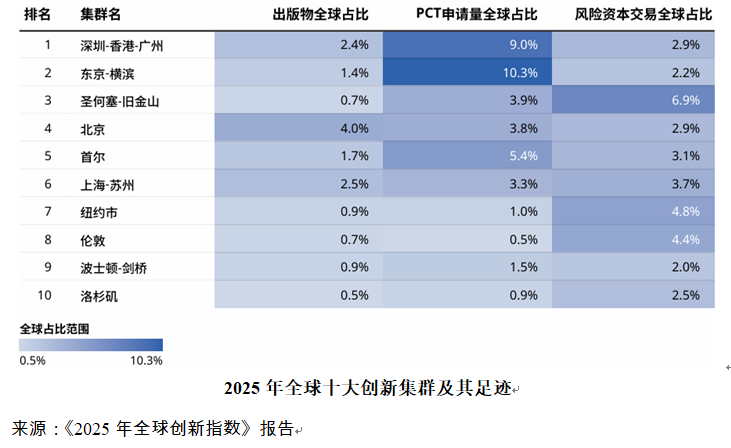
Core Insights - The report highlights that China's innovation clusters, particularly the "Shenzhen-Hong Kong-Guangzhou" cluster, have surpassed the "Tokyo-Yokohama" cluster to become the world's top innovation cluster, while the "Shanghai-Suzhou" cluster ranks sixth globally [1][2][3]. Investment and Innovation Metrics - The "Shenzhen-Hong Kong-Guangzhou" cluster leads with a global publication share of 2.4%, a PCT application share of 9.0%, and a venture capital transaction share of 2.9% [3]. - The "Shanghai-Suzhou" cluster ranks fourth globally in venture capital transaction volume, despite being sixth overall in the innovation cluster ranking [2][3]. Regional Collaboration and Innovation Ecosystem - The collaboration among Shenzhen, Hong Kong, and Guangzhou is characterized by a strong complementarity in innovation capabilities, with Shenzhen's robust manufacturing base, Guangzhou's educational resources, and Hong Kong's international market access [5]. - The "Shanghai-Suzhou" collaboration is progressing under the Yangtze River Delta integration strategy, with various joint initiatives and funding mechanisms established to enhance innovation [9]. Innovation Platforms and Resource Sharing - Significant efforts are being made to build innovation platforms, such as the establishment of joint laboratories and research centers between cities in both clusters [11][12]. - The Guangdong province has initiated measures to open up major research facilities and instruments for shared use across the Greater Bay Area, enhancing collaborative research capabilities [14]. Capital Flow and Investment Mechanisms - Cross-border funding mechanisms have been established to facilitate the flow of research funds between Guangdong and Hong Kong, with over 460 million RMB allocated to date [15]. - The Yangtze River Delta region has seen the establishment of various joint investment funds to support collaborative research and innovation projects [15]. Differences in Collaboration Models - The "Shenzhen-Hong Kong-Guangzhou" cluster benefits from a more integrated administrative structure, while the "Shanghai-Suzhou" collaboration faces challenges due to differing administrative levels [17]. - Institutional differences, particularly in regulatory frameworks, impact the ease of collaboration in the "Shenzhen-Hong Kong-Guangzhou" cluster compared to the more aligned rules in the "Shanghai-Suzhou" cluster [18]. Recommendations for Future Collaboration - The report suggests building a cooperative mechanism for technology innovation, enhancing legal frameworks, and fostering joint research initiatives to strengthen regional collaboration [21]. - It emphasizes the importance of creating shared innovation spaces and platforms to facilitate deeper cooperation and resource sharing across regions [22][24].

事关大湾区金融!这场论坛,信息量满满
Zheng Quan Shi Bao· 2025-08-30 14:32
Group 1: Financial Development in the Greater Bay Area - The seventh Greater Bay Area Financial Development Forum was held in Guangzhou, focusing on comprehensive financial cooperation and development towards the world [1] - The forum gathered government departments and financial industry representatives from Guangdong, Hong Kong, and Macau for multi-dimensional discussions [1] Group 2: Technology Innovation and Economic Development - Zhang Junkuo emphasized the need for China to shift from "following" to "leading" in technology innovation, addressing consumer confidence, real estate market recovery, and enhancing technological self-reliance [2][3] Group 3: Cross-Border Financial Development - Li Dongrong outlined five key areas to accelerate cross-border financial development in the Greater Bay Area, including regulatory cooperation, standard alignment, data flow, fintech application, and creating service models [4][5] - Huang Hong highlighted that deepening financial openness is crucial for high-quality financial development in the Greater Bay Area, advocating for a unified financial market and breaking down administrative barriers [6] Group 4: Technology and Financial Systems - Wang Yiming called for the establishment of a technology finance system that aligns with technological innovation, noting that R&D expenditure in the Greater Bay Area has surpassed 4% [7][9] Group 5: Global Economic Restructuring - Ding Zhijie stated that the Greater Bay Area should actively engage in high-level financial openness amid global economic restructuring, focusing on collaborative development among cities and establishing an international financial center [10][11] Group 6: Financial Cooperation and Regulation - Jiang Bo reported on the progress of financial cooperation between mainland China and Hong Kong/Macau, including regulatory alignment and the facilitation of banking operations [12][13] Group 7: Fund Management and Capital Markets - Huang Shanwen discussed efforts to attract domestic and international funds to Macau, enhancing long-term capital management and cross-border asset allocation capabilities [14][15] - Chen Weimin encouraged mainland enterprises to establish overseas business headquarters in Hong Kong, enhancing the management of overseas funds [16][18] Group 8: Stock Market and Financial Technology - Chen Yiting noted that new economy companies are driving Hong Kong's IPO market, with significant financing from sectors like healthcare and technology [19][20]