
沪苏同城化

Search documents
吴庆文专题调研沪苏(州)同城化工作
Su Zhou Ri Bao· 2026-02-27 00:19
Core Insights - The article emphasizes the importance of deepening the integration of Shanghai and Suzhou, highlighting the need for efficient flow of resources and collaborative innovation to enhance regional development [1][2]. Group 1: Policy and Strategic Initiatives - The Suzhou government is focusing on implementing Xi Jinping's directives on the integration of the Yangtze River Delta, aiming to accelerate the development of the Shanghai-Suzhou urban integration [1]. - The Shanghai Airport-Suzhou front cargo station is noted as the first cross-province and cross-customs area airport customs supervision station in the country, which aims to streamline air cargo operations and improve logistics efficiency [1]. Group 2: Economic Development and Industry Collaboration - The Hu-Kun Aesthetic Medicine and Anti-Aging Industrial Park is being developed in collaboration with Shanghai Industrial Group, aiming to leverage Shanghai's high-end medical industry to boost the consumer medical industry cluster in Suzhou [2]. - The Suzhou Deep Time Digital Earth Research Center is a key component of the DDE plan, focusing on enhancing collaboration with top global research institutions to foster innovation resource sharing and talent development [1].
相城高新区推进招商引资工作
Su Zhou Ri Bao· 2026-01-27 02:09
Core Insights - The meeting held on January 26 focused on advancing investment attraction efforts for 2026, summarizing the achievements of 2025 and outlining strategies for the upcoming year [1] - In 2025, the Xiangcheng High-tech Zone implemented the "1368" development strategy, achieving significant investment goals and establishing a unique investment attraction system [1] Group 1 - In 2025, the Xiangcheng High-tech Zone successfully signed 112 key projects with a total investment exceeding 11.8 billion yuan, achieving the "double hundred" target for investment attraction [1] - The establishment of five state-owned companies in various sectors, including technology and cultural industries, contributed to the investment success [1] - The successful listing of Aisheren on the Beijing Stock Exchange marked a significant milestone as the first local company to achieve this, signaling a strong start for 2026 [1] Group 2 - The 2026 investment strategy will focus on establishing a Shanghai investment company to leverage opportunities from the integration of Shanghai and Suzhou, targeting high-end business, exhibition economy, logistics, and innovation resources [2] - The strategy aims to integrate into the "Greater Hongqiao" initiative, enhancing the region's attractiveness for international innovation and technology [2]
昆山,太热闹啦!
Xin Lang Cai Jing· 2026-01-25 09:59
Group 1: Cultural and Tourism Activities - The city of Kunshan is enhancing its cultural identity and lifestyle through various tourism and cultural activities as the Spring Festival approaches [1] - A series of engaging cultural tourism events took place on January 24, including the roadshow of the romantic comedy film "Non-Traditional Romantic Relationships," which will be released nationwide on January 31 [1] - The film's promotional activities include a special viewing event in Zhouzhuang, inviting audiences to explore the scenic locations featured in the film [1] Group 2: Community Engagement and Traditional Arts - A community event at the city square featured youth participating in calligraphy, showcasing traditional culture and creativity [3] - The event allowed children to display their written "Fu" characters, promoting a sense of community and cultural pride [3] - A concert featuring Xu Hong's performances highlighted the depth of traditional music, engaging the audience with its emotional resonance [4] Group 3: Sports and Local Events - The first "Flag Football" tournament in Kunshan attracted 20 high-level teams from the Yangtze River Delta region, promoting sports and community interaction [6] - The event serves as a significant step in integrating sports education and enriching the local sports ecosystem [6] Group 4: Traditional Customs and Local Markets - The "Catch Fish for New Year Customs" event in Nanyu Village allowed residents and visitors to engage in traditional fishing activities, blending modern experiences with cultural heritage [9] - The event featured a fish-catching competition and a market showcasing local delicacies, enhancing the festive atmosphere [9] - The first "Artistic Village Evening" event integrated local customs and provided opportunities for residents to purchase local products [11] Group 5: Cultural Exchange and Community Support - A collaboration between Su Yuzhai and the "Tuxin Fresh" brand aimed to promote Xinjiang's specialty products in Kunshan, fostering cultural exchange and community support [14] - This initiative helps local farmers by bringing their products to a broader market while educating Kunshan residents about Xinjiang's culture and resources [14] Group 6: Overall Festive Atmosphere - Kunshan is actively inviting visitors to experience a vibrant and warm New Year atmosphere, showcasing its cultural richness and community spirit [16]


苏州“十五五”规划建议:加快推进沪苏同城化发展
Jin Rong Jie· 2026-01-21 13:23
Core Viewpoint - The article emphasizes the acceleration of the integration of Suzhou and Shanghai, highlighting the importance of Suzhou's role in supporting Shanghai's leadership and its involvement in the development of Shanghai's "five centers" and metropolitan area [1] Group 1: Economic Development - The proposal includes enhancing cooperation in technology innovation platforms and sharing innovation resources to strengthen the international competitiveness of the Shanghai-Suzhou technology innovation cluster [1] - The initiative aims to collaboratively develop world-class high-end industrial clusters in integrated circuits, artificial intelligence, biomedicine, automotive, and large aircraft [1] Group 2: Infrastructure and Services - The plan promotes the improvement and expansion of the Hongqiao International Open Hub and actively connects with the Shanghai Eastern Hub International Business Cooperation Zone [1] - It emphasizes the need for strengthening interconnectivity of transportation infrastructure, co-building public services, and jointly managing ecological environments [1] Group 3: Policy and Mechanism - The proposal calls for the enhancement of the institutional mechanisms for urban integration development [1]
共聚创新力 激活强引擎
Su Zhou Ri Bao· 2025-12-25 22:33
Core Insights - The Shanghai-Suzhou innovation cluster ranks sixth globally in the "Top 100 Global Innovation Clusters" list for 2025, as reported by the World Intellectual Property Organization, highlighting its strong intellectual property and innovation capabilities [1] - The integration of Shanghai and Suzhou's innovation resources is significantly enhancing collaborative effects, contributing to high-quality development in the Yangtze River Delta region [1][2] Group 1: National Strategy and Innovation Collaboration - The Central Economic Work Conference emphasizes the construction of international technology innovation centers in Beijing, Shanghai, and the Guangdong-Hong Kong-Macau Greater Bay Area, providing new opportunities for Suzhou to deepen its integration with Shanghai [2] - Suzhou has become a prominent area for the release of urban synergy effects, actively aligning with Shanghai to accelerate their integration and collaborative innovation efforts [2] Group 2: Innovation Ecosystem Development - The G60 Science and Technology Innovation Corridor and the Yangtze River Delta industrial innovation belt are crucial links for deepening collaboration between Shanghai and Suzhou [3] - The establishment of various innovation alliances and joint ventures, such as the "Large Size Silver-Free Battery Full Chain Technology and Equipment Innovation Alliance," showcases the commitment to overcoming key technological challenges [3] Group 3: Economic Performance and Innovation Capacity - By 2024, the combined GDP and industrial output of Shanghai and Suzhou are expected to exceed 8 trillion yuan, reflecting the maturity of the "Shanghai R&D + Suzhou Transformation" model [4] - As of October 2025, there are over 42,500 national high-tech enterprises and nearly 2,000 specialized "little giant" enterprises in the region, indicating a robust innovation capacity [4] Group 4: Resource Sharing and Ecosystem Integration - The collaboration between Suzhou and Shanghai has evolved from project-based interactions to a shared innovation ecosystem, exemplified by the establishment of the Shanghai Jiao Tong University Suzhou Innovation Institute [5] - The new Shanghai Jiao Tong University Suzhou Advanced Research Institute aims to integrate academic resources with local industry, fostering innovation and talent development [5] Group 5: Strategic Innovations and Infrastructure - The establishment of the COMAC Taicang Research Center marks a significant step in integrating Suzhou into the aircraft design and research chain, enhancing the local aerospace industry [6] - Kunshan is actively integrating into Shanghai's innovation ecosystem, implementing initiatives like the "Hu-Kun Technology Innovation Voucher" to facilitate cross-regional collaboration [6] Group 6: Cross-Regional Collaboration and Efficiency - The launch of the "Shanghai Airport-Suzhou Pre-Positioning Cargo Station" has significantly improved logistics efficiency, reducing costs and time for high-tech product exports [7][8] - The development of a comprehensive financial service system for high-tech enterprises in Suzhou has led to 57 companies successfully listing on the Shanghai Stock Exchange's Sci-Tech Innovation Board [8] Group 7: Future Directions - The Shanghai-Suzhou innovation cluster is poised to further integrate into the international technology innovation center framework, focusing on deepening collaborative development and enhancing new productive forces [9]
高铁苏州北站项目建设取得重大突破 超深地下连续墙施工全面开启
Huan Qiu Wang· 2025-12-23 03:00
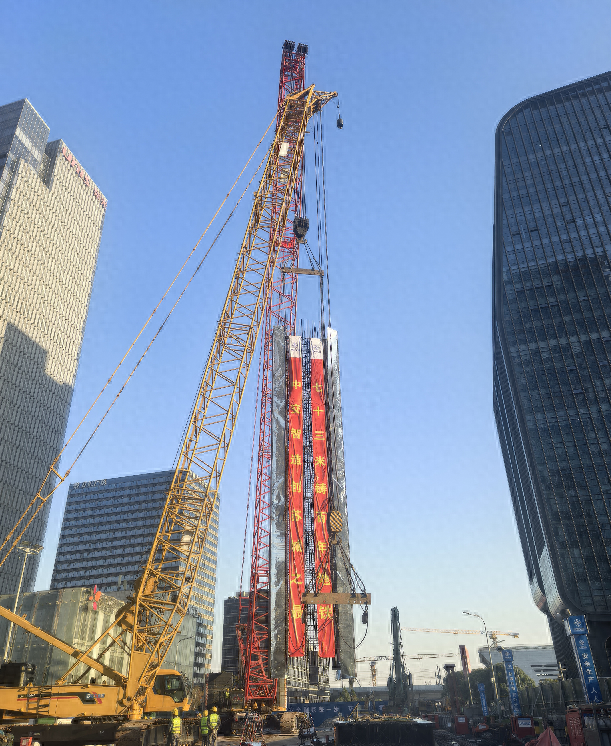
Group 1 - The Suzhou North Station high-speed rail project has achieved a significant milestone with the commencement of the construction of the underground continuous wall, marking the start of the protective structure phase [1] - The project features a dual protection system consisting of a 73-meter underground continuous wall and an 80-meter TRD waterproof curtain, designed to address the challenges posed by a 38.65-meter deep foundation pit and surrounding dense buildings [1] - The China Communications Construction Company (CCCC) has established an expert group to oversee the project, ensuring the operational safety of the Beijing-Shanghai high-speed railway and the stability of nearby buildings [1] Group 2 - The CCCC's technical team, led by Chief Engineer Zhou Feng, conducted 47 sets of slurry mix ratio tests to optimize parameters, ensuring that the performance of new and recycled slurries meets complex geological requirements [3] - The construction of the first section of the underground continuous wall involved close supervision from experts, maintaining quality standards above regulatory requirements to ensure the wall's integrity, which is crucial for the deep foundation pit excavation [3] - The successful implementation of the temporary shield well's continuous wall provides conditions for the subsequent reception of the shield machine, contributing to the integration of high-speed rail, intercity rail, urban rail, and city transit systems in Suzhou [3]
长三角议事厅·周报|沪苏同城化:硬联通之后,还需算四本账
Xin Lang Cai Jing· 2025-12-22 07:57
Core Insights - The integration of Shanghai and Suzhou has reached a significant milestone with improved transportation links, but the next phase focuses on smoother operational integration rather than just speed [1][2][3] - The recent proposal by the Jiangsu Provincial Party Committee emphasizes the need for Suzhou to transition from merely learning from Shanghai to fully integrating with it, highlighting the importance of addressing discrepancies in standards, interests, and assessments [1][2] Group 1: Hard Connectivity Achievements - The Shanghai Metro Line 11 has been extended to Kunshan, and high-speed rail travel between Suzhou North Station and Shanghai Hongqiao has been reduced to approximately 23 minutes [1] - The combined GDP of Shanghai and Suzhou is projected to exceed 8 trillion yuan in 2024, with Shanghai at 5.39 trillion yuan and Suzhou at 2.67 trillion yuan [1] Group 2: Soft Frictions in Integration - The main challenges in the integration process are categorized into three types of "soft frictions": differences in standards and processes, difficulties in benefit distribution, and structural constraints from assessment and competition logic [2][3] - The fragmentation in standards and processes leads to increased hidden costs for businesses operating across cities, as multiple recognitions and submissions are required [2] Group 3: Institutional Tools for Collaboration - Effective solutions to the identified soft frictions involve creating executable, assessable, and replicable institutional tools rather than merely increasing coordination meetings [4][5] - The Long Triangle Ecological Green Integration Development Demonstration Zone has successfully transformed cross-provincial collaboration from project-based to rule-based, addressing common bottlenecks with a practical "toolbox" approach [4] Group 4: Focus on Public Welfare - The integration's success is also measured by its impact on public welfare, with initiatives to streamline cross-city services such as social security transfers and public housing loans, aiming for completion within three working days [5] - The establishment of a unified social security card system aims to enhance daily experiences of integration by covering various services like transportation and library access [5] Group 5: Expanding Institutional Frameworks - The current focus should be on expanding successful practices from pilot projects into a broader institutional product library, allowing for systematic operation rather than isolated breakthroughs [6] - The goal is to align evaluation standards and regulatory measures across regions, facilitating smoother project approvals and enhancing the overall experience of integration for residents and businesses [6] Group 6: National Demonstration Significance - The Shanghai-Suzhou integration serves as a national model for cross-provincial collaboration, emphasizing the need for both speed and clarity in operational processes [7] - The ongoing investment in infrastructure, such as the 600 billion yuan allocated for railway construction in the Yangtze River Delta during the 14th Five-Year Plan, supports this integration effort [7]
沪苏同城化提速,一个“超级城市”呼之欲出
Mei Ri Jing Ji Xin Wen· 2025-12-18 15:23
Core Viewpoint - The integration of Suzhou and Shanghai is a strategic focus for the development of the Yangtze River Delta, aiming to enhance regional collaboration and innovation capabilities [1][4][6]. Group 1: Economic Integration - Shanghai and Suzhou, as the leading cities in the Yangtze River Delta, have a combined GDP exceeding 8 trillion yuan, accounting for nearly 25% of the region's economy [1]. - The recent central economic work conference emphasized the need for stronger coordination among key urban clusters, with a focus on deepening cross-administrative cooperation [1][12]. - The Jiangsu "14th Five-Year" plan supports the co-development of Suzhou and Shanghai, indicating a commitment to urban integration [5]. Group 2: Innovation and Technology - The collaboration between Shanghai and Suzhou is seen as a critical point for advancing China's innovation capabilities, with both cities ranked among the top six in the global innovation index [3]. - The shift from "Shanghai R&D + Suzhou manufacturing" to a model of joint innovation efforts highlights the evolving nature of their industrial collaboration [7]. - The establishment of the Wusong River Innovation Belt is intended to connect various high-end industrial parks, enhancing Suzhou's role as a technology hub [8]. Group 3: Infrastructure and Connectivity - The development of transportation infrastructure, such as the upcoming intercity railway, is expected to further integrate Shanghai and Suzhou, enhancing economic interactions [10]. - The ecological integration initiative in the Yangtze River Delta aims to balance industrial growth with environmental sustainability, creating a favorable environment for attracting talent and investment [9][10]. Group 4: Challenges and Opportunities - Administrative barriers remain a significant challenge for the integration process, as local governments prioritize local economic indicators [14][15]. - The need for a restructured collaborative ecosystem that includes market mechanisms and social forces is essential for overcoming these challenges [15].
深化对接把握同城化发展大方向 陈吉宁龚正与苏州市领导座谈 高起点谋划未来五年发展蓝图
Jie Fang Ri Bao· 2025-12-06 01:55
Core Viewpoint - The meeting between Shanghai and Suzhou leaders emphasizes the importance of collaboration and integration in the Yangtze River Delta region, focusing on high-quality development and innovation in line with national strategies [1] Group 1: Strategic Planning - Shanghai is actively working on its "14th Five-Year Plan" and aims to create a high-level development blueprint for the next five years [1] - The meeting serves as an opportunity to strengthen communication and alignment between Shanghai and Suzhou, particularly in the context of urban integration and regional business environment optimization [1] Group 2: Collaborative Efforts - Suzhou expresses gratitude for Shanghai's support and aims to leverage the "14th Five-Year Plan" to enhance cooperation and integration with Shanghai [1] - The focus areas for collaboration include technological innovation, infrastructure connectivity, and cultural tourism cooperation, all aimed at achieving high-quality development and supporting national strategic initiatives [1]
陈吉宁龚正与范波吴庆文一行座谈
Zheng Quan Shi Bao Wang· 2025-12-05 12:50
Core Viewpoint - The meeting between Shanghai and Suzhou officials emphasizes the deep historical ties and frequent exchanges between the two cities, aiming to enhance cooperation and integration under the Yangtze River Delta integration strategy [1] Group 1: Strategic Cooperation - Shanghai and Suzhou aim to strengthen communication and alignment in urban development, leveraging the "14th Five-Year Plan" and Shanghai's metropolitan area land space planning as opportunities [1] - The focus is on optimizing the regional business environment to facilitate the smooth flow of market factors and better serve the national unified market construction [1] Group 2: Innovation and Development - Both cities plan to deepen cross-regional collaboration in technological and industrial innovation, contributing high-level technological supply to the Yangtze River Delta and the nation [1] - Suzhou intends to actively align with Shanghai's development, enhancing cooperation in technology innovation, infrastructure connectivity, and cultural tourism [1]