稀土高端光电应用

Search documents
稀土 大消息!
Zhong Guo Ji Jin Bao· 2025-11-25 09:44
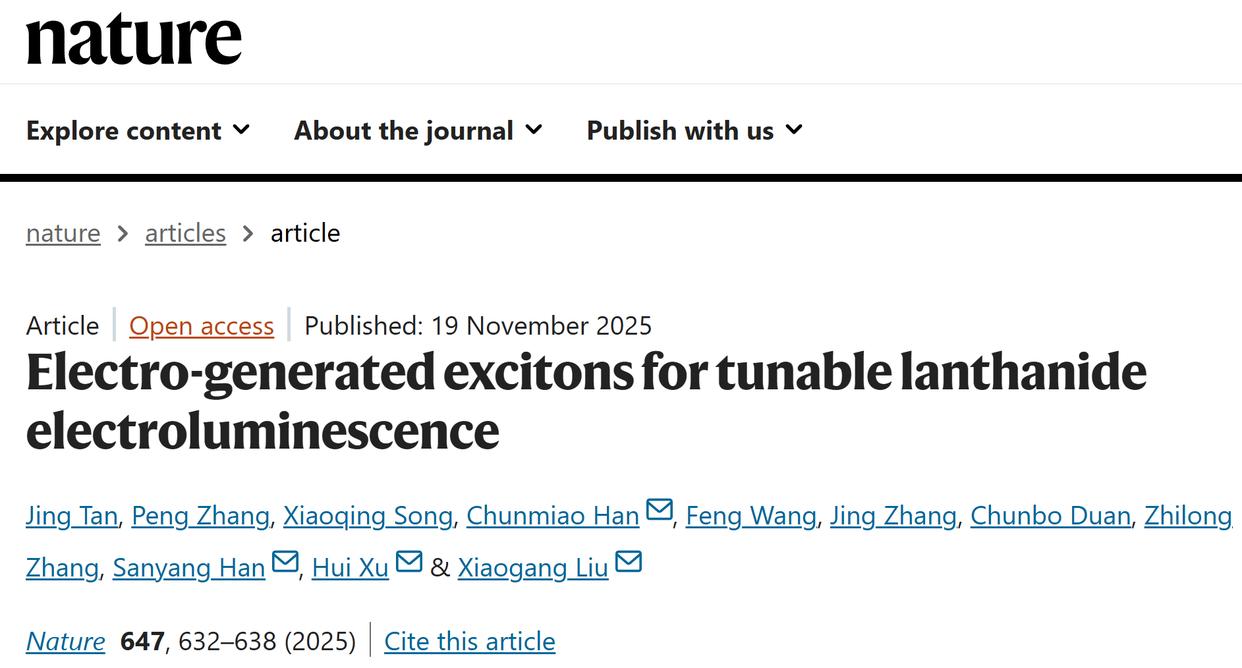
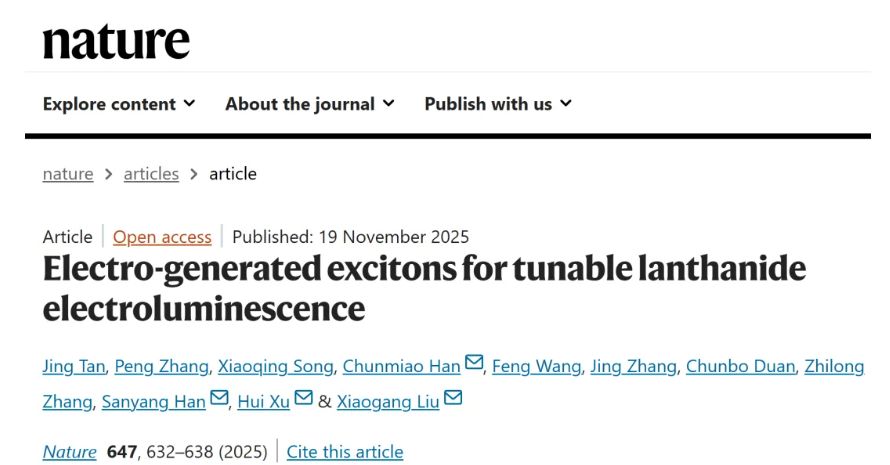
Core Insights - A groundbreaking research collaboration between Heilongjiang University, Tsinghua University, and the National University of Singapore has successfully addressed the challenge of efficient electroluminescence in insulating rare earth nanocrystals, as published in *Nature* [1][3][5] - This research supports China's strategic shift from "raw material export" to "high value-added technology output" in the rare earth sector [1][5] Industry Overview - Rare earth elements are considered irreplaceable strategic resources, often referred to as "industrial vitamins" [3] - China holds advantages in rare earth resource reserves and smelting but faces bottlenecks in high-end functional materials and devices [3] Technological Breakthrough - The research team introduced an organic semiconductor sensitization strategy, using functionalized organic ligands as a "photoelectric bridge" to efficiently transfer energy to insulating rare earth nanocrystals, enabling current-driven efficient light emission [3][5] - The new technology demonstrates significant application potential, with electroluminescent device efficiency improved by 76 times and the ability to achieve full-spectrum light emission through rare earth ion modulation in a single device [5] Implications for the Rare Earth Industry - This breakthrough paves the way for transforming the properties of rare earth materials into high-end device functionalities, contributing to the enhancement of China's independent innovation capabilities and the added value of end products in the rare earth industry [5]


稀土,大消息!
中国基金报· 2025-11-25 09:14
Core Insights - A groundbreaking research achievement by Heilongjiang University, Tsinghua University, and the National University of Singapore has successfully addressed the challenge of efficient electroluminescence in insulating rare earth nanocrystals, providing crucial technological support for China's strategic shift from "raw material export" to "high value-added technology output" [2][3]. Group 1: Research Significance - Rare earth elements are irreplaceable strategic resources, often referred to as "industrial vitamins" [3]. - China holds advantages in rare earth resource reserves and smelting but faces industrial bottlenecks in high-end functional materials and devices [3]. - The research team introduced an innovative organic semiconductor sensitization strategy, using functionalized organic ligands as a "photoelectric bridge" to efficiently transfer energy to insulating rare earth nanocrystals, enabling high-efficiency electroluminescence driven by electric current [3][4]. Group 2: Technological Breakthrough - The new technology demonstrates significant application potential, with electroluminescent device efficiency improved by 76 times, and the ability to achieve full-spectrum emission through rare earth ion modulation in a single device [4]. - This breakthrough marks a key advancement for China in the high-end optoelectronic application of rare earth materials, providing a new material system for the development of autonomous ultra-high-definition displays, near-infrared communication, and biomedical applications [4]. - The achievement successfully establishes a technical pathway for converting the properties of rare earth materials into high-end device functionalities, contributing substantively to enhancing China's independent innovation capabilities and the added value of end products in the rare earth industry [4].
重要成果!稀土,大消息!
证券时报· 2025-11-25 03:49
Core Viewpoint - A groundbreaking research achievement by Heilongjiang University, Tsinghua University, and the National University of Singapore has successfully addressed the challenge of efficient electroluminescence in insulating rare earth nanocrystals, providing key technological support for China's strategic shift from "raw material export" to "high value-added technology output" in rare earth resources [2][6]. Group 1: Research Significance - Rare earth elements are considered irreplaceable strategic resources, often referred to as "industrial vitamins" [5]. - China holds advantages in rare earth resource reserves and smelting but faces industrial bottlenecks in high-end functional materials and devices [5]. - The research team introduced an innovative organic semiconductor sensitization strategy, using functionalized organic ligands as "photoelectric bridges" to efficiently transfer energy to insulating rare earth nanocrystals, enabling high-efficiency electroluminescence driven by electric current [5][6]. Group 2: Technological Breakthrough - The new technology demonstrates significant application potential, with electroluminescent device efficiency improved by 76 times, and the ability to achieve full-spectrum emission through rare earth ion modulation within a single device [6]. - This breakthrough marks a critical advancement for China in the high-end optoelectronic application of rare earth materials, providing a new material system for the development of autonomous and controllable ultra-high-definition displays, near-infrared communication, and biomedical applications [6][9]. Group 3: Industry Impact - The breakthrough successfully establishes a technical pathway for converting the properties of rare earth materials into high-end device functionalities, contributing substantively to enhancing China's independent innovation capabilities and the added value of end products in the rare earth industry [9].
重要成果!稀土大消息!
Mei Ri Jing Ji Xin Wen· 2025-11-24 23:28
Group 1 - A groundbreaking research collaboration between Heilongjiang University, Tsinghua University, and the National University of Singapore has successfully addressed the challenge of efficient electroluminescence in insulating rare earth nanocrystals, as published in Nature [1][3] - The research provides critical technological support for China's strategic shift from "raw material export" to "high value-added technology output" in rare earth resources [1][3] - Rare earth elements are deemed irreplaceable strategic resources, often referred to as "industrial vitamins," with China holding advantages in resource reserves and smelting, but facing bottlenecks in high-end functional materials and devices [3][5] Group 2 - The research team introduced an organic semiconductor sensitization strategy, using functionalized organic ligands as a "photoelectric bridge" to efficiently transfer energy to insulating rare earth nanocrystals, enabling high-efficiency electroluminescence driven by electric current [3][5] - The new technology demonstrated a 76-fold increase in electroluminescent device efficiency and allows for full-spectrum light emission through rare earth ion modulation within a single device [5] - This breakthrough paves the way for advancements in autonomous and controllable ultra-high-definition displays, near-infrared communication, and biomedical applications, contributing significantly to enhancing China's rare earth industry chain's innovation capability and product value [5] Group 3 - Researchers discovered a significant accumulation of rare earth elements in a fern species called "Wumaozhe," observing a phenomenon of biogenic mineralization where these elements self-assemble into a mineral known as "lanthanite" within plant tissues [6] - This finding marks the first observation of biogenic mineralization of rare earth elements in natural plants, offering a new pathway for sustainable utilization of rare earth resources [6] - The study highlights the potential of "super-accumulating plants" like Wumaozhe, which can efficiently absorb and concentrate rare earth elements from the environment, presenting a cleaner and more sustainable method for rare earth extraction [6]
打破核心技术瓶颈 我国科研团队发布稀土材料最新成果
Yang Shi Xin Wen· 2025-11-23 15:06
Core Insights - A groundbreaking research collaboration between Heilongjiang University, Tsinghua University, and the National University of Singapore has successfully addressed the challenge of efficient electroluminescence in insulating rare earth nanocrystals, as published in *Nature* [1][4] - This research supports China's strategic shift from "raw material export" to "high value-added technology output" in the rare earth sector [1][4] Group 1: Research Significance - Rare earth elements are considered irreplaceable strategic resources, often referred to as "industrial vitamins" [4] - China holds advantages in rare earth resource reserves and smelting but faces industrial bottlenecks in high-end functional materials and devices [4] Group 2: Technical Breakthrough - The research team introduced an organic semiconductor sensitization strategy, using functionalized organic ligands as a "photoelectric bridge" to efficiently transfer energy to insulating rare earth nanocrystals, enabling current-driven efficient light emission [4][6] - The new technology demonstrates significant application potential, with electroluminescent device efficiency increased by 76 times and the ability to achieve full-spectrum light emission through rare earth ion modulation within a single device [6] Group 3: Industry Impact - This breakthrough establishes a technical pathway for converting the properties of rare earth materials into high-end device functionalities, contributing to the enhancement of China's rare earth industry chain's independent innovation capabilities and the added value of end products [7]