
稳定币风险防控

Search documents
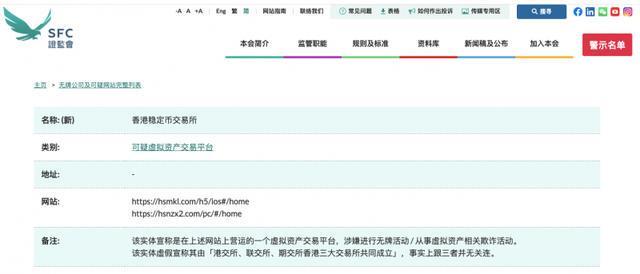
伪合规骗局曝光!稳定币风险暗涌,香港筑牢合规“防火墙”
Hua Xia Shi Bao· 2025-12-19 10:05
| | A A +A Eng 第 周 网站指南 联络我们 3 家见问题 主 资格 +2 如何作出按讲 (2) 传媒专用区 | | | Q 推荐 | 000000 | | --- | --- | --- | --- | --- | --- | | SFC 即監會 | 本食福介 髮则及标准 图料库 | 监管职能 | 新闻精及公布 | 加入本会 | 賢示名单 | | 主页 > 无棣公開及可显陪起完整引表 | | | | | | | 名称:(新) | 看港稳定币交易所 | | | | | | 炭射: | 可疑虚拟资产交易平台 | | | | | | 地址: | | | | | | | 网站: | https://hsmkl.com/h5/los#/home https://hsnzx2.com/pc/#/home | | | | | | 备注: | 该实体直称是在上述网站上营运的一个虚拟资产交易平台,涉嫌进行无牌活动/从事虚拟资产相关欺诈活动。 | | | | | | | 该实体虚假宣称其由「港交所、联交所、期交所香港三大交易所共同成立」,郡实上跟三者并无关注。 | | | | | 本报(chinatimes.net ...

13部门联手严打炒币 稳定币纳入虚拟币监管范畴
Di Yi Cai Jing· 2025-12-01 13:48
Core Viewpoint - The People's Bank of China has officially included stablecoins in the regulatory framework for virtual currencies, signaling a significant upgrade in the regulatory approach to combat illegal financial activities associated with virtual currencies [1][2]. Regulatory Developments - A meeting led by the People's Bank of China involved 13 national regulatory bodies, marking a comprehensive upgrade in the regulatory framework for virtual currencies, particularly focusing on stablecoins [1][2]. - The meeting emphasized the need for enhanced collaboration among regulatory units to improve monitoring capabilities and combat illegal activities related to stablecoins [2][3]. - The inclusion of stablecoins in the illegal financial activities framework indicates a more stringent regulatory environment aimed at curbing money laundering and other illicit activities [1][2]. Market Implications - The volatility in the cryptocurrency market, particularly the significant fluctuations in Bitcoin prices, has raised concerns about the stability and regulatory compliance of stablecoins [1][6]. - Rating agency S&P Global has downgraded Tether (USDT) from "4" (restricted) to "5" (vulnerable), reflecting growing concerns about the risks associated with stablecoins [1]. Legal Actions - There has been an increase in regulatory actions against cryptocurrency businesses, with many being prosecuted for illegal operations, money laundering, and other financial crimes [3][4]. - A notable case involved a group that facilitated illegal foreign exchange transactions using stablecoins, highlighting the risks of cross-border financial flows facilitated by these digital assets [3]. Global Context - The risks associated with stablecoins have become a focal point in global financial discussions, particularly at the recent IMF and World Bank meetings, where concerns about their compliance with anti-money laundering regulations were raised [5][6]. - The ongoing challenges in regulating stablecoins reflect broader issues in the global financial system, including vulnerabilities in financial sovereignty for developing economies [5]. Ongoing Monitoring - The regulatory landscape for virtual currencies, including stablecoins, is expected to remain stringent, with continuous efforts to monitor and evaluate developments in both domestic and international markets [7]. - The People's Bank of China plans to maintain its prohibitive stance on virtual currencies while closely tracking the evolution of stablecoins globally [7].
深度 | 稳定币纳入虚拟币监管范畴 涵盖三大核心考量
2 1 Shi Ji Jing Ji Bao Dao· 2025-12-01 10:23
Core Viewpoint - The People's Bank of China (PBOC) has reinforced its regulatory stance on stablecoins, categorizing them as a form of virtual currency and emphasizing their lack of legal status equivalent to fiat currency, thereby prohibiting their circulation and related activities in the market [1][5][9]. Regulatory History - The regulatory framework for virtual currencies in China has evolved since 2013, with multiple government bodies consistently asserting that virtual currencies do not hold the same legal status as fiat currencies and prohibiting their use in financial activities [2][4]. - Key regulatory milestones include the 2021 notice that intensified scrutiny on virtual currency activities, leading to the closure of domestic trading platforms [2][4]. Recent Developments - The emergence of new regulations, such as Hong Kong's Stablecoin Regulation, has prompted further scrutiny of stablecoins, especially in light of rising speculative activities and associated risks [3][4]. - The PBOC has highlighted the challenges posed by new technologies like blockchain, which have facilitated the growth of stablecoins while also complicating financial regulation [4][5]. Risk and Compliance Concerns - Stablecoins are viewed as high-risk due to their potential use in illegal activities such as money laundering and fraud, primarily because of their anonymous or semi-anonymous nature [8][12]. - The lack of effective customer identification and transaction traceability in stablecoin transactions raises significant compliance issues [8][12]. Regulatory Strategy - The PBOC's recent classification of stablecoins as virtual currencies aims to unify enforcement actions across various regulatory bodies, facilitating coordinated governance and legal clarity [9][10]. - Future regulatory measures are expected to focus on tightening compliance requirements for stablecoin-related activities, including issuance, trading, and payment processing [10][11]. Market Impact - The stringent regulatory environment is likely to restrict the operational space for stablecoins within China, pushing related activities towards offshore financial centers [10][11]. - The total market capitalization of stablecoins has reached approximately $300 billion, with USDT maintaining a market share of around 60%, indicating the significant scale of these assets despite regulatory challenges [11].